

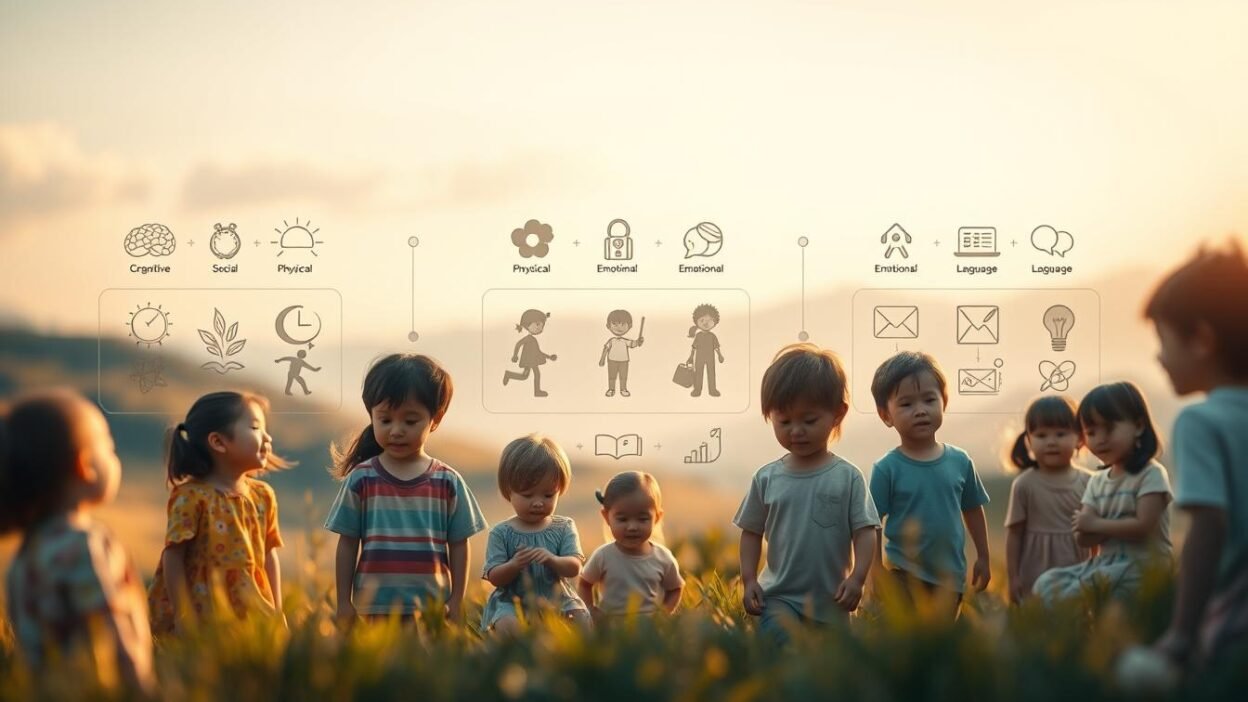
Some children excel at physical activities but struggle with social interactions. Others understand complex ideas yet find it hard to express them. Children grow across multiple interconnected areas rather than as a single process.
Child development unfolds through distinct yet interrelated developmental domains. These categories shape how youngsters learn, interact, and mature from infancy through early childhood. They help us understand the complex journey children navigate as they grow.
Researchers and educators organize this process into observable dimensions. These include physical, cognitive, emotional, social, and linguistic growth. Each area supports the others in remarkable ways.
A toddler who learns to walk reaches a physical milestone. This achievement opens new opportunities for exploration and social engagement.
Understanding these frameworks matters deeply for parents, teachers, and healthcare providers. Rather than viewing development as isolated skill acquisition, we recognize it as dynamic and integrated. Progress in one dimension influences all others simultaneously, supporting holistic child growth.
Tracking developmental milestones is essential for understanding a child’s growth, readiness, and support needs. The Developmental Milestones section provides structured age-wise charts and expert-backed guidance to help parents identify progress or delays with clarity. To complement this understanding, the Special Needs Awareness category offers detailed information on early signs of developmental challenges, helping families recognize when additional assessment may be necessary. When milestones impact learning or academic performance, readers can explore the Learning Disabilities section for targeted strategies and classroom support ideas. For emotional, cognitive, and behavioural insights related to child development, PsyForU.com offers evidence-based explanations. And for parents wanting to build healthier routines, reduce overwhelm, and develop intentional parenting practices, IntentMerchant.com provides powerful tools rooted in behavioural psychology. These interconnected resources support a holistic view of child development, enabling parents to track, understand, and nurture growth at every stage.
Key Takeaways
- Child development occurs across multiple interconnected domains rather than as a single linear process
- The primary developmental areas include physical, cognitive, emotional, social, and linguistic growth
- Progress in one domain directly influences and supports development in other areas
- Understanding these frameworks helps parents and educators provide targeted, effective support
- Children develop holistically, with biological, environmental, and social factors working together
- Viewing development through domain-specific lenses allows for better observation and assessment of children’s progress
Understanding the Concept of Child Development
The journey from helpless infant to capable young adult represents a remarkable transformation. This metamorphosis involves far more than simple physical growth. It encompasses intricate changes across multiple dimensions that unfold in predictable yet individually unique patterns.
Child development stands at the intersection of biology, psychology, sociology, and education. The field of developmental psychology has evolved significantly over recent decades. Groundbreaking advances in neuroscience and sophisticated research methodologies have driven this progress.
These scientific developments have revealed important findings about the brain. Neural connections establish themselves most rapidly during early childhood. This creates critical windows of opportunity for learning and growth.
Contemporary understanding recognizes that development emerges from a dynamic interplay between biological characteristics and environmental influences. Neither genetics nor experience alone determines outcomes. Instead, each shapes the other in continuous exchanges that create unique developmental pathways.
Defining the Developmental Process
Child development refers to the systematic, predictable sequence of changes in children. This comprehensive process begins at birth and continues through early adulthood. It encompasses transformations across physical, cognitive, emotional, social, and linguistic dimensions.
The concept extends beyond mere physical maturation. Child growth principles distinguish between two fundamental mechanisms that drive developmental change. Maturation involves biologically determined changes that unfold according to genetic programming.
Learning encompasses experience-based changes that result from interaction with the environment. Children acquire language, develop problem-solving abilities, and form social bonds through active engagement. These learning processes build upon maturational foundations while simultaneously shaping how biological potentials express themselves.
Modern Child Development Theories emphasize the epigenetic nature of development. This perspective recognizes that genetic predispositions interact continuously with environmental contexts. The same genetic potential may manifest differently depending on nutritional status and caregiver responsiveness.
The NAEYC framework articulates this complexity by identifying development as a dynamic process. It reflects the intricate dance between biological characteristics and environmental influences. Each element shapes the other while simultaneously determining future patterns of growth.
Several core principles undergird our understanding of developmental processes:
- Sequential progression: Development follows orderly, predictable sequences, though individual timing varies considerably
- Cumulative building: Earlier developments create foundations for later acquisitions, with each stage building upon previous accomplishments
- Individual variation: While general patterns hold across children, each child follows a unique developmental timeline
- Domain interaction: Progress in one area influences and is influenced by developments in other domains
- Critical periods: Certain developmental windows present optimal opportunities for specific types of learning and growth
The nature versus nurture debate has evolved into a more nuanced understanding. Contemporary developmental psychology recognizes that genes and environment engage in constant dialogue. Genetic instructions require environmental inputs to activate.
This epigenetic perspective has profound implications. It suggests that early experiences literally shape brain architecture. The quality of early relationships and exposure to language influence which neural pathways strengthen.
The Significance of Developmental Knowledge
Understanding Psychological Development Stages and developmental processes carries profound significance. This knowledge transforms how we approach childrearing, education, healthcare, and social policy. The practical applications extend across professional disciplines and into everyday parenting practices.
For parents and caregivers, familiarity with typical developmental patterns enables appropriate expectations. Recognizing that two-year-olds lack impulse control helps adults respond with patience. Understanding language acquisition timelines allows parents to provide rich verbal environments during critical periods.
Responsive caregiving depends fundamentally on developmental awareness. Adults who grasp what children can do at different ages provide appropriate supports. This zone of proximal development represents the sweet spot where learning flourishes.
Educational professionals rely heavily on child growth principles to design developmentally appropriate curricula. Teachers who understand cognitive development create learning experiences that align with children’s thinking abilities. They introduce concrete materials before abstract concepts.
Classroom management strategies similarly benefit from developmental knowledge. Understanding social development helps educators facilitate peer interactions and resolve conflicts appropriately. Age-appropriate expectations reduce frustration for both teachers and students.
Healthcare providers use developmental milestones as diagnostic tools. Pediatricians screen for delays by comparing individual progress against established norms. Early identification of developmental concerns enables timely interventions that can dramatically improve outcomes.
The medical community has increasingly recognized that physical health and developmental progress intertwine. Nutritional deficiencies, chronic illnesses, and environmental toxins all affect developmental trajectories. Comprehensive pediatric care therefore addresses developmental dimensions alongside physical health concerns.
Policymakers increasingly ground early childhood investments in developmental science. Research demonstrating the long-term returns on early interventions has shaped public policy decisions. Understanding sensitive periods for brain development has catalyzed funding for preschool programs.
Evidence-based policy recognizes that supporting healthy development yields societal benefits. Children who receive responsive care and adequate nutrition are more likely to succeed academically. They also maintain physical health and contribute productively to their communities.
Developmental knowledge also serves equity and social justice goals. Understanding how adverse experiences affect development illuminates the mechanisms through which disadvantage perpetuates. This awareness motivates targeted interventions to break cycles of poverty and marginalization.
Child Development Theories provide frameworks for understanding how systematic barriers impede development for some children. This understanding can motivate efforts to level playing fields. It helps maximize potential across diverse circumstances.
The study of developmental psychology ultimately reveals universal human capacities alongside individual differences. Every child follows broadly similar developmental pathways. Yet each journey unfolds uniquely, shaped by genetic endowments, family relationships, and cultural contexts.
The Physical Domain of Child Development
From birth, children follow a predictable yet unique path of physical transformation. This shapes their ability to explore, interact with, and master their environment. The physical domain covers all aspects of bodily growth and motor development.
This domain represents one of the most visible and measurable dimensions of childhood development. It includes changes in body size and proportions. It also involves strengthening of muscles and bones, refinement of sensory systems, and progressive mastery of movements.
Physical development follows organized patterns that reflect nervous system maturation and musculoskeletal structure growth. These changes enable children to gain increasing independence in daily activities. They progress from feeding themselves to exploring their surroundings with confidence.
Understanding Physical Development Milestones provides parents, educators, and healthcare professionals with essential benchmarks. These benchmarks help monitor healthy growth. They also help identify potential concerns that may require intervention.
The physical domain interconnects deeply with other developmental areas. Motor capabilities open new opportunities for cognitive exploration, social interaction, and emotional expression. A child who learns to walk gains not only a new mode of transportation.
They also gain expanded possibilities for discovery, play, and relationship-building with peers and caregivers.
Tracking Physical Growth Patterns
Physical growth during early childhood follows remarkably consistent patterns. Scientists have documented these patterns across diverse populations and cultures. Children grow in two primary directional sequences.
Cephalocaudal development proceeds from head to toe. Proximodistal development moves from the center of the body outward to the extremities. These principles explain why infants develop head control before they can sit independently.
They also explain why infants master arm movements well before achieving precise finger manipulations.
During the first year of life, physical growth occurs at an astonishing rate. Infants typically triple their birth weight by their first birthday. They increase their length by approximately 50 percent.
After this initial period of rapid expansion, physical growth patterns gradually decelerate. This slower growth continues throughout early and middle childhood. Another acceleration occurs during adolescence.
Healthcare professionals use standardized growth charts to track children’s progress. These charts monitor height, weight, and head circumference. They represent statistical distributions based on large population samples.
The charts help identify children whose growth deviates significantly from expected ranges. However, growth charts serve as screening tools rather than diagnostic instruments. Substantial individual variability exists within the normal range.
Growth is not merely a matter of getting bigger; it involves complex changes in body proportions, tissue composition, and skeletal maturation that unfold according to genetic programming while remaining responsive to environmental influences.
Several factors influence individual growth trajectories. These include genetic inheritance, nutritional status, overall health, and environmental conditions. Children inherit growth potential from their parents.
However, environmental factors determine whether they achieve that potential. Chronic stress, inadequate nutrition, or recurrent illness can suppress growth. Optimal conditions support full expression of genetic programming.
Body proportions change dramatically during childhood as different body parts grow at different rates. Newborns have relatively large heads that comprise about one-quarter of their total body length. Adults’ heads represent only about one-eighth of their height.
Similarly, the center of the body shifts from near the umbilicus in infancy. It moves to the pubic symphysis in adulthood. This reflects differential growth rates of the trunk and legs.
Progressive Motor Coordination
Motor Skills Development encompasses the acquisition of both gross motor skills and fine motor skills. Together, these enable children to navigate and manipulate their physical environment with increasing competence. This developmental process reflects not merely physical maturation.
It also reflects the effects of practice, environmental affordances, and motivational factors. These factors encourage children to attempt new movements.
Gross motor skills involve the large muscles of the arms, legs, back, and stomach. They enable fundamental movements such as sitting, standing, walking, running, jumping, throwing, and climbing. These capabilities develop in a generally predictable sequence.
This sequence reflects the maturation of the central nervous system and the strengthening of supporting musculature. At six months, most infants can lean on their hands to support themselves when sitting. By nine months, they typically achieve independent sitting by getting into position themselves.
The milestone of independent walking typically emerges around 12 months. At this age, most children can pull up to stand and may take their first unsupported steps. By 18 months, children usually walk confidently without holding on.
They begin attempting to use implements like spoons during mealtimes. At two years, running becomes possible as balance and coordination improve. Children eat more successfully with utensils.
Fine motor skills involve the small muscles of the hands and fingers working in coordination with the eyes. They enable precise manipulations essential for daily living. These skills include grasping, releasing, reaching, pinching, and turning the wrists.
These movements allow children to perform increasingly complex tasks. The development of fine motor skills follows the proximodistal principle. Shoulder and elbow control precedes wrist and finger dexterity.
Young children gradually refine their grasp patterns. They progress from the palmer grasp that uses the entire hand. They develop the more sophisticated pincer grasp that employs just the thumb and forefinger.
This refinement enables activities such as buttoning buttons and picking up small finger foods. It allows using utensils effectively and washing hands independently. By age three, most children can put on some clothing items by themselves.
This demonstrates the integration of fine motor skills with cognitive understanding and problem-solving.
Contemporary research emphasizes that motor development results from the dynamic interaction of multiple factors. It is not simply biological maturation. The “dynamic systems” perspective recognizes that new motor abilities emerge under specific conditions.
These conditions occur when children’s motivation, physical capabilities, environmental support, and task demands align favorably. This understanding explains why children in environments that encourage movement and exploration often achieve motor milestones earlier. Those with limited opportunities for physical activity may develop more slowly.
| Age | Gross Motor Milestones | Fine Motor Milestones |
|---|---|---|
| 6 Months | Leans on hands for support when sitting; rolls from back to stomach | Reaches for objects; transfers items between hands |
| 12 Months | Pulls up to stand; may take first independent steps | Uses pincer grasp; places objects into containers |
| 18 Months | Walks independently without support; begins climbing stairs | Attempts to use spoon; scribbles with crayons |
| 2 Years | Runs with coordination; kicks ball forward | Eats with spoon successfully; turns pages in books |
| 3 Years | Pedals tricycle; jumps with both feet | Puts on some clothing independently; copies simple shapes |
Foundations of Healthy Physical Growth
Adequate nutrition, sufficient sleep, regular healthcare, and opportunities for physical activity form the essential foundations. These support optimal physical development. These environmental factors interact with genetic programming.
They determine whether children achieve their full growth potential and develop motor competencies on expected timelines. The quality of these foundational elements during early childhood creates lasting effects. These effects extend throughout the lifespan.
Nutritional requirements during childhood are substantial relative to body size. Growing bodies need adequate calories, proteins, vitamins, and minerals to support tissue building and energy expenditure. Malnutrition during critical growth periods can result in stunted growth.
It can also cause delayed motor development and increased susceptibility to illness. Conversely, excessive caloric intake without adequate physical activity contributes to childhood obesity. This can impair motor skill development and establish unhealthy patterns.
Sleep plays a crucial but often underappreciated role in supporting physical development. During deep sleep, the body releases growth hormone. This hormone stimulates tissue growth and muscle development.
Children who consistently receive insufficient sleep may experience compromised growth and decreased motor performance. Sleep requirements vary by age. Infants need 14-17 hours daily, toddlers require 11-14 hours, and preschoolers need 10-13 hours.
Regular healthcare, including well-child visits, immunizations, and prompt treatment of illnesses, protects physical development. It prevents or minimizes the growth-suppressing effects of disease. Chronic health conditions, when poorly managed, can significantly compromise both growth and motor development.
Healthcare providers monitor Physical Development Milestones during routine visits. They offer early identification of potential concerns and guidance to support healthy development.
Physical activity itself serves as both an outcome and a driver of motor development. Children develop motor skills through active practice and exploration. This makes opportunities for safe, varied physical activity essential for typical development.
Sedentary lifestyles limit the practice opportunities children need to refine their gross motor skills and coordination. Establishing habits of regular physical activity during early childhood creates patterns. These patterns support lifelong health and wellness.
Environmental safety considerations balance the need for exploration with protection from serious injury. Child-proofed environments that allow supervised exploration enable children to practice emerging motor skills while minimizing risks. Overly restrictive environments may protect children from minor bumps and falls.
However, they limit the practice opportunities essential for developing balance, coordination, and risk assessment capabilities.
The Cognitive Domain of Child Development
Intellectual development in children is one of the most fascinating aspects of human growth. It involves complex mental processes that change dramatically from birth through adolescence. The cognitive domain includes all mental activities through which children gain and use knowledge.
This includes attention, memory, reasoning, and understanding relationships between objects, events, and ideas.
Cognitive development involves more than simply accumulating facts or information. It fundamentally changes how young minds perceive reality and solve problems. The intellectual development journey shapes every aspect of learning.
This ranges from recognizing patterns in infancy to engaging in abstract reasoning during later childhood.
Stages of Cognitive Growth
Jean Piaget revolutionized our understanding of how children think through his comprehensive stage theory. Piaget’s stages describe qualitatively distinct periods in which children’s thinking differs fundamentally. These stages provide a framework for understanding the progressive sophistication of mental capabilities.
The sensorimotor stage, spanning from birth to approximately two years, represents the foundation of cognitive development. During this period, infants construct understanding primarily through physical interactions with their environment. They learn by touching, grasping, shaking, and manipulating objects around them.
A crucial achievement of this stage involves developing object permanence. This means understanding that objects continue to exist even when they disappear from view. Early in this stage, an infant believes that a toy hidden under a blanket has ceased to exist.
By the end of the sensorimotor period, children actively search for hidden objects. This demonstrates their grasp of this fundamental concept.
The preoperational stage, extending from approximately two to seven years, introduces symbolic thinking as a defining characteristic. Children begin using words, images, and symbols to represent objects and experiences. Pretend play flourishes during this period.
Children transform sticks into magic wands or cardboard boxes into castles.
However, Piaget’s stages also identify limitations in preoperational thinking. Children at this stage typically exhibit egocentrism, struggling to understand that others perceive the world differently. They also lack conservation concepts.
They believe that the amount of liquid changes when poured from a short, wide glass into a tall, narrow one.
The concrete operational stage, from approximately seven to eleven years, marks the emergence of logical thinking about tangible situations. Children develop the ability to perform mental operations on concrete objects and events. They master conservation, understanding that quantity remains constant despite changes in appearance.
During this stage, children acquire classification skills, organizing objects into hierarchical categories. They understand that a dog is simultaneously an animal, a mammal, and a specific breed. Reversibility also emerges—the recognition that actions can be mentally undone.
“The principle goal of education in the schools should be creating men and women who are capable of doing new things, not simply repeating what other generations have done.”
The formal operational stage, beginning around age eleven and continuing into adulthood, introduces abstract reasoning and hypothetical thinking. While this stage extends beyond early childhood, it completes the theoretical framework. Adolescents develop the capacity to think about possibilities and consider hypothetical situations.
They also engage in systematic problem-solving.
Contemporary research has refined our understanding of Piaget’s stages. Cognitive development may be more gradual and context-dependent than originally proposed. Children sometimes demonstrate capabilities earlier than Piaget suggested when tasks are presented in familiar contexts.
Additionally, cognitive growth appears more domain-specific. Children show advanced reasoning in some areas while remaining at earlier stages in others.
Cognitive milestones provide concrete markers of intellectual development throughout these stages. Infants demonstrate early problem-solving skills by reaching to grab desired toys. They also bang two objects together to produce sounds.
Toddlers exhibit growing cognitive sophistication by stacking at least two small objects or completing simple shape-sorting puzzles.
The Role of Play in Learning
Play serves as the primary mechanism through which young children develop essential cognitive competencies. Far from being mere entertainment, play provides rich contexts for exploration and experimentation. Children naturally engage in playful learning that builds foundational thinking skills.
Research demonstrates clear connections between play experiences and cognitive capabilities. Studies reveal that self-directed and guided play strengthen executive functions. These are a set of mental processes essential for learning and development.
These executive functions include working memory, which allows children to hold and manipulate information mentally.
Cognitive flexibility, another executive function developed through play, enables children to shift attention between different tasks. It also helps them adjust to changing rules or expectations. Inhibitory control, the third major executive function, helps children resist impulses and maintain focus on goals.
Together, these capabilities predict academic success more reliably than intelligence tests alone.
Play also develops problem-solving skills through natural experimentation. Building with blocks helps children test hypotheses about balance, weight, and structural stability. Pretend play allows them to navigate complex social scenarios that require planning, negotiation, and creative thinking.
Different types of play contribute uniquely to cognitive growth:
- Constructive play with blocks, puzzles, or art materials develops spatial reasoning and planning skills
- Symbolic play strengthens the ability to use one object to represent another, laying groundwork for reading and mathematics
- Games with rules build logical thinking and the capacity to follow complex instructions
- Exploratory play fosters curiosity, observation skills, and scientific thinking
The joyful nature of play creates optimal conditions for learning. Children feel relaxed and engaged, so their brains form stronger neural connections. Play-based learning reduces stress while increasing motivation, attention, and information retention.
These benefits extend across all academic disciplines.
Social play specifically enhances cognitive development by requiring children to coordinate actions with peers. They must communicate intentions and understand different perspectives. Collaborative play scenarios demand that children hold multiple viewpoints in mind simultaneously.
This is a sophisticated cognitive achievement that supports later academic and social success.
Language Acquisition
Language development represents both a remarkable cognitive achievement and a transformative tool that fundamentally alters thinking capabilities. The acquisition of language enables increasingly complex thought processes and sophisticated memory organization. Language serves as the primary medium through which cultural knowledge passes from one generation to the next.
Children progress through predictable stages of language acquisition, beginning with cooing and babbling in infancy. By their first birthday, most children produce their first recognizable words. Vocabulary expands rapidly during the second year.
Children often learn several new words daily during vocabulary spurts.
The relationship between language and cognitive development flows in both directions. Cognitive advances enable more sophisticated language use, while language acquisition transforms cognitive capabilities. Once children acquire words for concepts, they can think about those concepts more efficiently.
They can also communicate ideas to others.
Language provides tools for categorization and memory. Children learn that multiple four-legged animals share the label “dog,” forming conceptual categories that organize experience. These linguistic categories help children notice similarities, make predictions, and retrieve relevant information from memory.
The development of inner speech—the internal dialogue children conduct with themselves—represents a particularly important cognitive advancement. Around age three, children begin using language to guide their own behavior. They talk themselves through challenging tasks.
This self-directed speech eventually becomes internalized as silent thought.
Language also enables children to transcend immediate experience. Through words, children can think about past events, plan future actions, and consider hypothetical situations. This temporal flexibility dramatically expands the scope of thinking beyond the here-and-now constraints of infant cognition.
Research reveals that language exposure quality matters tremendously for cognitive development. Children who experience rich conversational interactions develop stronger language skills. Adults responding to their communications, expanding on their utterances, and introducing new vocabulary in context help tremendously.
These children develop broader cognitive capabilities than children with limited linguistic input.
Bilingual development offers unique cognitive advantages. Children acquiring multiple languages simultaneously demonstrate enhanced executive functions. This is particularly true in areas requiring cognitive flexibility and selective attention.
The mental exercise of managing two language systems strengthens broader thinking skills that extend beyond language itself.
The profound connection between language and thought continues throughout childhood and beyond. As children’s language becomes more complex, their capacity for sophisticated reasoning expands correspondingly. Language ultimately transforms human cognition.
It enables the complex problem-solving skills and abstract thinking that distinguish human intellectual development.
The Emotional Domain of Child Development
Social-Emotional Child Development covers how children learn to handle their feelings and connect with others. This area is a key part of human growth. It affects how children build relationships, face challenges, and form their identity.
Children’s emotional skills grow quickly from infancy through early childhood. They move from basic emotional expressions to understanding complex feelings. Research shows that emotional competence in childhood predicts academic success, relationship quality, and psychological wellbeing throughout life.
Understanding this area means looking at how children develop emotional intelligence and learn to manage feelings. Each part builds on the others. Together, they create a system that shapes personality and how we connect with people.
Recognizing and Interpreting Feelings
Emotional development starts with basic emotions that appear during infancy: joy, anger, sadness, and fear. These fundamental feelings show up early in life. A six-month-old baby recognizes familiar people and responds with laughter.
As thinking skills grow, children develop self-conscious emotions that require self-awareness and social understanding. Embarrassment, pride, shame, and guilt typically emerge between 18 months and three years. These complex emotions depend on children’s ability to judge themselves against expectations and social rules.
Children’s emotional understanding progresses through predictable stages. At first, they recognize basic emotions in faces and voices. By nine months, infants show wariness around strangers.
Around 18 months, toddlers explore their environment while checking back with caregivers for reassurance. This behavior shows developing emotional security and the formation of attachment bonds. At two years, children look to parents’ faces in new situations to gauge appropriate reactions.
Attachment theory provides key insights into emotional development. Early caregiver-infant relationships create internal working models—mental pictures of self, others, and relationships. These models shape emotional expectations throughout development.
Secure attachments build emotional intelligence by providing consistent, responsive care that helps children understand their feelings. When caregivers acknowledge and validate emotions, children learn to recognize and express their experiences. Inconsistent or dismissive responses can harm emotional understanding and expression.
Cultural contexts deeply influence emotional development. Different cultures emphasize varying emotions and encourage distinct expression styles. Some cultures value emotional restraint while others encourage open expression.
| Age | Emotional Milestone | Developmental Significance |
|---|---|---|
| 6 months | Knows familiar people, laughs | Basic social recognition and joy expression |
| 9 months | Shows shyness or fear around strangers | Discrimination between familiar and unfamiliar |
| 12 months | Plays interactive games like pat-a-cake | Social engagement and turn-taking |
| 18 months | Explores but checks for caregiver presence | Secure base for exploration |
| 2 years | Uses social referencing in new situations | Emotional learning through observation |
| 3 years | Notices peers and joins cooperative play | Social awareness and group participation |
Managing Emotional Responses
Emotional regulation represents one of the most critical achievements in early childhood development. This ability lets children control their emotional experiences and expressions in appropriate ways. Children transform from depending completely on caregivers for soothing to gaining independent control over their emotional states.
Early regulation depends entirely on co-regulation—the process where caregivers help infants manage distress. When a baby cries and a parent responds with soothing, the infant gradually learns these calming strategies. This external support creates the foundation for later self-regulation abilities.
Brain development plays a central role in regulatory growth. The prefrontal cortex governs executive functions including impulse control and planning. This brain region enables increasingly sophisticated emotional regulation as children mature.
Specific regulatory strategies emerge in predictable sequences:
- Attentional deployment: Directing attention away from distressing stimuli or toward comforting elements
- Cognitive reappraisal: Reinterpreting situations to change emotional responses
- Behavioral regulation: Using actions like deep breathing or seeking support to manage feelings
- Response modulation: Adjusting emotional expressions to match social expectations
Caregiving practices significantly influence regulatory development. Parents who acknowledge children’s emotions while teaching appropriate expression strategies foster healthy emotional regulation. Providing language for feelings helps children understand and communicate their emotional states more effectively.
Dismissive or punitive responses to emotional expressions can undermine regulatory development. Children who face harsh reactions to negative emotions may suppress feelings rather than learning to manage them. This suppression can lead to difficulties extending into adolescence and adulthood.
Environmental factors also affect regulatory capacities. Chronic stress, inconsistent caregiving, or exposure to trauma can impair developing regulatory systems. Children experiencing adversity often struggle with emotional control because their nervous systems remain in heightened states.
The ability to regulate emotions is not about suppressing feelings but about experiencing them fully while managing their expression appropriately.
Developing Positive Self-Perception
Building self-esteem involves constructing a positive self-concept through social interactions and feedback from important people. This process begins in toddlerhood as children develop self-awareness. Healthy self-esteem provides a foundation for resilience, motivation, and psychological wellbeing.
Children develop self-concepts by observing how others respond to them. When caregivers and teachers provide consistent positive regard and constructive feedback, children internalize these messages. They begin to see themselves as capable, valued, and competent individuals.
Self-esteem has multiple dimensions including academic competence, social acceptance, physical appearance, and behavioral conduct. Children evaluate themselves differently across these areas. A child might feel confident academically while struggling with social self-esteem.
Mastery experiences play a crucial role in building self-esteem. When children successfully accomplish tasks through effort and persistence, they develop belief in their abilities. This sense of capability motivates continued engagement with challenges.
Authentic praise that focuses on effort and strategies rather than innate abilities promotes healthier self-esteem. When adults acknowledge the process of learning rather than simply praising outcomes, children develop more resilient self-concepts. They learn that abilities can be developed through dedication.
Social comparisons become increasingly important as children enter school environments. Observing peers provides information about relative abilities and social standing. Excessive focus on outperforming others can undermine intrinsic motivation and self-worth.
Cultural values influence how self-esteem develops and shows up. Individualistic cultures often emphasize personal achievement and standing out from the group. Collectivistic cultures may prioritize group harmony and fitting in.
The relationship between self-esteem and emotional regulation works both ways. Children with positive self-concepts typically demonstrate better emotional control because they trust their ability to handle challenges. Effective emotional regulation contributes to self-esteem by enabling successful navigation of social situations.
Supporting healthy self-esteem development requires balancing unconditional acceptance with appropriate expectations. Children need to feel valued for who they are while also receiving guidance toward growth. This balance helps them develop both self-acceptance and motivation for improvement.
The Social Domain of Child Development
Social development unfolds as children learn skills to participate in relationships and social structures. This domain includes how children form attachments, interpret social cues, and establish meaningful connections. Unlike physical or cognitive growth, social competence emerges through active participation in diverse relationship contexts.
The social domain represents a critical foundation for overall well-being and success. Children who develop strong interpersonal skills demonstrate better academic performance and mental health outcomes. These capabilities enable young people to share resources, accept differences, and build relationships.
Understanding how children acquire social knowledge requires examining multiple interconnected contexts. Each setting provides unique opportunities for learning and practicing social behaviors. These experiences contribute to developing social identities and cultural membership.
How Children Learn Social Norms and Behaviors
Socialization represents the process through which children become members of their cultural communities. This process involves far more than passive absorption of rules and expectations. Children actively interpret, negotiate, and selectively internalize the social norms they encounter.
Several key mechanisms facilitate socialization throughout childhood. Modeling allows children to observe and imitate behaviors demonstrated by parents, siblings, and peers. Reinforcement shapes behavior through positive responses to appropriate actions and negative consequences for unacceptable conduct.
Direct instruction provides explicit teaching about social rules. Participation in joint activities offers experiential learning opportunities. These mechanisms work together to help children understand their social world.
Cultural contexts significantly shape socialization goals and practices. Some cultures emphasize individual autonomy, self-expression, and personal achievement as primary outcomes. Others prioritize interdependence, group harmony, and collective responsibility.
Children learn social roles through exposure to gender expectations and family responsibilities. They develop understanding of appropriate behaviors for different settings. This contextual awareness reflects sophisticated social development that emerges gradually through repeated experiences.
Building Connections with Age-Mates
Peer relationships provide unique developmental opportunities distinct from interactions with adults. Unlike adult-child relationships characterized by power differences, peer interactions occur between relative equals. Children must negotiate, compromise, and coordinate their activities through mutual agreement.
The developmental trajectory of peer interaction follows predictable patterns. Toddlers engage primarily in parallel play, occupying the same space while pursuing independent activities. Preschoolers progress to associative play, sharing materials and conversing while maintaining separate play goals.
By early elementary years, children demonstrate cooperative play involving shared objectives. They develop coordinated roles and sustained collaborative efforts. These advances reflect growing social competence in peer contexts.
Through peer interactions, children develop essential capabilities including perspective-taking and conflict resolution. They learn to read social cues, interpret intentions, and adjust their behavior. These experiences build social competence that extends beyond immediate relationships.
| Age Period | Peer Interaction Characteristics | Key Social Skills Developing | Common Challenges |
|---|---|---|---|
| Toddlerhood (1-3 years) | Parallel play, brief exchanges, limited cooperation | Basic turn-taking, sharing awareness, proximity tolerance | Resource conflicts, limited communication ability, egocentrism |
| Preschool (3-5 years) | Associative play, increased interaction, emerging friendships | Sharing, simple cooperation, emotion recognition, verbal negotiation | Exclusion behaviors, difficulty with perspective-taking, aggression |
| Early Elementary (6-8 years) | Cooperative play, rule-based games, stable friendships | Complex coordination, fairness concepts, loyalty, conflict resolution | Peer rejection, social comparison, conformity pressure |
| Middle Childhood (9-12 years) | Peer groups, social hierarchies, gender-segregated activities | Group membership navigation, reputation management, advanced empathy | Peer pressure, bullying, social anxiety, exclusion sensitivity |
Peer acceptance and rejection significantly influence children’s self-concepts and adjustment. Children who experience consistent peer rejection may develop negative self-perceptions. Conversely, peer acceptance reinforces positive social behaviors and supports healthy identity development.
Social reputations established within peer groups often become self-perpetuating. Children treated as aggressive or withdrawn may internalize these identities. They may behave in ways that confirm peers’ expectations, creating cycles difficult to interrupt.
The Foundation of Family Connections
Family relationships provide the first and most enduring context for social development. The quality of early attachment relationships creates internal working models. Securely attached children develop confidence in others’ availability, facilitating exploration and relationship formation.
Family influence extends beyond attachment to encompass parenting styles that impact social competence. Authoritative parenting, characterized by warmth combined with appropriate expectations, consistently correlates with positive outcomes. Children raised with this approach demonstrate better self-regulation and interpersonal skills.
Sibling relationships offer unique opportunities for developing social capabilities. Within sibling interactions, children practice negotiation, conflict resolution, and cooperation. Older siblings often serve as models and teachers.
Family structures and dynamics shape social learning in multiple ways. Single-parent families, blended families, and extended family households each present distinct relationship patterns. Family transitions such as divorce or relocation introduce challenges requiring adaptation.
Early childhood educators recognize the importance of creating inclusive learning environments. This requires intentional attention to diversity, inclusion, and equity in classroom practices. These environments provide optimal support for developing the social competence essential for success.
The Creative Domain of Child Development
Creativity in childhood extends beyond simple artistic pursuits. It functions as a fundamental cognitive capacity shaping problem-solving approaches. Creative development helps children express emotions and construct understanding.
The creative domain encompasses children’s developing abilities for imagination and innovation. Researchers recognize these capacities as essential for navigating modern life. Through creative development, children generate novel solutions and engage meaningfully with the world.
This domain intersects with all other areas of growth. It provides children with tools for flexible thinking. Creative capacities emerge naturally during early childhood but require nurturing environments.
Early experiences significantly influence whether creative potential expands or diminishes over time.
Nurturing Creative Capacities
Understanding creativity requires distinguishing between exceptional and everyday creativity. Researchers call these “Big-C” creativity and “little-c” creativity. Big-C creativity produces groundbreaking innovations that transform entire fields.
Little-c creativity manifests in daily problem-solving and unconventional material uses. It appears in original artistic expressions characterizing healthy childhood development.
Creative thinking in young children appears spontaneous and unconstrained. Toddlers and preschoolers naturally engage in imaginative play. They transform ordinary objects into fantastical props without concern for realistic conventions.
This uninhibited creativity represents a developmental strength adults often wish to reclaim.
Creative expression often becomes more conventional as children mature. School-age children increasingly compare their work to peers and adult standards. They may become self-critical and reluctant to share creative efforts.
Environmental factors play a crucial role in supporting or constraining creative development. Research identifies several key conditions that foster creativity:
- Open-ended materials that allow multiple uses and interpretations rather than single-purpose toys with predetermined functions
- Unstructured time for exploration without predetermined outcomes or adult-directed goals
- Encouragement of risk-taking and tolerance for ambiguity, uncertainty, and unconventional approaches
- Responsive feedback that focuses on process, effort, and exploration rather than evaluation of final products
- Modeling creative approaches by adults who demonstrate curiosity, experimentation, and comfort with mistakes
Excessive structure in children’s lives can inadvertently suppress creative impulses. Rigid curricula that emphasize rote memorization prioritize compliance over exploration. Premature emphasis on “correct” answers may communicate that innovation carries less value.
These messages can diminish children’s confidence in their creative thinking. They reduce willingness to propose original ideas.
Play develops young children’s symbolic and imaginative thinking. It also builds peer relationships, language abilities, and problem-solving capacities. Researchers have identified three key components of play pedagogy.
Choice means children decide whether to engage and determine play direction. Wonder appears as children explore and test hypotheses. Delight brings joy and laughter associated with discovery and achievement.
Multiple Modalities for Creative Expression
Children express creativity through diverse channels offering unique developmental benefits. Artistic expression encompasses visual arts, music, movement, and dramatic play. These modalities serve distinct yet overlapping functions supporting overall development.
Visual arts develop fine motor coordination, spatial reasoning, and symbolic representation. Children translate internal concepts into external forms through drawing, painting, and sculpting. This process strengthens symbolic thinking and abstract representation abilities.
Music engages auditory discrimination, pattern recognition, and emotional expression. Children who participate in musical activities develop sensitivity to temporal sequences. These musical experiences enhance cognitive flexibility and mathematical reasoning.
Movement and dance build body awareness and spatial concepts. Through creative movement, children explore how bodies can express feelings. This kinesthetic intelligence complements verbal and logical thinking modes.
Imaginative play represents the most comprehensive form of creative expression. Children adopt roles, create scenarios, and negotiate shared narratives with peers. This activity develops symbolic thinking, perspective-taking abilities, and social negotiation skills.
Play embodies the characteristics of effective development and learning including active, meaningful engagement driven by children’s choices.
The value of creative expression lies in the processes it activates. Adults who focus excessively on product quality may shift emphasis away from exploration. This shift can undermine intrinsic motivation driving sustained creative engagement.
Cross-curricular approaches integrate creative thinking with academic content. Project-based learning, inquiry learning, and maker education share characteristics of playful learning. These frameworks demonstrate that creativity and rigorous learning complement each other.
Wide-Ranging Benefits of Creative Engagement
Research shows participation in creative activities supports development across all domains. Creative development enhances multiple dimensions of children’s growth. Benefits extend well beyond artistic skill acquisition.
Cognitive flexibility strengthens through regular creative engagement. Children who frequently participate in imaginative play develop greater comfort with ambiguity. They demonstrate enhanced problem-solving abilities and adaptable thinking strategies.
Emotional regulation and expression benefit significantly from creative activities. Artistic expression provides nonverbal channels for communicating feelings children struggle to articulate. Music, movement, and visual arts offer safe outlets for processing complex emotions.
| Creative Activity Type | Primary Skills Developed | Emotional Benefits | Social Applications |
|---|---|---|---|
| Visual Arts | Fine motor control, spatial reasoning, symbolic representation | Emotional expression, stress reduction, self-reflection | Sharing perspectives, appreciating diversity |
| Music and Rhythm | Auditory discrimination, pattern recognition, temporal sequencing | Mood regulation, emotional communication, joy cultivation | Collaborative performance, cultural connection |
| Dramatic Play | Symbolic thinking, narrative construction, role-taking | Empathy development, emotional exploration, confidence building | Negotiation skills, cooperative storytelling, perspective-taking |
| Movement and Dance | Body awareness, spatial concepts, kinesthetic intelligence | Physical expression of feelings, energy release, embodied confidence | Nonverbal communication, group coordination, cultural expression |
Social understanding develops through creative activities requiring perspective-taking and collaborative negotiation. Group dramatic play requires children to coordinate roles and negotiate storylines. These experiences build theory of mind—understanding that others hold different thoughts and feelings.
Innovation skills cultivated through creative engagement prepare children for future success. The capacity to generate original ideas represents core competencies for the 21st-century workforce. Employers across industries increasingly prioritize these abilities alongside technical expertise.
Intrinsic motivation increases when children participate in creative activities. Unlike tasks driven by external rewards, creative exploration generates self-directed engagement. Children who experience internal motivation in creative contexts transfer these patterns to other domains.
The cognitive domain includes expressing creativity as a fundamental component. Recognizing this integration helps educators and families prioritize creative opportunities. Children who receive regular encouragement develop confidence in their perspectives and demonstrate lifelong resilience.
The Importance of Developmental Milestones
Children gain new skills at predictable times, showing healthy growth. These achievements are called developmental milestones. They cover physical, thinking, language, and social-emotional areas.
Understanding these markers helps parents, teachers, and doctors track progress. They can see if a child develops as expected. These checkpoints guide decisions about a child’s needs.
Developmental milestones create a common way to discuss childhood growth. They turn abstract ideas into clear, measurable behaviors. Adults can observe these behaviors in everyday life.
A child’s first steps or words signal more than simple wins. They show that brain, muscle, and thinking systems are growing properly. These moments mark important progress.
Tracking milestones does more than celebrate achievements. These benchmarks work as an early warning system. They identify potential delays when help works best.
Research shows children who get support during key periods do better long-term. They succeed more in school, social settings, and daily life. Early help makes a lasting difference.
Age-Specific Developmental Achievements
Children move through growth stages with remarkable consistency. Individual differences remain normal and expected. Understanding typical skills at different ages helps adults spot both normal development and concerns.
Infants grow rapidly during their first six months. Most babies recognize familiar people by this age. They show preference for caregivers through smiling and cooing.
Babies begin taking turns making sounds in early conversations. These exchanges build foundations for later language. Physical skills expand as infants reach for toys with better accuracy.
Many six-month-olds can lean on their hands while sitting. This position helps them explore their surroundings. It shows growing strength and balance.
The twelve-month mark brings major changes in development. Most one-year-olds play simple games like pat-a-cake and peek-a-boo. They demonstrate both memory and social understanding.
Toddlers typically use special names for parents and familiar people. Fine motor skills advance as they put objects in containers. Gross motor development enables pulling up to stand.
Many twelve-month-olds take their first independent steps. This mobility opens new opportunities for exploration. It marks a significant physical achievement.
At eighteen months, toddlers typically say three or more words. These words go beyond “mama” and “dada.” Pronunciation may remain unclear, which is normal.
Children show growing independence by copying adults doing chores. They attempt to help with simple tasks. Most walk without support by this age.
Self-help skills emerge as toddlers try using a spoon during meals. Coordination remains imperfect, but effort shows progress. This independence builds confidence.
By twenty-four months, language abilities expand considerably. Most two-year-olds combine at least two words together. They say meaningful phrases like “more juice” or “daddy go.”
Play becomes more complex as children use multiple toys together. They create coordinated activities with different objects. Gross motor skills progress to running.
Self-feeding with a spoon becomes more efficient at two years. Messiness persists, which is expected. Practice improves coordination over time.
The three-year milestone brings major advances in social awareness. Children typically notice other children and join their play. This marks important progress in peer relationships.
They engage in conversations with back-and-forth exchanges. This demonstrates sophisticated language understanding and expression. Communication skills grow rapidly at this age.
Fine motor control improves so most can draw a circle. Many dress themselves in simple clothing independently. These self-care skills build autonomy.
| Age | Physical Milestones | Cognitive & Language | Social-Emotional |
|---|---|---|---|
| 6 Months | Reaches for toys, leans on hands while sitting | Takes turns making sounds, explores objects with mouth | Knows familiar people, responds to emotions |
| 12 Months | Pulls to stand, may take first steps, puts objects in containers | Says simple words, follows simple directions with gestures | Plays games like pat-a-cake, shows preferences |
| 18 Months | Walks without support, tries to use spoon | Says three or more words, points to show interest | Copies adults doing chores, plays simple pretend |
| 24 Months | Runs, eats with spoon, kicks ball | Says two-word phrases, follows two-step instructions | Plays with multiple toys together, shows defiance |
| 36 Months | Draws circle, puts on some clothes, pedals tricycle | Holds conversation, understands concepts like “in” and “under” | Joins other children playing, shows wider range of emotions |
Systematic Approaches to Monitoring Progress
Effective milestone tracking requires consistent observation over time. Single assessments don’t capture the full picture. Parents and caregivers serve as primary observers during everyday interactions.
This ongoing perspective captures each child’s unique growth pattern. Progress occurs at varying rates across different areas. Continuous watching reveals these individual differences.
Informal monitoring involves noticing how children interact during daily routines. Caregivers naturally see when new abilities emerge. They also notice when expected skills seem delayed.
Keeping a simple record of major milestones creates a valuable reference. Note first words, first steps, and first drawings. Share this information with healthcare providers.
Formal developmental screening provides structured evaluation using standardized tools. The Ages and Stages Questionnaires (ASQ) offer one widely-used system. Parents complete these at specific age intervals.
These questionnaires ask targeted questions about behaviors and abilities. Scoring systems identify when responses suggest potential delays. The Centers for Disease Control and Prevention provides free milestone checklists.
Healthcare providers typically conduct developmental screening at well-child visits. These happen particularly at 9, 18, and 30 months. Screenings complement continuous observation with expert assessment.
Professionals compare results against normative data. Screening results sometimes raise concerns. More comprehensive evaluations by developmental specialists may be recommended.
Cultural context significantly influences milestone interpretation. Different communities encourage various behaviors at different ages. This reflects values, child-rearing practices, and environmental factors.
Some cultures emphasize early independence in self-feeding. Others prioritize adult feeding as an expression of care. Effective screening considers these variations.
Professionals distinguish between culturally-based differences and true delays. This understanding prevents misidentification of normal variation. It ensures accurate assessment for all children.
Recognizing Concerning Patterns
Children develop at individual paces within normal ranges. However, certain patterns signal the need for professional evaluation. Understanding these warning signs enables timely access to early intervention.
Red flags vary by age but include significant delays. Loss of previously mastered abilities raises concerns. Marked differences in development across areas also warrant attention.
For infants under twelve months, concerns include lack of eye contact. Absence of social smiling by three months is worrisome. Not responding to sounds or failure to develop reciprocal interactions matters.
In toddlers, warning signs include not speaking any words by eighteen months. Not walking by eighteen months requires evaluation. Appearing unaware of others also raises concerns.
Parental concerns deserve serious attention even without obvious delays. Research shows parents accurately detect developmental issues early. Their intimate knowledge provides insights that brief clinical observations may miss.
Significant delays mean a child hasn’t achieved milestones expected several months earlier. An eighteen-month-old showing no interest in walking needs evaluation. One who cannot stand independently demonstrates a concerning delay.
A two-year-old using no words needs assessment. One who doesn’t attempt to communicate requires professional attention. Delays affecting multiple areas simultaneously raise greater concern.
Early intervention programs provide crucial support for children showing delays. Every state offers services for children under age three. These programs are federally mandated.
Services include developmental evaluations at no cost to families. Individualized support plans address specific needs. Therapeutic services include speech therapy, physical therapy, or occupational therapy.
Professionals deliver services in natural settings including homes and childcare programs. This approach helps children learn in familiar environments. It supports families in their daily routines.
For children over age three, school districts must provide evaluations. They offer appropriate programming under the Individuals with Disabilities Education Act (IDEA). Services transition from home-based to school-based support.
This includes preschool programs designed for children with delays or disabilities. Accessing services begins with requesting an evaluation from the local school district. Districts must respond within specific timeframes established by federal law.
The importance of timely intervention cannot be overstated. Neural plasticity remains highest during early childhood. The brain’s ability to form new connections works best now.
Therapeutic interventions during this period leverage this plasticity. They support skill development and minimize the impact of delays. Children who receive appropriate support early often close developmental gaps.
Many enter school ready to learn alongside their peers. Early help creates lasting positive outcomes. It maximizes each child’s potential for success.
Cultural Influences on Child Development
Cultural development shapes how children grow, learn, and form their identities. Every child develops within a specific cultural context. This context establishes the framework for understanding appropriate behaviors, emotional expressions, and social relationships.
Culture functions as the lens through which children interpret their experiences. Children construct meaning about themselves and the world around them through this lens.
The significance of cultural influences extends far beyond surface-level customs or traditions. Cultural context fundamentally shapes developmental goals and socialization practices. It also shapes the very definitions of successful development.
What one cultural community values as optimal development may differ substantially from another community’s priorities. Yet both approaches can produce competent, well-adjusted individuals. These individuals are adapted to their specific social environments.
Understanding cross-cultural child development requires recognizing that developmental pathways are not universal. Instead, they reflect adaptive responses to diverse ecological, social, and historical contexts. This recognition challenges practitioners and researchers to move beyond single-model approaches.
How Culture Shapes Development
Culture establishes the fundamental architecture within which all developmental processes unfold. Different cultural communities hold distinct implicit theories about the nature of children. They view children variously as inherently willful beings requiring discipline or naturally curious learners needing exploration opportunities.
These cultural models directly influence how adults interact with children. They also influence what developmental outcomes adults prioritize.
Some cultural communities emphasize the development of individual autonomy and self-expression as primary developmental goals. In these contexts, children are encouraged to voice their opinions and make independent choices. They develop a strong sense of personal identity separate from family or community.
Caregivers in these communities often engage children in one-on-one interactions. They ask questions to stimulate individual thinking. They praise unique accomplishments.
Other cultural communities prioritize interdependence, group harmony, and fulfillment of social obligations. Children in these contexts learn through observation and participation in adult activities. They learn rather than through isolated play or direct instruction.
They develop competencies by quietly watching skilled community members. They gradually assume responsibilities that contribute to family welfare.
These different approaches to cultural development produce distinct but equally valuable competencies. Children raised with independence-oriented goals often develop strong skills in self-advocacy, critical thinking, and individual problem-solving. Children socialized toward interdependence typically excel in social sensitivity, collaborative work, and understanding of complex relationship dynamics.
The variations manifest across multiple developmental domains. Self-concept development illustrates this clearly. Some children develop independent self-construals where personal attributes and individual achievements define identity.
Others develop interdependent self-construals where social roles and relationships form the core of self-understanding. Neither approach represents a developmental deficit. Each reflects adaptive responses to different social realities.
Communication styles also vary significantly across cultural contexts. Some communities value direct, explicit verbal communication. Children are taught to clearly state their needs and opinions.
Other communities emphasize indirect communication. Children learn to read contextual cues and understand unspoken expectations. These different communication approaches prepare children for success within their specific cultural environments.
Learning approaches demonstrate similar cultural variation. In some cultural communities, children learn primarily through formal instruction. Adults explicitly teach discrete skills in structured settings.
In others, children learn through legitimate peripheral participation. They gradually take on more complex tasks as they observe and assist experienced practitioners in authentic activities.
Parenting Styles Across Cultures
Parenting across cultures reveals remarkable diversity in approaches to child-rearing. This challenges simplistic classification systems. Diana Baumrind’s widely-cited parenting typology provides useful conceptual distinctions.
This framework was developed primarily through research with middle-class European American families. This framework requires careful reconsideration when applied to diverse cultural communities.
Behaviors classified as “authoritarian” within mainstream American frameworks may carry different meanings in other cultural contexts. They may produce different outcomes in cultural contexts that emphasize respect for authority and family interdependence. High parental control combined with warmth serves adaptive functions in communities where children must learn to navigate hierarchical social structures.
What appears restrictive from one cultural perspective may represent protective and nurturing care from another.
Cross-cultural child development research reveals specific parenting practices that vary substantially across communities. Physical contact and sleeping arrangements differ widely. Some cultural communities practice extended co-sleeping and constant physical contact.
They view these as essential for emotional security. Others encourage independent sleeping from early infancy to foster autonomy. Both approaches reflect coherent cultural values about appropriate child development.
Feeding practices similarly demonstrate cultural variation. Some communities follow rigid feeding schedules and encourage early self-feeding to promote independence. Others practice responsive, on-demand feeding and extended assisted feeding as expressions of nurturance and relational bonding.
These different practices produce children who are equally well-nourished. However, they are socialized toward different relationship patterns.
Language socialization varies across cultural contexts in ways that shape children’s communicative competence. In some communities, adults engage infants in elaborate verbal exchanges. They treat prelinguistic vocalizations as conversational turns.
In other communities, adults speak less directly to preverbal children. They immerse them in rich language environments where they observe adult conversations. They gradually participate when developmentally ready.
Discipline approaches reflect fundamental cultural values about authority, respect, and behavioral control. Some cultural communities favor explanation-based discipline where adults provide detailed reasoning for rules. This encourages children to internalize principles.
Others employ directive discipline with clear expectations and consequences. This teaches children to respect authority and fulfill obligations without extended negotiation.
Expectations for children’s participation in family work vary dramatically across cultural contexts. Some communities protect children from work responsibilities to maximize time for play and academic learning. Others integrate children into productive activities from early ages.
They view this participation as essential for developing competence, responsibility, and family belonging.
| Cultural Dimension | Independence-Oriented Approach | Interdependence-Oriented Approach | Developmental Outcome |
|---|---|---|---|
| Primary Developmental Goal | Individual autonomy and self-expression | Group harmony and social obligation fulfillment | Competence adapted to cultural context |
| Learning Method | Direct instruction and individual exploration | Observation and guided participation | Domain-specific knowledge acquisition |
| Communication Style | Explicit verbal expression encouraged | Contextual interpretation emphasized | Culturally-appropriate communication skills |
| Discipline Approach | Explanation-based with reasoning | Directive with clear expectations | Internalized behavioral standards |
| Self-Concept Development | Independent self-construal | Interdependent self-construal | Culturally-congruent identity formation |
The Role of Tradition and Values
Cultural traditions and cultural values form the foundation upon which families build their child-rearing practices. Religious beliefs, spiritual traditions, and philosophical systems provide comprehensive frameworks. These frameworks help understand children’s nature, development, and ultimate life purposes.
These belief systems offer guidance on daily parenting decisions. They connect child-rearing to larger meaning systems.
Gender role expectations vary substantially across cultural communities. This shapes different developmental experiences for boys and girls. Some cultural traditions maintain distinct socialization practices based on gender.
They prepare children for specific adult roles. Others minimize gender distinctions in childhood. They emphasize individual capacities over traditional role expectations.
Educational values differ across cultural contexts in ways that profoundly influence children’s academic experiences. Some communities view formal education as the primary pathway to success. They invest heavily in academic achievement from early ages.
Others balance academic learning with practical skill development, spiritual education, or artistic expression. This reflects different conceptions of what knowledge matters most.
Family structure and intergenerational relationships vary across cultures. This creates different social contexts for child development. Extended family involvement in child-rearing ranges from minimal in nuclear family systems to extensive in multigenerational households.
In multigenerational households, grandparents, aunts, uncles, and cousins share caregiving responsibilities. These different family configurations provide children with varying relationship experiences and support networks.
Cultural values regarding emotional expression shape how children learn to recognize, label, and regulate emotions. Some cultural communities encourage open emotional expression and detailed discussion of feelings. They view this as pathways to emotional health.
Others value emotional restraint and private processing of feelings. They teach children to maintain composure and avoid burdening others with personal emotional states.
The impact of systemic inequities and racism creates disparate developmental contexts that demand explicit recognition. Research consistently demonstrates that Black and Latino/a children experience higher rates of adverse childhood experiences. Children in refugee and immigrant families, some Asian-American families, and children in Native American families also experience these higher rates.
These disparities reflect historical and ongoing systemic inequities. They do not reflect inherent community characteristics.
Racism functions as a chronic stressor that affects diverse development through multiple pathways. Direct experiences of discrimination create immediate psychological harm. They also model social hierarchies that shape children’s understanding of their place in society.
Indirect effects operate through limited access to resources, exposure to environmental hazards, and restricted opportunities. These constrain developmental possibilities.
The long-term impacts of racism extend across generations. They extend through mechanisms including intergenerational trauma, accumulated disadvantage, and structural barriers to opportunity. These effects demonstrate how social inequity becomes biologically embedded through stress pathways.
These pathways affect brain development, immune function, and health outcomes. Recognizing these impacts is essential for supporting affected children and advocating for systemic change.
Despite these challenges, cultural communities demonstrate remarkable resilience. They maintain cultural strengths that support positive development. Strong cultural identity, community connection, spiritual practices, and extended family support serve as protective factors.
These resilience factors highlight the importance of strength-based approaches. These approaches recognize and build upon existing cultural resources rather than focusing solely on deficits.
Cultural traditions provide children with a sense of belonging, historical continuity, and meaningful identity. This supports psychological well-being. Participation in cultural practices connects children to their heritage.
It provides structured contexts for learning values, developing skills, and forming relationships. These connections become particularly important for children navigating bicultural or multicultural contexts. In these contexts, they must integrate multiple, sometimes conflicting, cultural models.
Role of Education in Child Development
Educational environments play a critical role in fostering holistic child development across all domains. These experiences shape cognitive abilities, social competencies, emotional regulation, and physical skills. The quality of these experiences determines whether children become confident learners or struggle with challenges.
Research shows that high-quality early learning experiences establish foundations for lifelong success. These experiences extend beyond academics to encompass comprehensive developmental support. Children in effective programs show enhanced outcomes across multiple domains.
The educational environment influences not only what children learn but also how they learn. Strong learning environments foster children’s sense of belonging, purpose, and agency. This connection between environmental quality and learning motivation represents a fundamental principle of educational development.
Early Childhood Education
Early childhood education represents one of the most significant investments in children’s developmental trajectories. The period from birth through age eight constitutes a critical window for brain development. High-quality programs during these years create advantages that persist throughout schooling and into adulthood.
Defining “high quality” in early childhood education requires examining multiple interconnected elements. Appropriate adult-child ratios ensure that each child receives adequate individual attention and responsive care. Research indicates ratios of one adult to every three or four infants support optimal development.
Educated and well-compensated teachers represent another essential component. Teachers with specialized training demonstrate greater ability to implement developmentally appropriate practice. Unfortunately, the early childhood workforce often receives inadequate compensation, leading to high turnover rates.
The curriculum approach significantly influences educational outcomes. Effective early childhood curricula integrate learning across developmental domains rather than focusing narrowly on academics. They balance child-initiated exploration with teacher-guided instruction.
Landmark longitudinal studies provide compelling evidence for the long-term benefits of high-quality early childhood education. The Perry Preschool Project followed participants for over forty years. Children who attended high-quality preschool showed higher rates of high school completion and employment.
These benefits prove particularly pronounced for children from economically disadvantaged backgrounds. High-quality early childhood education helps level the playing field. However, significant barriers prevent many children from accessing these transformative programs.
| Program Type | Key Characteristics | Target Population | Research-Supported Benefits |
|---|---|---|---|
| Center-Based Care | Group settings with structured curriculum, certified teachers, age-segregated classrooms | Children ages 6 weeks to 5 years from diverse backgrounds | Enhanced school readiness, improved social skills, stronger language development |
| Head Start Programs | Comprehensive services including education, health, nutrition, and family support | Children from low-income families ages 3-5 years | Improved cognitive outcomes, better health, increased parent involvement, long-term academic gains |
| Pre-Kindergarten Programs | State-funded programs in school settings, focus on school readiness and transition | Four-year-old children, often prioritizing at-risk populations | Increased kindergarten readiness, reduced grade retention, enhanced literacy and math skills |
| Family Child Care | Home-based settings with mixed-age groups, smaller group sizes, flexible schedules | Infants through preschoolers, often serving working families | Strong attachment relationships, individualized attention, continuity of care across ages |
Cost represents the most significant barrier to accessing high-quality early childhood education. Many families cannot afford the tuition rates that quality programs must charge. Geographic availability also limits access in many communities.
Systemic inequities disproportionately affect children from marginalized communities. Black and Latino children have less access to high-quality early childhood education than their white peers. These disparities contribute to persistent achievement gaps that widen as children progress through school.
The Impact of School Environment
The physical, social, and pedagogical characteristics of school environments profoundly influence children’s development. A well-designed learning environment serves as a “third teacher,” supporting exploration and independence. Conversely, inappropriate environments create barriers to learning and undermine developmental progress.
Developmentally appropriate practice provides the foundation for effective educational environments. This approach requires matching teaching strategies and curriculum content to children’s developmental levels. Educators must understand typical developmental progressions while remaining responsive to individual variation.
Effective practice includes guided play where educators strategically create learning environments that reflect children’s interests. Teachers provide sustained time for self-directed play while making intentional comments. This approach contrasts with both unstructured play and rigid direct instruction.
Developmentally appropriate environments emphasize active, hands-on learning rather than passive reception of information. Children engage with concrete materials that invite exploration and experimentation. Learning centers allow children to make choices about activities that interest them.
The physical arrangement of classroom space influences behavior and learning. Flexible spaces accommodate various activity types, from quiet individual work to collaborative group projects. Clearly defined areas help children understand expectations for different locations.
Materials should represent diversity and reflect children’s cultural backgrounds and current interests. Books featuring characters from various backgrounds help all children see themselves represented. Displays of children’s work and family photographs create a sense of ownership.
Unfortunately, many kindergarten and primary grade classrooms implement practices that contradict developmental research. Highly didactic curricula dominated by worksheets prove unlikely to engage children meaningfully. These approaches fail to build the broad knowledge children need for reading comprehension.
The social-emotional climate of classrooms matters as much as physical arrangements. Teacher-child relationships characterized by warmth and respect create secure bases for exploration. Teachers who demonstrate genuine interest in children’s ideas foster engagement and motivation.
Approaches to guidance and discipline significantly impact children’s development. Positive guidance strategies that teach appropriate behavior support emotional regulation and social competence. Punitive approaches that rely on shame undermine self-esteem and damage relationships.
Peer dynamics within classrooms influence social development and learning opportunities. Teachers can facilitate positive peer interactions through cooperative learning structures and conflict resolution support. Creating inclusive classroom communities where all children feel valued reduces bullying.
Lifelong Learning Principles
Educational experiences during early childhood establish foundations for ongoing learning throughout life. The dispositions developed during these formative years shape educational trajectories and life outcomes. These characteristics prove more predictive of long-term success than narrow academic skills.
Effective early education cultivates intrinsic motivation rather than dependence on external rewards. Children who experience learning as inherently interesting develop sustained engagement with challenges. Teachers foster intrinsic motivation by offering appropriate levels of challenge and providing choices.
Conversely, overuse of external rewards like stickers can undermine intrinsic motivation. Children begin to view activities as means to rewards rather than worthwhile pursuits. This shift reduces engagement when rewards are absent.
Growth mindsets represent another critical foundation for lifelong learning. Children who believe abilities develop through effort persist through challenges more effectively. Teachers cultivate growth mindsets by praising effort rather than innate talent.
Executive functioning skills support self-regulated learning across the lifespan. These skills enable individuals to plan, monitor progress, and maintain focus despite distractions. High-quality educational experiences strengthen executive functioning through activities that require sustained attention.
Play-based learning proves particularly effective for developing executive functioning. Dramatic play requires children to hold scenarios in mind and flexibly adjust to others’ ideas. Games with rules demand attention to instructions and self-regulation of behavior.
Despite compelling evidence supporting the value of play, not all children receive adequate opportunities. This inequity disproportionately affects Black and Latino children, who more frequently attend programs emphasizing rote instruction. These differential experiences contribute to persistent disparities in later academic outcomes.
Educators bear responsibility for fostering children’s development across all domains while building general learning competencies. This comprehensive approach recognizes that cognitive skills develop alongside social, emotional, and physical capacities. Narrow focus on academic skills ultimately limits learning potential.
Educational systems must prioritize learning environments that support the whole child. Policies and practices should align with developmental science. All children deserve access to educational experiences that foster curiosity, confidence, and capabilities for lifelong learning.
Challenges in Child Development
Developmental challenges affect millions of children across the United States. These obstacles create barriers that require comprehensive assessment and targeted interventions. They range from neurobiological differences to environmental factors that shape development.
Understanding these challenges helps families, educators, and healthcare providers implement effective support systems. Early identification coupled with appropriate intervention significantly improves long-term outcomes. Recognition of warning signs allows timely access to services that can reduce developmental delays.
Children facing adversity often show remarkable resilience with supportive relationships and quality educational experiences. The interaction between risk factors and protective elements determines whether challenges become permanent obstacles. This dynamic relationship highlights the importance of comprehensive support systems.
Common Developmental Disorders
Several prevalent developmental disorders affect children’s growth across multiple domains. Each presents unique characteristics and intervention needs. Early recognition enables families to access specialized services and educational accommodations.
Autism spectrum disorder represents a complex neurodevelopmental condition. It is characterized by differences in social communication and restricted, repetitive behavioral patterns. Children with autism may struggle understanding social cues, engaging in conversation, and adapting to routine changes.
The spectrum nature means severity varies widely. Some children require substantial support while others function independently with minimal assistance.
ADHD affects attention, impulse control, and activity regulation in ways that interfere with learning. Children with ADHD often struggle to maintain focus on tasks and follow multi-step directions. Evidence-based interventions combine behavioral strategies, environmental modifications, and sometimes medication management.
Specific learning disabilities encompass several distinct conditions affecting academic skill acquisition. These developmental disorders include:
- Dyslexia: Affects reading accuracy, fluency, and comprehension due to difficulties with phonological processing
- Dyscalculia: Impairs mathematical reasoning, number sense, and calculation skills
- Dysgraphia: Impacts written expression, handwriting legibility, and spelling accuracy
- Communication disorders: Affect speech sound production, language comprehension, or expressive language abilities
- Developmental coordination disorder: Impairs motor planning and execution, affecting activities requiring physical coordination
Each condition reflects differences in how the brain processes specific types of information. Specialized instruction using evidence-based methods helps affected children develop compensatory strategies. Strengths-based approaches recognize capabilities alongside challenges, fostering positive self-concept and motivation.
Intellectual disabilities involve limitations in cognitive functioning and adaptive behavior. These conditions affect learning rate, problem-solving abilities, and practical life skills. Individualized education plans provide tailored instruction that enables meaningful progress toward functional independence.
Impact of Socioeconomic Factors
Poverty and economic instability create profound developmental risks through multiple interconnected pathways. Living in persistent poverty generates chronic stress that negatively affects brain development. The socioeconomic impact extends beyond material deprivation to limited access to healthcare, nutritious food, and education.
The concept of toxic stress describes prolonged activation of stress response systems. Chronic stressors associated with poverty can compromise learning, memory, and emotional regulation. This biological embedding of adversity creates lasting effects on developmental outcomes.
Socioeconomic disadvantage often co-occurs with other risk factors, creating cumulative risk. Children experiencing poverty face higher exposure to environmental toxins and greater family instability. Systemic inequities mean that Black, Latino/a, refugee, immigrant, Asian-American, and Native American children experience disproportionate adversity.
However, resilience research provides encouraging evidence that protective factors can buffer against risk. Supportive relationships with caring adults serve as powerful protective influences. Children who develop positive self-concepts and effective coping strategies demonstrate remarkable capacity to thrive.
High-quality early childhood education represents a particularly potent protective factor. Programs that provide nurturing relationships and cognitively stimulating activities contribute substantially to children’s resilience. The buffering effects of caring, consistent relationships help counteract the negative impacts of chronic stress.
Addressing Developmental Delays
Prompt evaluation and intervention maximize opportunities for improved outcomes. Missing one or two milestones can signal concern. Parents should consult healthcare providers if worried their child is not meeting expected milestones.
Every state offers early intervention programs to support children with developmental delays under age three. These programs provide family-centered services delivered in natural environments like homes and childcare settings. Services may include speech therapy, physical therapy, occupational therapy, and family training.
The early intervention process begins with referral, followed by comprehensive evaluation. Families then collaborate with professionals to develop an Individualized Family Service Plan. This collaborative approach recognizes families as essential partners in their children’s development.
For preschool and school-age children, special education services are available through local school districts. Eligible children receive individualized education programs that specify educational goals and necessary accommodations. These protections ensure children with developmental challenges access appropriate educational opportunities.
Evidence-based intervention approaches share several critical characteristics that enhance effectiveness:
- Intensity: Sufficient frequency and duration to promote meaningful skill development
- Individualization: Tailored to each child’s specific strengths, needs, and learning style
- Family involvement: Active parent participation and coaching to support skill generalization
- Natural environment delivery: Implementation in settings where children naturally live, learn, and play
- Developmentally appropriate practices: Alignment with typical developmental sequences and child-centered approaches
Families navigating service systems benefit from understanding their rights and asking questions about recommended interventions. Healthcare providers can evaluate children and recommend appropriate services. Coordination among medical professionals, therapists, educators, and families ensures comprehensive support.
Conclusion and Future Directions in Child Development
Understanding child development domains helps support children in a complex world. Physical, cognitive, emotional, social, and creative growth shape each child’s unique path. Research keeps revealing new insights about how children learn and thrive.
Building Foundations for Tomorrow
Early experiences create lasting impacts on future development. Children with strong self-regulation, curiosity, and problem-solving skills acquire 21st century abilities throughout life. Language Acquisition in Children remains central, enabling communication and complex thinking that support continuous growth.
Navigating Digital Landscapes
The relationship between technology and development needs careful consideration. Digital tools can enhance learning through adaptive programs and assistive technologies. Parents and educators must balance screen time with hands-on exploration and face-to-face interaction.
Creating Comprehensive Networks
Effective family support systems integrate healthcare, education, and community resources. Developmental support works best when services coordinate seamlessly across sectors.
Investment in quality early childhood education, accessible healthcare, and parent programs creates conditions for success. Optimal development requires both scientific understanding and collective commitment to social equity and community investment.