

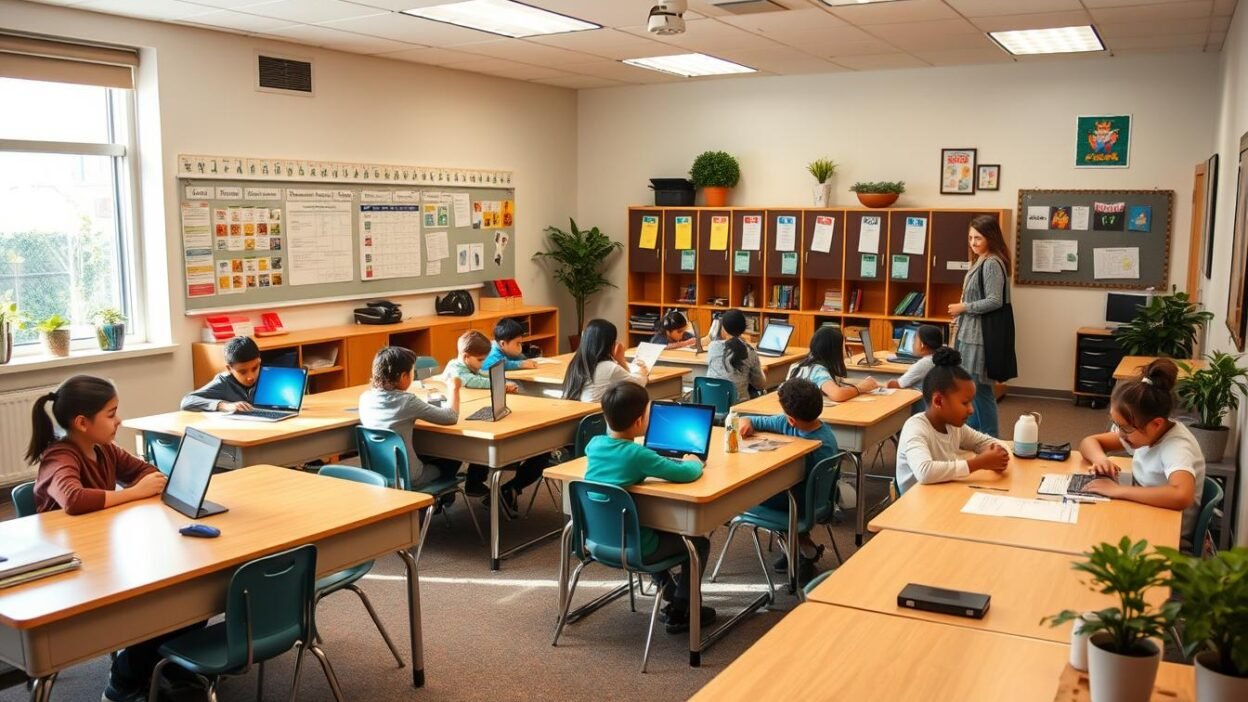
Ms. Rodriguez noticed Marcus struggling in class. The eight-year-old covered his ears and rocked back and forth. The noisy classroom environment made it hard for Marcus to focus.
Ms. Rodriguez made simple changes to help Marcus. She gave him noise-canceling headphones and a quiet workspace. These adjustments made a big difference for Marcus.
Soon, Marcus started finishing his work on his own. He even joined in group talks. This shows how small changes can have a big impact.
Effective autism classroom accommodations are more than just simple tweaks. They reshape learning spaces to fit different thinking styles. These changes help students learn in ways that work for them.
Good accommodations connect lessons to different brain types. They let students show what they know in their own way. This approach honors how each student learns best.
Key Takeaways
- Accommodations are environmental modifications that help students access curriculum content without lowering academic standards
- Effective support strategies must be tailored to individual student needs and adapted based on ongoing observation
- Successful implementation requires understanding the relationship between neurodivergent processing patterns and learning environments
- Environmental changes can dramatically improve academic performance and classroom participation
- Accommodations function as bridges between diverse cognitive architectures and educational content
- Creating structured, predictable spaces supports sensory regulation and meaningful learning engagement
What Teachers Need to Know About Autism and Learning Differences
Autism classroom modifications start with understanding how autistic students process information. Teachers can create inclusive learning spaces by knowing students’ unique needs. This knowledge helps meet educational goals while honoring neurodiversity.
Successful strategies come from seeing autism as a difference, not a deficit. This view helps teachers spot student strengths and challenges. Ongoing learning and adaptation are key to effective modifications.
Understanding student traits is crucial for proper accommodations. Without this knowledge, even well-meant changes may create new learning barriers.
Core Characteristics That Impact Learning
Autistic students often have executive functioning differences. These affect their school performance and behavior. Executive functions include planning, focus, and task management.
Task initiation is often hard for autistic learners. They may understand an assignment but struggle to start without help. This stems from brain differences, not lack of motivation.
Working memory limits can make multi-step directions overwhelming. Teachers must know that simple requests may exceed a student’s memory capacity.
Cognitive flexibility develops differently in autistic individuals. Unexpected changes or transitions can cause distress. Predictability and advance notice are vital for effective classroom modifications.
Autism varies widely among individuals. Common differences include:
- Communication differences: Some students use spoken language fluently while others communicate through alternative methods; verbal ability does not correlate directly with intelligence or comprehension
- Social interaction patterns: Autistic students may desire social connection but lack understanding of unwritten social rules, or may prefer solitary activities without experiencing loneliness
- Information processing: Many autistic learners excel with visual information while struggling with auditory processing, though the reverse pattern also occurs
- Special interests: Intense focus on specific topics can serve as powerful learning motivators when incorporated thoughtfully into curriculum
- Emotional regulation: Some students display emotions intensely while others have difficulty identifying or expressing their emotional states
These traits help teachers understand student behavior accurately. For example, avoiding eye contact isn’t disrespect. It may help the student process auditory information better.
Sensory Processing Differences in Autistic Students
Sensory processing differences greatly impact classroom functioning. Autistic students may be over or under-sensitive to stimuli. This can make normal classrooms overwhelming or understimulating.
Seven sensory systems are affected: visual, auditory, tactile, olfactory, gustatory, vestibular, and proprioceptive. Each student has a unique sensory profile needing individual assessment.
| Sensory System | Hypersensitivity Examples | Hyposensitivity Examples | Classroom Impact |
|---|---|---|---|
| Auditory | Fluorescent light buzzing causes pain; background conversations prevent focus | Does not respond to name being called; seeks loud music or noise | Difficulty concentrating during group work; may need quiet space or noise-canceling support |
| Visual | Bright lights trigger headaches; overwhelmed by busy bulletin boards | Attracted to spinning objects; seeks visually stimulating patterns | Reduced visual distractions needed; may require dimmer lighting or organized visual environment |
| Tactile | Cannot tolerate certain clothing textures; avoids messy activities | Does not notice dirty hands; seeks pressure or texture experiences | Alternative materials for hands-on activities; access to fidget tools or weighted items |
| Vestibular | Experiences motion sickness easily; fearful of playground equipment | Constantly moving, rocking, or spinning; difficulty sitting still | Movement breaks needed; alternative seating options that allow motion |
Sensory responses often fluctuate based on stress levels, environmental factors, and overall regulation state. Sensory thresholds change dynamically. A student’s tolerance may vary from day to day.
Behaviors often seen as defiance may be responses to sensory experiences. Covering ears during assemblies isn’t being difficult. It’s protection from auditory pain.
Understanding sensory processing differences requires us to recognize that the same environment can be experienced in radically different ways by different nervous systems.
Effective modifications address sensory needs proactively. This prevents sensory distress from escalating into meltdowns that disrupt learning.
Legal Rights and Requirements Under IDEA
The Individuals with Disabilities Education Act (IDEA) makes accommodations a legal right. It ensures free appropriate public education in the least restrictive environment. This law empowers educators to advocate for resources and protect student rights.
IDEA requires eligible students to have an Individualized Education Program (IEP). The IEP specifies goals, services, and accommodations. Teachers play a key role in implementing these plans daily.
Key IDEA provisions relevant to classroom modifications for autistic students include:
- Access to general education curriculum with appropriate supports and modifications
- Related services such as speech therapy, occupational therapy, or counseling when necessary for educational benefit
- Supplementary aids and services that enable participation in general education settings
- Participation in state and district assessments with appropriate accommodations
- Transition planning for post-secondary success beginning by age 16
Section 504 provides additional protections for students with disabilities. It ensures equal access to education through accommodations. The ADA extends civil rights protections to educational settings.
Teachers must document accommodation use and student progress. This proves compliance and informs IEP decisions. It also shows which strategies work best for each student.
Collaboration with special education teams is crucial. It helps teachers understand their legal duties and get support. The legal mandate for appropriate accommodations includes the provision of adequate training, resources, and collaborative support for educators.
Knowing these laws helps teachers implement accommodations confidently. It also provides a framework to advocate for student needs effectively.
Transforming Your Physical Classroom Space
Classroom design changes can greatly help autistic students learn better. The physical space can either support or hinder their engagement. Good design choices are key for academic success. Autism-friendly classroom design looks at how space, senses, and environment work together.
Autistic students experience spaces differently than their peers. Small distractions can create big learning barriers. Educators must assess how classroom features impact students with diverse sensory needs.
Creating sensory-friendly classrooms needs more than simple tweaks. It requires rethinking how physical elements affect learning. The following sections guide you through important modifications.
Implementing Specialized Seating Arrangements
Specialized seating arrangements can greatly improve student comfort and focus. They affect sensory input, social demands, and visual access to instruction. Research shows that good seating leads to better on-task behavior and engagement.
Effective seating considers many factors at once. These include teacher proximity, distance from distractions, and positioning relative to peers. What works for one student may not work for another.

Flexible seating options go beyond regular desks and chairs. They address different sensory needs. Stability balls provide movement that helps some students focus. Wobble cushions offer subtle motion while keeping structure.
Standing desks help students who struggle with sitting still. Floor cushions create low-stress seating options. Hokki stools allow controlled rocking while keeping students in place.
Introducing flexible seating needs clear instructions. Students must learn how and when to use different options. Rotation systems or choice boards help students pick the best seating for their needs.
[Table content remains unchanged]
Strategic Classroom Positioning
Where students sit greatly affects their learning. Sitting near the teacher allows for more support and feedback. This placement helps during group lessons when students must focus on verbal information.
Seating away from busy areas reduces distractions. Doorways, supply areas, and tech stations can be overwhelming. Strategic positioning creates quiet zones that limit these distractions.
Sitting near positive peers can help with behavior and social skills. But this needs careful planning. The peer shouldn’t be disrupted, and the autistic student shouldn’t feel anxious.
Optimizing Lighting for Sensory-Friendly Classrooms
Lighting changes are crucial for sensory-friendly classrooms. Standard fluorescent lights can be distracting and uncomfortable for autistic students. The buzz adds extra sensory input that can interfere with learning.
Natural light is best for all learners. It supports body rhythms and reduces stress. When natural light isn’t enough, full-spectrum LED bulbs are a good alternative.
Creating lighting zones lets students work in areas with different brightness levels. Desk lamps give individual control. Dimmer switches allow teachers to adjust overall lighting as needed.
Reducing Noise in the Learning Environment
Noise reduction for autism classrooms is key to supporting learning. Background noise can be very distracting for autistic students. It can affect understanding, task completion, and behavior.
Carpets or rugs help reduce sound. Acoustic tiles and fabric hangings also absorb noise. These changes benefit all students, especially those with hearing sensitivities.
Furniture can create natural sound barriers. Bookshelves can block noise between areas. Quiet zones offer refuge for students feeling overwhelmed by sound.
Visual cues can replace noisy signals. This includes visual timers and hand signals for transitions. Speaking when the room is quiet helps students process instructions better.
Creating sensory breaks allows students to reset before getting overwhelmed. Break spaces, in or out of class, provide needed rest. These prevent stress that can lead to behavior issues.
Essential Sensory Tools for Autism Support
Sensory tools are crucial for supporting students with autism. They help with learning, emotions, and behavior. These tools address differences in how autistic students process sensory input.
Sensory integration theory explains why these tools work well in schools. It shows that fidgeting and sensory behaviors are not disruptive. Instead, they help students regulate themselves.
Students should help choose their sensory tools. They know what works best for them. This approach promotes self-awareness and independence. It also ensures the tools meet real needs.
Selecting and Introducing Noise-Canceling Headphones for Students
Noise-canceling headphones for students are common in schools. They reduce background noise that can overwhelm autistic students. When choosing headphones, consider both effectiveness and practical use.
There are two types of noise-canceling headphones: passive and active. Passive models use physical barriers. Active models use electronics to cancel out noise.
Comfort is key for long-term wear. Look for adjustable headbands and soft ear cups. Volume-limiting technology is important to protect students’ hearing.
When introducing headphones, teach students about their purpose and proper use. Explain when to use them and how to communicate while wearing them. Show how to care for the headphones.
Make headphones a normal part of the classroom. Present them as tools anyone can use. This reduces stigma and helps all students understand different sensory needs.
Fidget Tools and Manipulatives
Fidget tools help students focus and reduce anxiety. They provide sensory input that improves cognitive function. There are many types to suit different preferences.
Choose quiet fidget tools to avoid distracting others. Examples include therapy putty, stretchy strings, and smooth stones. Set clear rules for using these tools in class.
Make sure fidget tools support learning for everyone. They should stay under the desk and not distract others. Students should still be able to do their work while using them.
Weighted Items and Compression Tools
Deep pressure can help calm and organize students. Weighted items and compression tools provide this input. They can reduce stress and promote relaxation.
Use about 10% of the student’s body weight for weighted items. Introduce them slowly and ask for feedback. Different tools work for different needs:
- Weighted lap pads: Good for sitting activities
- Weighted vests: Useful during movement
- Weighted blankets: Great for calm-down areas
- Weighted stuffed animals: Comforting for younger students
Compression tools work similarly but use elastic materials. They include vests, body socks, and special seating. Limit use to 20-minute periods to stay effective.
Setting Up a Sensory Tools Station
A sensory tools station helps students self-regulate. It should be well-organized and easy to use. Clear containers and labels help students find what they need.
Use visual supports to guide proper tool use. Include pictures of tools and how to use them. Show steps for returning items to keep the station tidy.
Teach students how to use the station effectively. Help them recognize when they need tools. Show how to match tools to their needs. Practice using the station properly.
Track tool use with sign-out sheets or apps. This helps refine accommodations. Use this data in IEP meetings to improve support.
Make sensory tools normal in your classroom. Use them yourself and talk about regulating emotions. This helps all students understand and accept diverse needs.
Planning and Implementing Sensory Breaks
Autistic students need regular sensory breaks to manage the demands of school. These breaks help them process information and meet social and academic expectations. Educators can use this knowledge to better support their students.
Sensory breaks prevent problems before they start. They keep students in a state where learning can happen. These breaks aren’t just rest periods; they help students reset and engage better.
Active movement increases the ability to focus and should be incorporated throughout the school day, with physical activities positioned as essential accommodations rather than optional rewards.
Establishing Structured Break Schedules
To create effective break schedules, observe students closely. Look for patterns in their behavior throughout the day. Some students struggle more in the morning, others after lunch.
Watch for signs of sensory overload. Schedule breaks before difficult tasks or after high-energy activities. This approach stops problems before they start.
Customize break timing for each student. Some need short breaks often, others longer breaks less frequently. This reflects the unique needs of each autistic student.
Various break formats serve distinct regulatory functions:
- Movement breaks include jumping jacks, wall pushes, stretching exercises, or brief hallway walks that provide proprioceptive input
- Heavy work activities incorporate carrying classroom materials, pushing chairs into place, or completing physical classroom chores that ground the nervous system
- Calming activities feature deep breathing exercises, progressive muscle relaxation, or quiet sensory activities with manipulatives
- Social breaks reduce interpersonal processing demands by allowing solitary time in designated quiet spaces
Include movement in regular classroom activities. Have students walk to the board or hand out assignments. This combines task completion with sensory input.
Protect physical activities as essential accommodations. Never take away recess as punishment. This ensures students get the movement they need.
Creating Therapeutic Calm-Down Spaces
Calm-down zones offer a safe space during overwhelming moments. Design these areas carefully, considering all senses. The space’s setup directly affects how well it helps students.
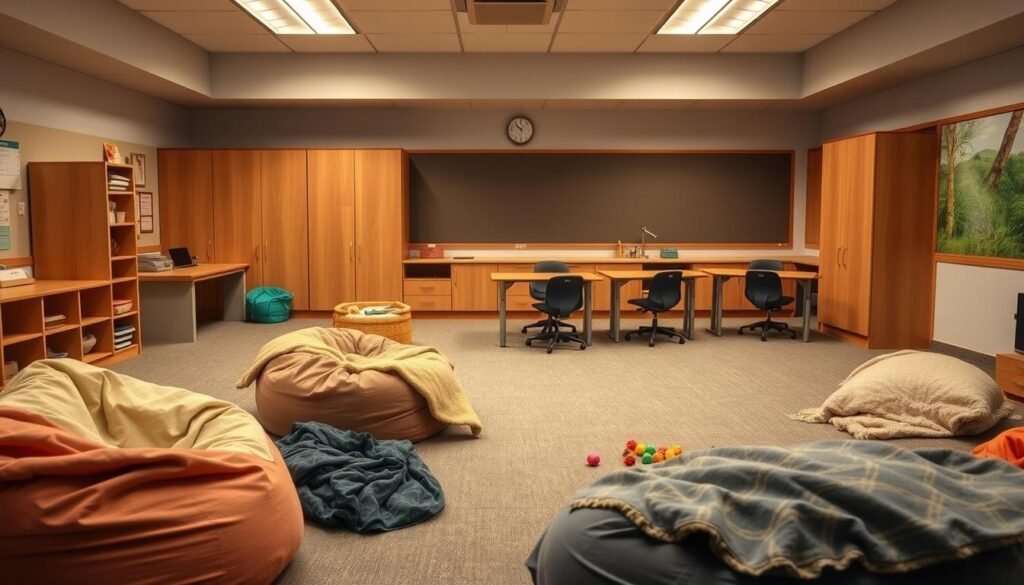
Use dim lighting and comfortable seating in calm-down zones. Add noise-reducing elements like acoustic panels. Choose soft, neutral colors and simple visual patterns.
Provide sensory tools like weighted lap pads and fidget items. Include noise-canceling headphones and soft textured objects. Teach students to choose tools that help them best.
Calm-down zones are not punishment locations but therapeutic environments supporting self-regulation skill development. Explain this purpose clearly to prevent negative associations.
Consider privacy in these spaces. Use partial barriers like bookshelves or curtains. This allows students to retreat while maintaining supervision.
| Break Type | Primary Function | Best Used When | Duration |
|---|---|---|---|
| Movement Break | Increase alertness and focus | Student appears under-stimulated or lethargic | 2-5 minutes |
| Heavy Work Activity | Provide grounding proprioceptive input | Student shows signs of anxiety or restlessness | 5-10 minutes |
| Calming Activity | Reduce arousal and promote relaxation | Student displays overstimulation signals | 5-15 minutes |
| Social Break | Decrease interpersonal processing demands | After group activities or social challenges | 10-20 minutes |
Developing Self-Awareness and Advocacy Skills
Teaching students to recognize sensory overload is crucial. This helps them manage their own needs. These skills are useful beyond the classroom.
Start with interoception training. Help students identify internal body signals of stress. Teach them to notice physical sensations like a racing heart or tense muscles.
Use body scans and emotion charts in class. These tools make abstract feelings more concrete. Practice helps students connect internal experiences with external labels.
Help students spot early signs of stress. Teach them to notice yellow zone indicators like difficulty focusing or increased fidgeting. Early recognition makes coping strategies more effective.
Empower students to ask for breaks when needed. Use break cards or hand signals for easy communication. This preserves dignity while ensuring access to support.
Frame sensory breaks as smart self-management, not weakness. This builds positive associations. Students learn that successful people use these tools too.
These self-advocacy skills apply to many settings. Students can use them at home, in the community, and later at work. This makes the effort of teaching worth it.
Track progress by noting fewer stress episodes and more student-initiated breaks. This shows growing self-awareness and comfort with self-advocacy. Over time, students need less adult help.
Using Visual Schedules for Autistic Students
Visual supports are powerful tools for autistic students. They turn uncertain time into clear sequences. Many autistic people process visual info better than verbal info. This creates a chance for teaching methods that use visual strengths.
Visual schedules act as external memory aids. They reduce mental strain from planning and organizing. These tools make abstract time concrete and visible. This helps ease anxiety about unpredictable events in classrooms.
Visual schedules do more than reduce worry. They help students become independent and organized. These skills benefit students throughout school and beyond. Understanding good schedule design helps teachers create custom supports for each student.
Creating Effective Daily Visual Schedules
Making useful daily schedules requires careful thought. Consider the student’s age, reading ability, and symbol understanding. Effective schedules give enough info to reduce anxiety without overwhelming. Teachers must decide if students need to see the whole day or just upcoming activities.
Assess how well a student understands symbols. Some need object-based schedules. Others can use written formats. Choose based on the student’s abilities, not just age or diagnosis.
Visual schedules work best with consistent design and placement. Students should easily see their schedules without moving around. Many teachers use desk schedules and a main classroom schedule.
Picture schedules use images that work for all learners. They can use photos, drawings, or standard symbols. Choose images based on how well the student understands symbols and likes different visual styles.
Object schedules are the most concrete. Students can move actual items or small versions. This helps students who struggle with flat images. It makes abstract ideas more real.
Photo schedules show real classroom scenes. They’re often easier to understand than abstract symbols. Symbol systems like Boardmaker offer consistency across settings. But students must learn their meanings first.
Written Schedule Formats
Text-based schedules help strong readers. They can include more details about assignments, times, and locations. These schedules look more grown-up while still organizing information.
Written schedules can be simple or detailed. Some students like short lists. Others need times and task descriptions. The main goal is to reduce mental effort, not add complexity.
Older students often prefer written schedules. They look like planners used by other students. Digital formats offer extra features like reminders and easy changes.
Visual Supports for Transitions
Changing activities can be hard for autistic students. Visual transition aids prepare them for changes. These tools help students shift focus more easily.
Countdown timers show how much time is left. Visual timers with shrinking colors work better than numbers for many students. They help students mentally prepare for changes.
“First-then” boards show current and next activities. This simple tool answers the question, “What happens next?” Sequence strips show multiple upcoming activities.
Transition warnings use visuals and words to signal changes. A “5 minutes” card with a verbal reminder helps students prepare. Multiple warnings at different times often work best for autistic learners.
[Table content remains unchanged]
Task Completion Visual Aids
Visual aids show progress on tasks. They help with staying focused and motivated. These tools break big projects into smaller, doable steps. Seeing progress keeps students engaged.
Checklists break complex tasks into simple steps. Checking off items feels satisfying. Digital checklists are easy to change and can link to resources.
Progress bars show completion percentages graphically. They work well for long projects. Students can update them to see their progress toward goals.
Token boards combine task tracking with rewards. Students earn tokens for finishing work. Full boards lead to rewards. This helps with organization and motivation.
Step-completion markers guide students through complex tasks. They use numbered cards or color-coded stages. This helps students keep track of where they are in a process.
Implementing Visual Supports and Learning Aids
Visual supports act as cognitive bridges for autistic students. They turn abstract ideas into concrete forms. These tools help with memory, executive function, and understanding classroom expectations.
Visual aids create fair access to learning content. They reduce the mental work needed. Research shows visual presentations boost understanding for autistic students.
Visual Instructions and Step-by-Step Guides
Visual instructions break down complex tasks into simple steps. They use lists, charts, or pictures to reduce memory strain. Many autistic students excel at visual processing but struggle with verbal information.
Effective guides use consistent visual formats. This helps students become familiar with the structure. Each guide should focus on essential steps, using clear highlighting for important actions.
Teachers should create visual guides for common classroom tasks. These supports should be easy to access during activities. The aim is to build independence and reduce reliance on teacher help.
Photo guides work well for hands-on tasks. They help with safety in science experiments. For writing, flowcharts can map out the process from start to finish.
Color-Coding Systems for Organization
Color-coding creates visual categories that bypass language processing. It links colors to subjects, assignment types, or priorities. Consistent use across contexts is key for this system to work well.
Subject-based coding assigns colors to each class. This helps students quickly find materials without reading labels. Assignment-type coding differentiates homework from classwork.
Priority-based systems use colors to show task urgency. Red for immediate tasks, orange for upcoming deadlines, yellow for current work, and green for completed items.
Anchor Charts and Reference Materials
Anchor charts display key concepts, steps, and rules in the classroom. They reduce memory demands by providing constant visual support. This helps autistic students who may struggle with information recall.
Effective charts use clear headings and colors to organize information. Math charts might show problem-solving steps. Language arts charts can present writing processes or grammar rules.
Chart placement is crucial for effectiveness. Place them at eye level in relevant areas. Strategic positioning ensures easy access without disrupting class.
Visual Behavior Expectations
Visual behavior guides show what good conduct looks like in practice. They help autistic students understand abstract social rules. Showing, not just telling, addresses this challenge effectively.
Photo models offer concrete behavior supports. Teachers can photograph students demonstrating expected behaviors. Video models can show more complex social interactions or routines.
Social scripts with visuals break down tricky interactions. They might show steps for asking a peer to play. This removes confusion from social expectations.
| Visual Support Type | Primary Function | Implementation Context | Cognitive Benefits |
|---|---|---|---|
| Step-by-Step Guides | Task completion scaffolding | Individual desk reference, procedure stations | Reduces working memory load, prevents step omission |
| Color-Coding Systems | Organizational categorization | Materials management, priority identification | Bypasses language processing, enables quick visual sorting |
| Anchor Charts | Continuous information access | Classroom walls, digital devices | Reduces retrieval demands, legitimizes reference use |
| Visual Behavior Models | Social expectation clarification | Transition areas, social learning zones | Translates abstract rules into concrete demonstrations |
Using visual supports for autistic students needs careful planning. Teachers should check their current visual aids and find gaps. Working with special education teams ensures supports match IEP goals.
Training in creating visual aids improves teacher skills. Many teachers at first make materials too abstract. Refining based on student feedback makes supports better over time.
The ultimate goal is to help students advocate for themselves. Teachers can discuss which visuals work best. This helps students request specific supports and create their own visual aids.
Integrating Autism Communication Tools and Assistive Technology
Assistive tech is crucial for autistic students to show their true abilities. These digital tools bridge the gap between understanding and communication. They open new paths for participation that traditional methods can’t offer.
Research shows computers increase focus and help organize complex thoughts. The multisensory nature of tech aligns with diverse processing styles common in autistic students.
Autism communication tools address genuine access needs. Students may record lessons, use audio recorders, or word processors to bypass challenges. These tools recognize that communication skills often exceed traditional output abilities.
Augmentative and Alternative Communication Systems
AAC systems give voice to students whose abilities surpass spoken language. Tools range from simple picture-based options to advanced speech-generating technology. Low-tech solutions include Picture Exchange Systems, communication boards, and choice cards.
High-tech AAC systems transform communication for minimally speaking students. Devices and apps convert symbol selection into speech. Popular platforms include Proloquo2Go, TouchChat, and LAMP Words for Life.
Successful AAC use requires training for students and staff. Consistent access across all environments is essential. Research shows AAC is legitimate communication, not a barrier to speech development.
Educators should model AAC use during instruction and conversation. This approach, called aided language stimulation, demonstrates practical application. It reduces stigma and helps students learn by observing adults use the systems.
Speech-to-Text and Text-to-Speech Software
Many autistic students struggle with written expression. Speech-to-text software enables voice-dictated composition, bypassing handwriting difficulties. Students can share complex thoughts verbally without motor skill limitations.
Common options include built-in features in Google Docs and Microsoft Word. Specialized programs like Dragon NaturallySpeaking are also available. These tools need initial voice training but offer sophisticated recognition capabilities.
Text-to-speech software provides auditory access to written materials. Programs like Natural Reader convert digital text into spoken language. This tech supports reading comprehension and offers multisensory input to enhance understanding.
Implementation should include teaching effective dictation strategies. Students learn to indicate punctuation, organize thoughts, and edit transcribed text. Training in computer usage complements these tools, allowing students to choose between typing and dictation.
Digital Visual Timers and Scheduling Apps
Digital timers display countdown animations that make abstract time concepts concrete. Apps like Time Timer provide adjustable intervals with color-coded displays. These tools promote time awareness without constant adult reminders.
Scheduling apps extend daily visual schedules into interactive digital formats. Options like Choiceworks offer customizable schedule creation with symbol support. Students receive notifications for transitions and can preview upcoming events independently.
Digital scheduling tools provide age-appropriate supports aligned with older student preferences. They reduce stigma while maintaining essential structure. Portability ensures schedule access across all settings, from classroom to community.
Organizational Technology Tools
Task management apps like Todoist provide frameworks for tracking assignments and setting reminders. These digital supports compensate for working memory limitations and planning difficulties.
Note-taking apps address organizational challenges during instruction. Tools like OneNote allow multimedia integration, combining text with audio, photos, and documents. Cloud-based systems provide centralized access to coursework, due dates, and submission portals.
Reminder systems offer just-in-time prompts for task initiation and routine adherence. Students can set alerts for medication, bringing materials home, or starting homework. These accommodations teach skills through structured frameworks while providing immediate support.
[Table content remains unchanged]
Choosing the right assistive tech requires assessing each student’s strengths and challenges. What works for one may not suit another. Trial periods allow students to experience various options before committing.
Professional training ensures educators can troubleshoot issues and integrate technology into instruction. Students need explicit teaching in alternative output methods. Systematic skill-building transforms technology from novelty into functional accommodation.
Universal Design for Learning recognizes that assistive tech benefits all students. It provides multiple means of representation, expression, and engagement. When autism tools become standard options, stigma decreases and accessibility increases.
Providing Testing Accommodations and Assessment Modifications
Autistic students often face barriers during tests that hide their true abilities. Accommodations are vital for accurate assessment. They ensure tests measure knowledge, not a student’s ability to handle sensory overload or processing challenges.
These changes create fair conditions. They separate learning mastery from disability-related obstacles. Assessments should evaluate curriculum skills, not the effects of neurological differences.
Without proper changes, test results reflect environmental barriers instead of actual knowledge. This leads to inaccurate measurements of student achievement.
Assessment accommodations do not give students an unfair advantage; they provide access to demonstrate what they truly know by removing barriers unrelated to the content being tested.
Environmental Accommodations for Testing
Standard test settings can impair performance unrelated to content mastery. Lighting, noise, and visual clutter can distract students. For autistic students, these factors can turn tests into endurance trials.
Environmental changes aim to reduce stimuli that compete for cognitive resources. When sensory demands decrease, students can better access their working memory and executive functions.
Separate testing locations offer controlled environments with less sensory input. These quiet spaces typically accommodate small groups or individual students. Resource rooms or designated testing centers work well for this purpose.
Private locations allow for multiple accommodations without peer awareness. Students can use headphones, take breaks, or read aloud without disrupting others. This privacy reduces anxiety about appearing different.
These spaces also allow special education staff to administer tests. Familiar adults can better explain instructions without giving content help.
Reducing Visual and Auditory Distractions
Minimizing stimuli requires careful room selection and removal of unnecessary sensory information. Test spaces should have neutral colors, limited displays, and controlled lighting. Covering boards and choosing quiet rooms reduces competing input.
Noise-canceling headphones or white noise machines can mask unpredictable sounds. These tools help autistic students who struggle to filter background noise. When environmental sounds decrease, students can focus more on test content.
Visual privacy boards create focused workspaces. They reduce the urge to check what other students are doing. This helps students who find it hard to ignore movement.
Timing and Format Adjustments
Processing speed differences and anxiety can affect test completion speed. Timed tests measure both knowledge and processing speed. For many autistic students, time pressure triggers anxiety that further impairs performance.
Extended time is a common accommodation. It gives students more minutes to decode questions and formulate responses. Research shows this leads to more accurate knowledge measures for students with processing differences.
Dividing tests into multiple sessions addresses stamina limitations. It prevents cognitive fatigue during long assessments. This recognizes that maintaining focus for hours may exceed capacity regardless of understanding.
| Timing Accommodation | Primary Benefit | Best Suited For |
|---|---|---|
| Extended time (1.5x) | Reduces time pressure anxiety | Mild processing speed differences |
| Extended time (2x) | Accommodates significant processing delays | Moderate to severe processing challenges |
| Multiple sessions | Prevents cognitive fatigue | Attention and stamina limitations |
| Untimed testing | Eliminates speed as measurement variable | Documented processing speed disabilities |
Format adjustments improve test accessibility. Larger print and increased spacing decrease visual processing demands. Oral administration eliminates decoding requirements. These changes ensure tests measure intended skills, not format navigation abilities.
Alternative Ways to Demonstrate Knowledge
Written tests may poorly capture learning for some students. Motor difficulties or anxiety can prevent knowledge demonstration through traditional methods. Alternative formats evaluate the same standards while bypassing disability-related barriers.
Oral exams allow students to explain concepts verbally. This helps those whose verbal skills exceed writing abilities. It also reduces anxiety for students who perform better in discussion settings.
Project-based assessments show mastery through applied tasks. Students might create models or conduct experiments. These hands-on evaluations often provide more accurate measures for some learners.
Portfolios compile work samples to show learning progress. This approach benefits students whose performance varies across different days. Portfolios capture abilities more fully than single test sessions.
Multimedia presentations use technology to show knowledge through videos or interactive media. These formats help students with writing difficulties. They allow creative expression that engages multiple learning styles.
Alternative methods focus on outcome over process. The method of demonstration should remain flexible to accommodate diverse learning profiles. This ensures accurate measurement of all students’ knowledge, regardless of how they express it.
Supporting Executive Functioning with Autism Executive Functioning Aids
Many autistic students face challenges with organization, planning, and task management. These difficulties stem from neurological differences, not lack of intelligence or effort. Understanding this is key to providing helpful accommodations.
Executive functioning involves multiple cognitive skills for academic success. These include planning, organization, task initiation, and self-monitoring. Autistic students often excel in some areas while struggling with executive functioning.
Classroom success requires more than just content knowledge. Students must juggle assignments, manage materials, and monitor progress. These demands create barriers for autistic learners who process executive functioning differently.
Organizational Systems and Checklists
External structures help reduce cognitive load for autistic students. Color-coded folders and designated locations for supplies create predictable routines. These systems bypass the need for constant organizational planning.
Checklists turn abstract expectations into concrete steps. Daily checklists for routines provide visual confirmation and teach organizational sequences. Weekly assignment sheets help students track multiple obligations over time.
Implementing these systems requires explicit instruction and practice. Teachers should model system use and recognize that these supports may be permanent accommodations. Scheduled check-ins throughout the day provide consistent support and teach skills.
Effective interventions include end-of-day study halls and morning preparation check-ins. Allocating class time for desk organization prevents overwhelming material buildup. These strategies address multiple organizational demands simultaneously.
Breaking Down Complex Tasks
Task analysis divides complex assignments into manageable steps. This support transforms overwhelming projects into clear instructions with estimated time requirements. It compensates for difficulties with planning, sequencing, and maintaining focus.
Effective breakdown includes visual representations of project stages and numbered steps. Teachers might divide a research report into distinct phases. Each phase gets separate instructions and completion confirmation.
This process addresses challenges beyond procrastination. Autistic students often struggle to envision project pathways and prioritize tasks. Task breakdown provides external structure that makes complex work accessible.
Visual task maps show relationships between project components. Checklists with time estimates teach realistic planning. Scheduled check-ins ensure steady progress and identify difficulties early.
Time Management and Planning Supports
Time blindness creates academic challenges for autistic students. They may struggle to estimate task duration or recognize approaching deadlines. Supports that externalize time awareness are essential.
Visual timers turn abstract time into visible quantities. Analog timers with colored sections often work better than digital displays. Scheduled time blocks create structure for managing activities.
Backward planning teaches temporal sequencing. Teachers guide students through identifying due dates and necessary steps. This instruction builds planning skills to address executive functioning deficits.
Long-term planning benefits from multi-week calendars and scheduled project work periods. Training in time management provides supports that address fundamental cognitive differences affecting academic success.
Working Memory Accommodations
Limited working memory affects autistic students’ ability to retain multi-step instructions. It also impacts information retention and mental manipulation. These constraints create learning barriers when instruction assumes strong memory skills.
Written instructions provide permanent reference materials. Teachers might offer printed direction sheets and assignment requirement reminders. Permission to use these materials during work acknowledges memory challenges.
Reducing simultaneous cognitive demands is another critical accommodation. Breaking complex instructions into sequential steps prevents working memory overload. Allowing task completion before introducing new requirements respects cognitive capacity limits.
Reference sheets eliminate constant recall demands. Note-taking during verbal instruction provides external information storage. These accommodations recognize working memory constraints as neurological differences requiring support.
| Executive Functioning Challenge | Accommodation Strategy | Implementation Method | Expected Outcome |
|---|---|---|---|
| Organization Difficulties | Color-coded systems and checklists | Assigned folders, designated locations, daily/weekly tracking sheets | Reduced cognitive load for material management |
| Task Initiation and Planning | Task breakdown with visual maps | Sequential steps, completion checkpoints, visual project timelines | Clear pathway from assignment to completion |
| Time Blindness | Visual timers and backward planning | Analog timers, estimated duration annotations, scheduled work blocks | Improved time awareness and deadline management |
| Working Memory Limitations | Written instructions and reference materials | Printed directions, formula sheets, permission to reference notes | Reduced cognitive overload from constant recall |
Comprehensive executive functioning supports address core autism features. They require ongoing accommodation rather than temporary assistance. Regular reviews ensure accommodations remain effective as academic demands increase.
These aids transform academic accessibility for autistic students. They provide external structure to compensate for internal differences. This enables students to demonstrate knowledge that would otherwise remain inaccessible despite adequate understanding.
Effective Autism Behavior Management Strategies
Autism behavior management focuses on understanding behaviors as responses to challenges or unmet needs. This approach differs from traditional discipline models. It sees behaviors as communication or neurological differences, not just discipline problems.
Effective support systems prioritize understanding the reasons behind behaviors. This shifts classroom management from punishment to proactive support. Teachers who use this approach create environments where challenging behaviors naturally decrease.
Research shows autistic students respond better to positive reinforcement. Praising good behavior more often than addressing challenges builds trust. This reduces anxiety that can trigger behavioral difficulties.
Implementing Positive Behavior Support Systems
Positive behavior support systems are key for managing autism behaviors in schools. These focus on prevention, teaching, and changing the environment. This approach recognizes that autistic students need clear, well-taught expectations.
Teaching behavioral expectations requires concrete examples and reasons. Teachers should explain what behaviors are expected and why. This helps autistic students understand social rules that may not be obvious.
Systematic teaching involves modeling, practice, and feedback. Students need chances to practice appropriate responses in safe situations. This proactive teaching builds skills and prevents challenges.
Recognition systems are crucial in positive behavior support. Research suggests frequent brief feedback helps maintain awareness of expectations. Teachers should aim for four positive interactions for every corrective one.
Data collection provides key insights into behavior patterns. Teachers should track behaviors, triggers, and consequences to identify patterns. This observation reveals what causes behaviors and helps create targeted interventions.
| Positive Behavior Support Component | Implementation Strategy | Expected Outcome | Monitoring Method |
|---|---|---|---|
| Clear Expectations | Explicitly teach 3-5 core behavioral expectations with visual supports and rationales | Students understand what behaviors are appropriate and why they matter | Student demonstration and verbal explanation assessments |
| Frequent Positive Feedback | Provide specific praise for expected behaviors at minimum 4:1 ratio to corrections | Increased appropriate behaviors and improved student-teacher relationships | Daily tallies of positive versus corrective interactions |
| Systematic Teaching | Model expected behaviors, provide practice opportunities, and offer immediate feedback | Students develop behavioral competence through instruction rather than trial and error | Skills checklists and practice session observations |
| Environmental Modifications | Adjust physical space, schedules, and demands to reduce behavioral triggers | Prevention of challenging behaviors through supportive environmental design | Behavior frequency data before and after modifications |
Identifying Triggers and Preventing Meltdowns
Understanding meltdowns is crucial for supporting autistic students. Meltdowns are neurological responses to overwhelming input. They differ from tantrums, which are intentional behaviors aimed at specific goals.
Identifying triggers requires careful observation and documentation. Teachers should note conditions present before behavioral escalation. Patterns usually emerge, revealing specific triggers that can be addressed.
Common triggers include sensory overload, unexpected changes, unclear instructions, and social demands. Recognizing these patterns allows teachers to prevent escalation before it occurs.
Early warning signs offer chances to intervene before meltdowns happen. Students may show increased stimming, withdrawal, or signs of distress. Private signals can gently remind students when behavior becomes inappropriate.
Prevention strategies address triggers directly through accommodations. This might include reducing sensory input or providing advance notice of changes. Proactive prevention works better than reacting after meltdowns start.
De-escalation techniques support students showing signs of distress. Providing space or offering sensory tools can interrupt escalation. Teachers should avoid power struggles when students approach overwhelm.
Ignoring minor misbehavior that represents self-regulation attempts can be helpful. This teaches students that appropriate coping gets neutral or positive responses. It also preserves classroom flow.
Creating Individualized Reinforcement Systems
Autism affects motivation and interests in unique ways. Standard reward systems often fail with autistic students. Effective strategies require finding what each student finds truly rewarding.
Identifying reinforcers starts with observation and student input. Teachers should note preferred activities and topics. Conversations about preferences provide valuable insights, though some students may need visual options.
Clear connections between behaviors and rewards are essential. Students need to understand exactly what behaviors earn rewards. Ambiguity undermines effectiveness, especially for autistic students who need explicit connections.
Immediate feedback linking behavior to consequences strengthens learning. In-class point systems with daily rewards provide frequent reinforcement. These might use token economies where students earn points for preferred activities.
Reinforcement frequency needs individualization based on student responses. Some students need nearly continuous reinforcement at first. Others respond well to intermittent schedules. Data on behavior rates guides these decisions.
Response costs for misbehavior provide consequences without escalation risks. Students might lose earned points rather than face punitive measures. This maintains focus on positive outcomes while providing natural consequences.
Time-outs, when needed, should be breaks for self-regulation, not punishments. Providing feedback privately preserves self-esteem. This approach respects student dignity while addressing behavioral concerns.
Teaching Self-Regulation Skills
Self-regulation skills help autistic students manage emotions, sensory challenges, and impulses independently. These skills promote autonomy beyond the classroom. Teaching students to monitor their own behavior is crucial for comprehensive support.
Identifying internal states is the foundation of self-regulation. Many autistic students struggle with recognizing bodily signals. Explicit instruction using body mapping and emotion scales helps develop this awareness.
Recognizing escalation patterns enables students to use coping strategies early. Teachers can help identify personal warning signs through reflective conversations. Creating individualized escalation scales provides concrete reference points.
Building a personal toolkit of regulation techniques is important. Students need multiple options because effective strategies vary by situation. Options might include breathing exercises, sensory tools, or quiet spaces.
Using sensory tools proactively prevents problems before they start. Teaching students to recognize when they need sensory input builds independence. This approach frames sensory tools as aids, not rewards.
Requesting breaks or support shows important self-advocacy skills. Students should learn to recognize when demands exceed their capacity. Promoting self-awareness by discussing problems and solutions builds insight and communication skills.
Cognitive self-instruction techniques teach students to guide their own behavior. This might involve teaching self-talk scripts or problem-solving frameworks. These strategies build executive functioning skills while supporting behavioral self-management.
Practice in low-stakes situations helps develop self-regulation skills gradually. Role-playing, discussing hypothetical situations, and reflecting on experiences build competence. Teachers should provide feedback to refine student skills over time.
| Self-Regulation Skill | Teaching Approach | Practice Activities | Independence Indicators |
|---|---|---|---|
| Identifying Internal States | Use emotion scales, body mapping, and regular check-ins to build interoceptive awareness | Emotion check-ins three times daily, body scan exercises, feelings journaling | Student independently identifies emotional states and intensity levels without prompting |
| Recognizing Escalation Patterns | Create personalized escalation scales showing warning signs at each level | Post-incident reflection discussions, warning sign identification exercises | Student notices early warning signs and communicates escalation before crisis |
| Implementing Calming Strategies | Teach multiple regulation techniques and help students identify personally effective options | Strategy practice during calm periods, choice boards of calming options | Student selects and uses appropriate calming strategies based on situation and need |
| Requesting Support | Explicitly teach when and how to ask for breaks, accommodations, or assistance | Role-playing support requests, using break cards, practicing self-advocacy language | Student appropriately requests needed support before behavioral challenges emerge |
These autism behavior management strategies create comprehensive support frameworks. They address immediate needs and long-term skill development. By combining various approaches, educators provide autistic students with essential tools for success.
This multi-faceted approach recognizes that effective behavior management goes beyond compliance. It fosters genuine competence, confidence, and independence in autistic students. These strategies help create a supportive environment for growth and learning.
Building Social Skills Support Systems
Autistic students often face challenges in social interactions. These include controlling emotions, interpreting social cues, and making friends. These difficulties stem from differences in how autistic individuals process social information.
Effective social skills support systems use multiple approaches. They provide explicit instruction, structured practice, and environmental modifications. Inclusive education strategies recognize that autistic learners may need direct teaching of social skills.
Structured Social Learning Opportunities
Controlled social contexts help autistic students practice with clear expectations. Structured recess activities with defined rules reduce playground complexity. Teachers can organize games like four-square or basketball with transparent guidelines.
Facilitated lunch groups offer another format for inclusive education practices. These small groups focus on specific topics chosen in advance. An adult guides turn-taking and models responses without controlling the conversation.
Social skills groups target specific abilities. They might focus on greeting routines one week and asking for help the next. This format turns vague expectations into concrete, teachable skills.
Cooperative learning activities with assigned roles reduce social ambiguity. Each student has a defined responsibility, making social demands more manageable and purposeful.
Peer Support and Buddy Programs
Pairing with socially competent peers creates natural support networks. Peer support programs work best when buddy students receive training in supporting autistic classmates. This training might include understanding autism basics and recognizing sensory overload signs.
Buddy programs provide autistic students with consistent peer models of appropriate social behavior. Students observe and practice with peers who demonstrate friendship skills authentically. These relationships offer social opportunities with reduced anxiety.
Schools report decreased social isolation for autistic students through peer support. Peer buddies develop empathy, leadership skills, and appreciation for neurodiversity. Teachers should monitor these relationships to ensure balance.
Giving autistic students leadership roles allows peers to see them positively. Assigning classroom jobs or letting them share special interests builds social capital.
Explicit Social Skills Instruction
Systematic teaching of social behaviors makes expectations clear for students. Direct instruction in greeting routines establishes clear scripts. This transforms ambiguous social expectations into concrete, executable steps.
Conversational turn-taking receives attention through social skills support curricula. Students learn to notice when others finish speaking and ask follow-up questions. Video modeling demonstrates these skills in action.
Perspective-taking activities help autistic students understand others’ thoughts and feelings. “Hidden object” games build this foundational social cognition skill. Role-playing allows practice with conflict resolution and emotion recognition.
Social narratives prepare students for upcoming events or teach responses to scenarios. They describe social situations with embedded guidance.
Facilitating Inclusive Group Work
Modifications transform group work into supported practice opportunities. Clearly defined individual roles eliminate confusion about each person’s contribution. This structure benefits all learners while particularly supporting autistic students.
Explicit collaboration procedures detail how to work together. Teachers might provide sentence frames for requesting or offering help. Visual task structures break complex projects into sequential steps.
Alternative participation formats acknowledge diverse strengths. Some autistic students contribute by recording ideas or creating visual representations. These accommodations represent inclusive education practices that recognize diverse strengths.
Teacher facilitation during group work prevents social exclusion. Strategic monitoring allows teachers to prompt inclusion and address conflicts. This active facilitation gradually fades as peer relationships strengthen.
| Social Skills Strategy | Implementation Method | Key Benefits | Teacher Role |
|---|---|---|---|
| Structured Social Learning | Organized activities with explicit rules and defined parameters | Reduces ambiguity, provides clear behavioral expectations, creates safe practice contexts | Facilitator who establishes structure and provides gentle guidance |
| Peer Buddy Programs | Strategic pairing with trained, compassionate peers for consistent support | Decreases isolation, provides peer modeling, offers anxiety-reduced social opportunities | Coordinator who trains buddies, monitors relationships, prevents dependency |
| Explicit Instruction | Direct teaching of social behaviors using scripts, video modeling, role-play, social narratives | Makes implicit rules visible, provides concrete steps, allows repeated practice | Instructor who breaks down skills, provides examples, gives specific feedback |
| Modified Group Work | Defined roles, explicit procedures, alternative participation formats, active facilitation | Reduces social overwhelm, prevents exclusion, builds collaboration skills through support | Active facilitator who structures tasks, monitors inclusion, adjusts participation formats |
Monitoring playground and lunchroom interactions provides valuable assessment data. Teachers can identify skills needing more instruction and recognize successful strategy application. This monitoring also allows timely intervention when conflicts arise.
Conflict resolution training equips autistic students with tools for navigating social disagreements. Teaching specific phrases for expressing frustration gives students alternatives to emotional outbursts. Practicing problem-solving frameworks helps students work through social challenges systematically.
These social skills support approaches create environments where autistic students develop social competencies. Inclusive education strategies benefit all students by establishing clearer expectations and fostering diverse communication styles.
Developing IEP Accommodations for Autism and Implementation Strategies
IEPs are living roadmaps, not static paperwork. They guide daily decisions for autistic students. These documents ensure students get the right educational services.
Effective iep accommodations for autism come from teamwork. Many experts join forces to support student needs. This teamwork creates shared responsibility for success.
Translating Goals Into Daily Instructional Practice
IEP goals are specific, measurable targets for instruction. They address skills needing special support. Teachers must link these goals to daily learning activities.
To use iep accommodations well, break yearly goals into smaller steps. Find ways to work on goals during regular school activities. Make goals clear and measurable.
All teachers play key roles in IEP goals. Students spend lots of time in general classes. Support should be consistent across all settings.
Building Effective Special Education Team Collaboration
Team meetings are vital for coordinated support. They allow sharing progress and solving problems. These meetings prevent teachers from working alone.
Clear roles help teams work better. Special ed teachers often lead, while others focus on specific areas. General teachers use accommodations in class.
Good communication is key. Use both scheduled meetings and quick chats. Digital tools and shared planning time support ongoing teamwork.
- Establish regular consultation schedules with special education coordinators to review accommodation implementation
- Maintain shared digital logs documenting student responses to specific interventions
- Participate in monthly team meetings addressing progress toward IEP goals across settings
- Request in-service training on specific iep accommodations for autism when additional support is needed
- Consult with related service providers about embedding therapeutic strategies into classroom activities
Training helps teams work better together. Teachers learn about autism and interventions. Therapists learn how to fit their work into classrooms.
Systematic Progress Monitoring and Documentation
Tracking progress is crucial for IEP success. It shows if iep accommodations are working. Without it, teams can’t make informed decisions.
Use the right tools to measure different skills. Academic goals might use tests or work samples. Behavior goals often need observation data.
Good records serve many purposes. They capture important events and progress. They also show how well interventions work in tough situations.
| Documentation Type | Purpose | Frequency | Responsible Party |
|---|---|---|---|
| Progress Data Sheets | Track measurable goal attainment | Daily or weekly depending on goal | Implementing teacher or service provider |
| Narrative Observation Logs | Capture contextual information and significant events | As needed for notable incidents | Any team member observing relevant behaviors |
| Accommodation Implementation Checklists | Verify consistent delivery of required supports | Weekly self-monitoring by teachers | General and special education teachers |
| Quarterly Progress Reports | Summarize progress toward annual goals | Every grading period | Case manager with input from team |
Analyzing data helps make smart choices. Teams review progress to spot trends and make changes. This keeps iep accommodations for autism working well for students.
Tech tools make tracking easier. Apps allow quick data entry. Online platforms help share info and make graphs. These tools save time and improve record quality.
Establishing Collaborative Parent Partnerships
Parents are key team members with unique insights. They see their kids in many settings. Their knowledge helps create better supports.
Keep in touch with parents often. Use phone calls, meetings, and conferences. This helps address concerns quickly and celebrate successes.
Include parents in planning decisions. They know what works at home. Ask for their input on teachers and supports.
- Schedule regular communication through families’ preferred methods whether phone calls, emails, or communication notebooks
- Share positive updates and progress celebrations rather than contacting families only about problems
- Provide all relevant background information to assist families in understanding educational planning decisions
- Invite parent observations in classroom settings to build shared understanding of student performance
- Offer flexible meeting times accommodating family work schedules to facilitate participation
Respect both teacher and parent expertise. Teachers know teaching strategies. Parents know their kids best. Honoring both forms of expertise creates stronger partnerships.
Handle disagreements with care. Listen to parent concerns. Work together to find solutions. Focus on what’s best for the student.
Medication decisions involve teamwork. Teachers share classroom observations. Parents and doctors decide on treatment. This respects family choices while providing full information.
Keep records of all parent talks. Note calls, emails, and meetings. Write down decisions made. This helps when team members change.
Share info with families about autism and resources. This helps support learning at home. Remember, student success needs teamwork at school and home.
Creating Structured Learning Environments for Long-Term Success
Structured learning environments support autistic students through physical space, predictability, and clear expectations. These frameworks address core challenges autistic learners face. Effective educators design classrooms where structure is present in every aspect.
The TEACCH approach provides key principles for these environments. It focuses on organization, schedules, work systems, and structured tasks. Research shows these elements reduce anxiety and cognitive load for students.
Autism-friendly environments address how uncertainty affects learning. When students navigate unclear expectations, they have fewer mental resources for learning. Structured systems eliminate this unnecessary cognitive burden.
Establishing Predictable Routines
Routines create structures that answer important questions for autistic students. What’s next? When will this end? What should I do?
Good environments use consistent daily schedules students can check. These include visual activity representations, time indicators, and transition warnings. Routines should follow the same order each day.
Teachers should directly teach routines, not assume students will learn by watching. This includes modeling, practice, and feedback. For example, a morning routine might have five specific steps.
Some flexibility is needed. Students need preparation for inevitable changes in school. Give advance notice when possible. Explain reasons for changes. Keep core routine elements even during variations.
Consider using a “change card” in visual schedules. Place this card to show modifications. Review it with students. Explain what will stay the same. This acknowledges change while providing structure.
Teach flexibility skills step by step. Start with small, planned changes in easy situations. Increase change levels as students improve. Always discuss changes afterward.
Teaching and Reinforcing Clear Expectations
Many classroom expectations are unspoken. Autistic students often struggle with these hidden norms. This can lead to behavior issues from confusion.
Good environments make guidelines clear and visible. Teachers should post rules with pictures showing what they mean. Specific expectations like “raise hand before speaking” work better than vague ones.
Behavior charts explain expectations for different activities. Students can check these to understand how rules change in various situations.
Explicit teaching of procedures makes the invisible visible. Teachers should show expected behaviors and explain why they matter. This might include videos, role-play, or step-by-step photos.
Good environments reinforce actions that meet expectations. When giving feedback, teachers should mention the specific rule followed. This connects behavior to stated guidelines.
Post visual reminders at eye level in relevant places. Put transition rules near doors and group work guidelines in shared areas. This helps students remember expectations when needed.
Maintaining Consistency Across Settings
Autistic students often struggle to use skills in new places. Classroom skills may not transfer to the cafeteria or playground without support. Changing rules across settings can cause confusion.
All staff members need to understand and use the same support plans. This includes teachers, specialists, and other school workers. It ensures structure stays consistent no matter who’s in charge.
Regular team meetings help maintain this consistency. Teams should review plans and discuss challenges. Written protocols help new staff learn established systems.
Some changes across settings are necessary. PE classes naturally differ from library time. The key is teaching students why and how expectations change.
Consider using portable visual supports. A “cafeteria rules” card can teach lunch behavior standards. This provides consistent communication even when specific rules change.
Documentation systems help ensure consistent implementation. Staff should record how supports are used and how students respond. This data shows when supports work in one place but not another.
| Structure Component | Implementation Strategy | Student Benefit | Staff Requirement |
|---|---|---|---|
| Temporal Predictability | Visual schedules with consistent daily routines and advance change notification | Reduced anxiety about unknowns, increased mental resources for learning | Maintain schedule consistency, provide advance warnings, teach flexibility systematically |
| Explicit Expectations | Posted rules with visual supports, behavioral matrices, modeled procedures | Clear understanding of behavioral standards, reduced confusion about appropriate responses | Explicitly teach expectations, provide visual references, connect feedback to stated guidelines |
| Cross-Setting Consistency | Coordinated staff implementation, shared protocols, setting-specific visual supports | Successful generalization across contexts, confidence in knowing what is expected | Regular team communication, consistent accommodation implementation, documentation of approaches |
| Physical Organization | Defined work areas, labeled materials, visual boundaries for spaces | Independence in accessing materials, understanding of spatial expectations | Maintain organizational systems, teach location procedures, ensure materials remain in designated places |
This table shows how different parts of structured learning environments work together. Each part needs specific strategies and helps autistic students in unique ways.
Success comes when these parts work as a system, not separate tools. Organization supports routines, which reinforce expectations, which stay consistent across settings. This creates the structure that defines effective teaching environments.
Educators should check if their structures truly help students. Look for less anxiety, more independence, and better learning engagement. If problems continue, examine whether the structure is really consistent.
Conclusion
Autism classroom accommodations must be tailored to each student’s unique needs. Educators should observe student responses and adjust supports accordingly. Standardized checklists alone are not enough.
Effective inclusive education requires collaboration among teachers, specialists, families, and students. This partnership ensures accommodations reflect actual student needs. Students often provide valuable insights into which supports work best.
Progress monitoring is crucial for determining accommodation effectiveness. Regular assessment guides necessary modifications to existing supports. When interventions fail, teams must investigate causes and make adjustments.
Special education practice requires ongoing professional development. Research continues to expand our understanding of autism and effective interventions. Teachers who commit to learning create classrooms that honor neurological differences.
Implementing autism accommodations is an evolving practice, not a fixed destination. Educators who embrace this approach create environments where all students thrive. This dynamic method is grounded in observation, collaboration, and respect for neurodivergent learners.