
Watching your child miss milestones like babbling and first words can be tough. It’s hard to see other kids talk easily while your child struggles. This journey with autism speech delay is deeply touching for families, filled with worry and hope.
Every child with autism develops language in their own way. Some might talk later than others, or they might start speaking and then stop. Knowing this helps parents see that their child’s path to communication is unique.
The first three years are key for brain growth. Young ones learn language through every interaction and sound. Early help during these years can shape their communication for life.
Connecting with children who have trouble talking needs patience and understanding. What works for one child might not work for another. Finding what works for your child is the first step.
Parents play a huge role in helping their child talk. Every moment, like changing diapers or playing, is a chance to help. Simple things like naming objects and responding to their attempts to talk are important.
Parenting a child with unique developmental or learning needs can feel overwhelming, but informed guidance can make the journey more empowering. The Parenting & Family section provides practical strategies for communication, behavioural support, emotional connection, and building a calm home environment. Parents can explore related insights in the Special Needs Awareness category to better identify early signs and understand underlying needs. For clarity about developmental progress, the Developmental Milestones resources offer age-specific benchmarks that help caregivers set realistic expectations. When learning challenges arise, the Learning Disabilities category provides targeted support strategies for school and homework. For emotional wellbeing—both for children and parents—PsyForU.com offers mental-health tools rooted in psychology. Those wanting to build stronger routines, reduce stress, or cultivate intentional family habits can enhance their journey with guidance from IntentMerchant.com. These connected platforms ensure that parents never feel alone and always have trusted support at every step.
Key Takeaways
- The first three years are critical for language and brain growth
- Autism speech delay varies a lot between children and needs unique plans
- Parent-child interaction in daily routines helps with language learning
- Early help for autism leads to better communication skills
- Language development in autism can be different, including going backward
- Creating a language-rich environment helps with communication at any age
Understanding Speech Development Milestones in Early Childhood
Language development happens in stages early in a child’s life. Knowing these stages helps parents spot normal growth and pediatric speech delay. Every child grows at their own speed, but some skills usually show up by certain ages.
Critical Periods for Language Acquisition
The first three years of life are key for learning language. This time is when the brain is most flexible. Kids who hear lots of language during this period build a strong base for talking.
It’s very important to know about autism language milestones during these early years.
Typical Communication Development Timeline
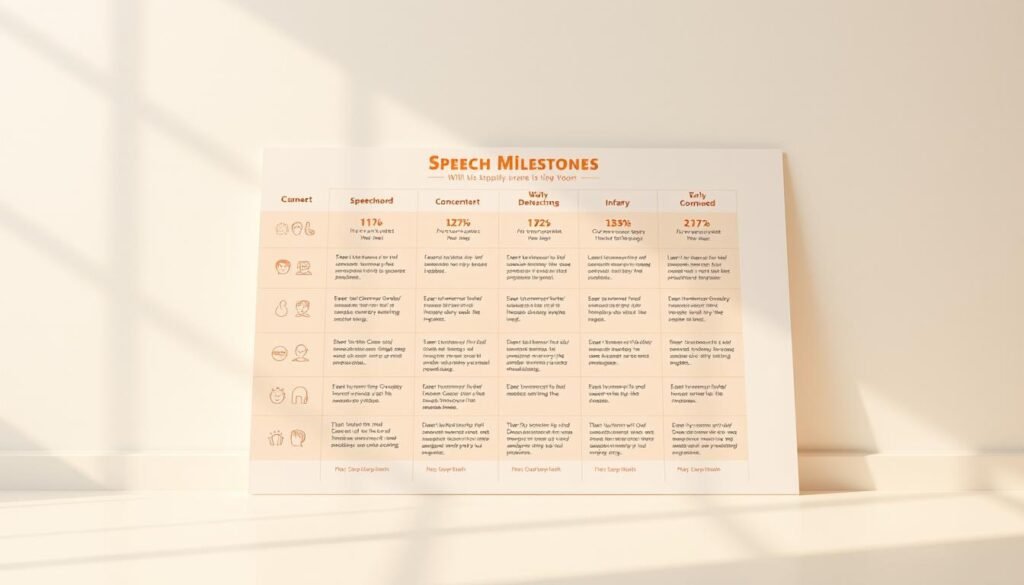
Communication starts at birth, with crying and noticing the world. Here’s what’s expected:
- Birth to 3 months: Babies know familiar voices and jump at loud noises
- 3-6 months: They start cooing, making eye contact, and responding with sounds
- 6-9 months: They start babbling with sounds like “mama” or “dada”
- 9-12 months: They point, wave, and communicate on purpose
- 12-16 months: They say their first real words
Early Signs of Communication in Infants
Before they say words, babies talk in other ways. They smile, reach for things, and use gestures. These skills are the start of speech.
Parents should watch if their baby responds to sounds, keeps eye contact, and gets excited about talking. Spotting delayed speech development means noticing these early signs. It’s about seeing both talking and non-talking ways of communicating in the first months.
Recognizing Autism Speech Delay
Spotting speech delays in kids with autism early can really help their growth. Parents and caregivers should watch for unusual speech patterns or missing language milestones. Knowing the signs of autism spectrum disorder speech helps families get the right help fast.
Common Patterns in Autism Spectrum Disorder Speech
Kids with autism often have unique speech traits. Some might start talking on time but then lose words. Others might know lots of words for objects but struggle to use them in social talks.
Echolalia, repeating words or phrases, is common in autism. Kids might repeat TV lines or questions instead of answering.

Many kids with autism have uneven language skills. They might know lots of words from books but struggle with simple requests. Some have big vocab on special topics but find everyday talk hard.
Differentiating Between Speech and Language Disorders
It’s key to know the difference between speech and language issues. Communication disorders are mainly divided into two types:
| Speech Disorders | Language Disorders | Common Signs |
|---|---|---|
| Difficulty producing sounds | Trouble understanding others | Unclear pronunciation |
| Problems with voice quality | Challenge expressing thoughts | Limited vocabulary use |
| Stuttering or hesitation | Difficulty following directions | Mixing up word order |
| Apraxia affecting sound sequences | Delayed grammar development | Frustration when communicating |
Kids with autism might face either or both speech and language challenges. Some struggle with the physical act of speaking, while others have trouble understanding social language. Developmental Language Disorder (DLD) can also happen with autism, making diagnosis and treatment more complex.
When to Seek Professional Evaluation
Parents should listen to their gut if they worry about their child’s speech. Look out for these signs of nonverbal autism:
- No babbling or pointing by 12 months
- Absence of single words by 16 months
- No two-word phrases by 24 months
- Loss of previously acquired language skills
- Limited eye contact during interactions
- Lack of response to their name
- Preference for solitary play over social engagement
The National Institute on Deafness and Other Communication Disorders supports research on communication disorders. Studies have found clear signs that help spot when a child needs help. Genetic research has also found links to language problems, helping us understand why some kids struggle.
Getting a child evaluated early can lead to better support. Speech-language pathologists can check language skills and find areas that need work. Early intervention can greatly improve a child’s future.
Early Intervention Strategies for Language Development
Early intervention is key for kids with delayed speech in toddlers or communication issues. Studies prove starting early helps a lot. Parents and caregivers are the main teachers, making their daily talks very important.
The Importance of Parent-Child Interaction
Talking every day is the base of language growth. It teaches new words and how to communicate. Parents should talk about what they do, describe what they see, and show feelings clearly.
Eye contact and closeness help kids learn from facial expressions and lip movements. When parents cheer on their child’s communication tries, kids feel their efforts are worth it. This makes them want to keep trying.
Creating a Language-Rich Environment
A rich language environment gives kids many chances to practice talking. Simple steps can make a big difference:
- Label objects during daily routines
- Sing songs and recite nursery rhymes
- Read books together every day
- Describe actions while playing
- Ask open-ended questions
Professional Speech Therapy Approaches
Speech-language pathologists offer special help through autism language therapy and more. They check communication skills and create plans just for each child. Speech therapy for autism uses games, pictures, and practice sessions. Many therapists also teach parents to help at home.
Encouraging First Words Through Daily Activities
Daily routines are great for helping kids with autism start talking. Simple tasks become learning chances when parents join in. They can make everyday moments teachable by pointing out interesting things.
Teaching kids with autism to talk involves naming things they like. Say “car” when they pick up a toy car. This links words to objects. Use simple words to describe what they do, like “You’re rolling the ball.”
| Daily Activity | Language Opportunity | Example Phrases |
|---|---|---|
| Mealtime | Food names and actions | “Apple,” “eat,” “yummy milk” |
| Bath time | Body parts and sensations | “Warm water,” “wash hands,” “bubbles pop” |
| Getting dressed | Clothing and sequence | “Red shirt,” “shoes on,” “zip up” |
| Outdoor play | Nature and movement | “Big tree,” “run fast,” “bird flying” |
Helping kids grow their vocabulary is easy. Turn baby sounds into real words. Say “Yes, that’s your bottle!” when they say “baba.” Using gestures helps them communicate in different ways.
The Role of Imitation and Repetition in Speech Learning
Children learn language by watching and copying what’s around them. The role of imitation and repetition is key in speech development, for kids with autism language delay too. These methods help kids see that sounds mean things and that talking follows patterns.
Modeling Speech Sounds and Words
Good modeling means building on what kids try to say. For example, if a child says “cat big,” parents can say, “Yes, that’s a big orange cat!” This way, kids learn the right way to talk without feeling judged. Parents should talk clearly, look at their child, and repeat important words during the day.
Turn-Taking in Conversations
Conversations need back-and-forth, which kids learn by doing. Start with simple sounds—when babies make sounds, respond with similar ones. This teaches the rhythm of talking. As kids get older, ask questions that need more than a yes or no answer. This helps them talk more and feel more confident.
Using Gestures to Support Communication
Gestures help connect non-verbal and verbal communication. Pointing, waving, and facial expressions all help with language. Kids often use gestures before they start talking. Parents should name what kids point to and show how gestures match words.
Communication Strategies for Non-Verbal Autism
Children with nonverbal autism have special challenges in sharing their needs and connecting with others. Research shows that about 25-30% of kids with autism don’t speak by age five. Each child learns differently, so it’s key to tailor communication strategies for them.
Learning about autism nonverbal signs is vital for support. Kids with non-verbal autism use behaviors, facial expressions, and body language to communicate. They might point to objects, make sounds for needs, or create their own gestures. Spotting these signs is the first step to helping them learn more.
Here are some effective ways to support kids with nonverbal autism:
- Picture Exchange Communication Systems (PECS) for asking for things
- Sign language with words to help them connect
- Speech-generating devices and apps for autism
- Visual schedules with pictures for daily plans
- Social stories with images for understanding situations
Research on brain plasticity shows amazing adaptability in those with communication differences. The brain can change to process information in new ways. This means using different senses in teaching can really help kids with non-verbal autism. Visual, tactile, and movement-based learning can reach their unique strengths.
Expanding Vocabulary Naturally Through Play and Exploration
Play is the best way for kids with autism to learn new words. They learn best when they’re doing something fun. This makes learning feel like an adventure, not a chore.
Parents can help their kids learn to talk without formal lessons. Just by playing together, they can support their child’s language growth.
Naming Objects of Interest
When your child plays, point out things they like. Say “truck” when they pick up a red one. Call bubbles “bubbles” while you blow them.
This method links words to real-life experiences. Start with simple words like “ball” or “dog.” As they get more comfortable, add more details like “big truck” or “pop bubbles.”
Describing Actions and Feelings
Playtime is full of chances to learn new words. Say things like “The ball rolls fast” or “The doll sleeps.” When your child feels something, say it out loud, like “happy” or “excited.”
Actions and feelings are both important. Use gestures and facial expressions to help them understand.
Using Books and Songs for Language Learning
Books and songs are great for learning new words. Simple songs like the ABC song teach letters. “Head, Shoulders, Knees, and Toes” teaches body parts through movement.
Picture books show kids familiar scenes. Point to words as you read to connect text with speech. Let them explore books in their own way, even if it means chewing on them.
Understanding Language Regression in Autism
Language regression in autism is a tough time for kids. They lose words they knew before. This usually happens between 15 and 24 months old. Parents see their child stop using words or not answer to their name anymore.
Genetic studies have found links between certain genes and autism language regression. Researchers at the National Institute on Deafness and Other Communication Disorders found specific genetic changes. These changes affect how kids develop and keep their language skills. This helps explain why some kids with autism spectrum disorder speech challenges have trouble with words.
- Loss of words or phrases
- Less eye contact
- Not responding to words
- Less social gestures
- Changes in babbling or sounds
Getting a professional check-up is important when you see regression. Speech-language pathologists can figure out how much is lost. They make plans to help the child. Early help can lessen the effect on talking skills later on. Knowing about regression helps parents and experts work together to help kids regain lost words.
Supporting Late-Talking Autistic Children
Supporting kids with late talking in autism means knowing they grow at their own pace. Some kids with autism might not start talking until they’re four or five. This is okay, as it’s part of the autism spectrum and doesn’t mean they won’t talk later.
Adapting Communication Methods
For late-talking autistic children, we often need to change how we talk to them. Using pictures, signs, or special devices can help. These tools let kids show what they know, even if they can’t speak yet. It helps them feel more confident and less frustrated.
Building on Existing Skills
Every child finds ways to communicate, even without words. Look for signs like pointing or making sounds. These are the first steps towards talking.
When we respond to these signs, we show them that talking works. This encourages them to keep trying.
| Current Skill | Next Step | Example Activity |
|---|---|---|
| Points to objects | Add simple sounds | Say “ba” for ball while pointing |
| Makes vowel sounds | Shape into words | Turn “ah” into “up” during play |
| Uses gestures | Pair with words | Wave while saying “bye-bye” |
Celebrating Small Progress Steps
Improvement in autism speech delay is often slow but important. Every new sound or gesture is a big deal. Keep track of these moments with videos or journals.
By celebrating each small victory, we keep our kids motivated. It also helps us see how far they’ve come, even if it’s not always obvious.
Managing Echolalia and Autistic Speech Patterns
Understanding echolalia is key to helping kids with unique speech patterns. Instead of seeing it as a problem, we now see it as a way to connect and learn. It’s a meaningful attempt at communication.
Children use echolalia for many reasons. Speech therapy now recognizes these reasons:
- Processing new language structures
- Self-soothing during stressful situations
- Expressing needs through familiar phrases
- Practicing social interactions
Speech-language pathologists are learning to understand echolalia better. They know it has two types: immediate and delayed. Each type has its own role in communication.
Immediate repetition helps kids process what they hear. Delayed echolalia, on the other hand, can express emotions or memories tied to certain phrases.
| Type of Echolalia | Communication Function | Response Strategy |
|---|---|---|
| Immediate Echo | Processing language | Pause, rephrase simply |
| Delayed Echo | Expressing emotions | Acknowledge feeling behind words |
| Functional Echo | Making requests | Model appropriate phrases |
Today, we focus on expanding communication options while respecting autistic speech patterns. This approach boosts confidence and encourages natural language growth. It doesn’t push for immediate changes.
Creating Effective Home-Based Language Activities
Turning daily moments into speech lessons can greatly help kids with autism. Parents can create learning experiences at home without spending a lot. These activities work best when they fit into daily life and play.
Interactive Reading Techniques
Reading together becomes more engaging when kids control the pace. Point to pictures and name objects to help them connect words with meanings. Let them turn pages and touch pictures. This lets them decide when to move on, respecting their focus and encouraging language.
Musical Activities for Speech Development
Songs can help when words are hard to say. Kids often sing words before they can speak them clearly. Use simple songs to teach:
- Basic concepts like colors and numbers
- Social language including friends’ and family members’ names
- Daily routine vocabulary through action songs
- Rhyming patterns that build phonological awareness
Making Personal Books About Your Child
Make photo books about your child’s life, favorite activities, and family. These books show that stories are about real life. Include photos of their morning routines, favorite toys, and places they like. Add simple text to describe each picture. Kids are often more interested in books about themselves, making these great for encouraging language.
Professional Resources and Speech Therapy Options
Looking for the right support for your child’s communication needs? Start by talking to a pediatrician. If you’re worried about your child’s speech, doctors can help. They can refer you to speech therapy for autism specialists.
These experts use proven methods to help kids with unique communication needs. They assess and support each child’s speech patterns.
A thorough professional evaluation includes several important steps:
- Standardized speech and language assessments
- Hearing screenings to check for any issues
- Watching how your child interacts socially
- Talking to parents about your child’s development
Speech-language pathologists decide if your child needs one-on-one or group therapy. They give you activities to practice at home. This helps create a consistent support system.
Many therapists now offer teletherapy. This makes pediatric speech services easier to get for families in remote areas.
There are many autism intervention resources available for families. The American Speech-Language-Hearing Association (ASHA) has checklists and directories. The National Institute on Deafness and Other Communication Disorders (NIDCD) has databases and research updates.
“Early intervention transforms possibilities into realities for children with communication differences.”
Research is always improving how we diagnose and treat communication issues. Studies show early speech therapy can help kids develop better communication skills. This research helps therapists create more effective plans for each child.
Conclusion
Helping kids with autism learn to talk needs patience and understanding. Every child grows at their own pace. Knowing this helps us support them better.
The early years are key for learning to communicate. We can help by talking to them a lot and making their world rich in language.
Getting a professional evaluation is important. It helps us figure out what each child needs. This way, we can use the right strategies to help them.
Every day, we can teach new words through play and reading. These moments are often more powerful than just sitting in a classroom.
Combining home activities with therapy works best. Reading, music, and special materials make learning fun. This helps kids learn to communicate better.
Parents who accept their child’s way of communicating make the most progress. Getting help from speech therapists keeps them on the right path.
Every small step forward is worth celebrating. Kids grow at different rates. We should support them, use professional help when needed, and celebrate their wins.
FAQ
What are the critical periods for language acquisition in children?
The first three years are key for learning speech and language. The brain is most ready to absorb language during this time. If not exposed to language, learning becomes harder.
FAQ
What are the critical periods for language acquisition in children?
The first three years are key for learning speech and language. The brain is most ready to absorb language during this time. If not exposed to language, learning becomes harder.
When should parents expect their child’s first words?
FAQ
What are the critical periods for language acquisition in children?
The first three years are key for learning speech and language. The brain is most ready to absorb language during this time. If not exposed to language, learning becomes harder.
FAQ
What are the critical periods for language acquisition in children?
The first three years are key for learning speech and language. The brain is most ready to absorb language during this time. If not exposed to language, learning becomes harder.
How can parents differentiate between speech disorders and language disorders?
FAQ
What are the critical periods for language acquisition in children?
The first three years are key for learning speech and language. The brain is most ready to absorb language during this time. If not exposed to language, learning becomes harder.
FAQ
What are the critical periods for language acquisition in children?
The first three years are key for learning speech and language. The brain is most ready to absorb language during this time. If not exposed to language, learning becomes harder.
What are early signs of autism-related speech delay?
FAQ
What are the critical periods for language acquisition in children?
The first three years are key for learning speech and language. The brain is most ready to absorb language during this time. If not exposed to language, learning becomes harder.
FAQ
What are the critical periods for language acquisition in children?
The first three years are key for learning speech and language. The brain is most ready to absorb language during this time. If not exposed to language, learning becomes harder.
How important is parent-child interaction for speech development?
FAQ
What are the critical periods for language acquisition in children?
The first three years are key for learning speech and language. The brain is most ready to absorb language during this time. If not exposed to language, learning becomes harder.
FAQ
What are the critical periods for language acquisition in children?
The first three years are key for learning speech and language. The brain is most ready to absorb language during this time. If not exposed to language, learning becomes harder.
What communication strategies work best for nonverbal autism?
FAQ
What are the critical periods for language acquisition in children?
The first three years are key for learning speech and language. The brain is most ready to absorb language during this time. If not exposed to language, learning becomes harder.
FAQ
What are the critical periods for language acquisition in children?
The first three years are key for learning speech and language. The brain is most ready to absorb language during this time. If not exposed to language, learning becomes harder.
How can parents encourage first words in children with speech delays?
FAQ
What are the critical periods for language acquisition in children?
The first three years are key for learning speech and language. The brain is most ready to absorb language during this time. If not exposed to language, learning becomes harder.
FAQ
What are the critical periods for language acquisition in children?
The first three years are key for learning speech and language. The brain is most ready to absorb language during this time. If not exposed to language, learning becomes harder.
What role does play serve in expanding vocabulary naturally?
FAQ
What are the critical periods for language acquisition in children?
The first three years are key for learning speech and language. The brain is most ready to absorb language during this time. If not exposed to language, learning becomes harder.
FAQ
What are the critical periods for language acquisition in children?
The first three years are key for learning speech and language. The brain is most ready to absorb language during this time. If not exposed to language, learning becomes harder.
When should parents seek professional evaluation for speech concerns?
FAQ
What are the critical periods for language acquisition in children?
The first three years are key for learning speech and language. The brain is most ready to absorb language during this time. If not exposed to language, learning becomes harder.
How should parents respond to echolalia in autistic children?
FAQ
What are the critical periods for language acquisition in children?
The first three years are key for learning speech and language. The brain is most ready to absorb language during this time. If not exposed to language, learning becomes harder.
FAQ
What are the critical periods for language acquisition in children?
The first three years are key for learning speech and language. The brain is most ready to absorb language during this time. If not exposed to language, learning becomes harder.
What are effective home-based language activities for speech delay?
FAQ
What are the critical periods for language acquisition in children?
The first three years are key for learning speech and language. The brain is most ready to absorb language during this time. If not exposed to language, learning becomes harder.
FAQ
What are the critical periods for language acquisition in children?
The first three years are key for learning speech and language. The brain is most ready to absorb language during this time. If not exposed to language, learning becomes harder.
How do screens affect language development in young children?
FAQ
What are the critical periods for language acquisition in children?
The first three years are key for learning speech and language. The brain is most ready to absorb language during this time. If not exposed to language, learning becomes harder.
FAQ
What are the critical periods for language acquisition in children?
The first three years are key for learning speech and language. The brain is most ready to absorb language during this time. If not exposed to language, learning becomes harder.
What communication milestones should parents monitor in autism?
FAQ
What are the critical periods for language acquisition in children?
The first three years are key for learning speech and language. The brain is most ready to absorb language during this time. If not exposed to language, learning becomes harder.
FAQ
What are the critical periods for language acquisition in children?
The first three years are key for learning speech and language. The brain is most ready to absorb language during this time. If not exposed to language, learning becomes harder.
How can music support autism language therapy?
FAQ
What are the critical periods for language acquisition in children?
The first three years are key for learning speech and language. The brain is most ready to absorb language during this time. If not exposed to language, learning becomes harder.
FAQ
What are the critical periods for language acquisition in children?
The first three years are key for learning speech and language. The brain is most ready to absorb language during this time. If not exposed to language, learning becomes harder.
What are early intervention autism speech strategies?
FAQ
What are the critical periods for language acquisition in children?
The first three years are key for learning speech and language. The brain is most ready to absorb language during this time. If not exposed to language, learning becomes harder.
FAQ
What are the critical periods for language acquisition in children?
The first three years are key for learning speech and language. The brain is most ready to absorb language during this time. If not exposed to language, learning becomes harder.



[…] Building Social Communication SkillsSupporting Speech Development […]
[…] Building Social Communication SkillsSupporting Speech Development […]
[…] feelings. Regular sessions mean more chances to get praised and build positive ways of thinking. Supporting Speech DevelopmentBuilding Social Communication […]
[…] to meet. This team approach supports the child’s mental health and gets them ready for therapy. Supporting Speech DevelopmentBuilding Social Communication […]