


Some students handle classroom changes easily. Others feel stressed during simple routine shifts. School transitions autism reveals unique challenges for children on the spectrum. These stem from how they process change and sensory information.
Experts identify two types of transitions: daily activity shifts and major developmental changes. Predictability is key, as transitions make up 25% of a student’s day. Autistic learners process these changes differently than their peers.
Challenges go beyond resisting change. Sensory processing and executive function differences create real barriers. However, these moments can help develop skills with proper support.
Autism education supports are essential for educational access. They’re not just accommodations. The following sections offer evidence-based strategies and collaborative frameworks.
These strategies honor each student’s unique learning profile. Effective transition planning considers individual needs while using proven techniques.
Key Takeaways
- Transitions include daily shifts and major educational changes, taking up 25% of a student’s day
- Autistic students experience transitions differently due to neurological variations
- Special education transitions are fundamental for educational access
- Research-based strategies focus on predictability and routine to reduce anxiety
- Successful support requires collaboration between educators, families, and specialists
- Neurodiversity-affirming approaches see transitions as skill-building opportunities
Understanding Why School Transitions Challenge Autistic Students
Autistic students face unique challenges during school transitions. Their brains process change differently than their peers. Research shows that autistic individuals often struggle with routine changes and environmental shifts.
These challenges stem from neurological differences, not behavioral issues. Multiple factors combine to create difficulties for students on the spectrum. This understanding helps develop better transition strategies.

The Neurological Basis of Transition Difficulties
Transition challenges are rooted in executive functioning differences. These affect cognitive flexibility and set-shifting abilities. Autistic individuals often show distinct prefrontal cortex development patterns.
Cognitive flexibility is the brain’s ability to adapt to new situations. For autistic students, this process requires more mental effort. Their brains struggle to disengage from established patterns.
Predictive processing differences add to these challenges. Autistic brains focus on details rather than making predictions. This makes transitions feel new and potentially threatening.
Restrictive behaviors serve as protective functions for autistic individuals. These patterns provide structure in an overwhelming world. Disrupting them during transitions triggers stress responses.
Common Triggers During School Changes
School changes present various triggers for autistic students. These include environmental, social, and sensory factors. Understanding these triggers allows for better support.
Environmental triggers involve changes in physical spaces. New classroom layouts or building locations can be disruptive. Lighting, sound, and temperature changes also create challenges.
Schedule changes are particularly difficult. Predictable routines help autistic students prepare mentally. Unexpected changes or special events can cause anxiety.
| Trigger Category | Specific Examples | Neurological Impact | Observable Responses |
|---|---|---|---|
| Environmental Changes | Classroom relocation, building modifications, furniture rearrangement, lighting differences | Disrupts spatial mapping and navigation systems in hippocampus | Disorientation, increased anxiety, avoidance behaviors, longer transition times |
| Social Modifications | New teachers, changing peer groups, unfamiliar support staff, different communication styles | Elevates social cognition demands, increases uncertainty in social prediction | Withdrawal, selective mutism, increased stimming, social exhaustion |
| Sensory Alterations | Noise level changes, temperature variations, different scents, tactile experiences | Overwhelms sensory processing capacity, triggers fight-flight-freeze response | Covering ears, seeking quiet spaces, meltdowns, sensory avoidance |
| Routine Disruptions | Schedule changes, unexpected events, modified procedures, altered sequences | Eliminates predictive framework, increases cognitive load exponentially | Verbal protests, rigidity, emotional dysregulation, task refusal |
Social triggers arise from changes in people and groups. New teachers require adapting to different communication styles. Peer group changes disrupt established friendships.
Sensory triggers occur during transitions between environments. Hallways can be noisy and crowded. Moving from quiet to noisy activities creates jarring contrasts.
Impact on Learning and Behavior
Transition difficulties can lead to visible behavioral changes. Stimming behaviors help autistic students manage stress. Withdrawal is another common response to overwhelming transitions.
Meltdowns and shutdowns occur when coping abilities are exceeded. These responses indicate depleted neurological and emotional resources. Recovery time and support are essential.
Long-term academic consequences can accumulate over time. Transition stress reduces available cognitive resources for learning. Students may be physically present but emotionally unavailable for instruction.
Repeated difficulties can lead to reduced engagement. Students may avoid new activities due to stress. This limits educational experiences and social development.
Chronic transition-related anxiety affects overall functioning. It can impact sleep, appetite, and emotional regulation. Students may show increased irritability or regression in skills.
Research shows that negative impacts can be prevented. Careful planning and preparation can increase predictability around transitions. This approach reduces transition time and improves behavioral responses.
Understanding transition difficulties as neurological differences changes the educational approach. It shifts focus from behavior management to environmental modification. This fosters compassionate support systems that address autistic students’ needs effectively.
Types of School Transitions Autism Students Face
Autistic learners face various school transitions. These range from daily classroom shifts to major educational changes. Educators classify transitions as “little t” for daily activities and “big T” for life-changing events. This helps tailor support for autistic students.
Transition preparation depends on its scale. Daily shifts need brief cues. Major changes require months of planning. This approach addresses specific demands of each transition type.
Daily Classroom Transitions
Autistic students navigate many transitions daily. These shifts create a hidden cognitive load. A typical school day has 15-20 transitions, including subject changes and specialized services.
Each shift demands mental flexibility and impulse control. These are often challenging for autistic individuals. Constant changes can lead to stress throughout the day.
School routine changes autism students face require ongoing mental effort. Moving between services adds complexity. Students must adapt to new expectations and groups quickly.
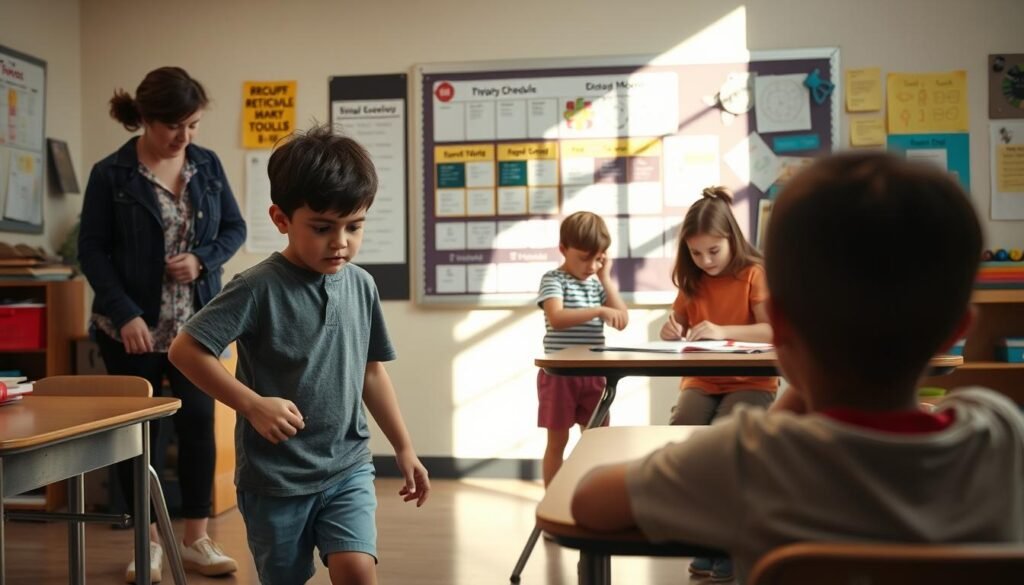
Unstructured transitions like lunch and recess are especially demanding. They combine sensory overload with unclear social rules. Cafeterias are noisy with complex food choices. Recess lacks structure and has unpredictable situations.
Moving Between Grades
Moving between grades brings significant changes for autistic students. New teachers, classroom setups, and peer groups create adaptation challenges. Even in familiar schools, these changes can be difficult.
Teacher expectations increase with each grade level. Students need more independence and social skills. This can widen the gap between expectations and student abilities.
Classroom layouts change as students progress. Upper grades have less structure and more abstract work. These shifts can disrupt helpful routines for autistic students.
Changing Schools or Districts
Moving to new schools disrupts multiple aspects of a student’s life. It changes physical spaces, rules, and social connections. Autistic students lose predictability they rely on daily.
New school buildings require complete re-learning of layouts and procedures. Even small differences in routines can cause uncertainty about proper behavior.
Transferring special education services between districts is complex. IEPs may be interpreted differently. New staff need time to understand the student’s needs.
Elementary to Middle School Progression
Middle school brings major changes in structure and expectations. Students now have different teachers for each subject. This replaces the consistency of elementary school’s single-classroom model.
Managing multiple teachers means adapting to various styles and rules. Students must remember different expectations for each class. They also navigate between classrooms with tight time limits.
Middle school demands more independence from students. They must manage lockers, organize materials, and follow complex schedules. This coincides with challenging social changes in early adolescence.
The social landscape becomes more complex in middle school. Peer groups are more exclusive. Lunch and passing periods involve crowded, noisy spaces. There’s pressure to conform and understand unspoken social rules.
Academic demands increase significantly in middle school. Work becomes more abstract and requires independent thinking. Long-term projects need sustained planning. These challenges often arise when previous supports are removed.
Building an Effective Autism School Transition Plan
Successful school transitions need careful planning. An autism school transition plan guides students through educational changes. It should start early and involve schools, educators, agencies, and parents.
Each plan must fit the student’s unique needs. Good planning increases predictability and routine. Strategies should be tailored to individual students, not applied uniformly.
Essential Components of a Transition Plan
Transition plans address both environment and student needs. The environmental assessment looks at current and future settings. It checks layouts, sensory features, social dynamics, and teaching methods.
A inventory of student strengths and support needs is crucial. It notes communication styles, sensory issues, and coping strategies. Understanding current supports helps plan new accommodations.
Plans identify potential challenges in the new environment. These might include:
- Sensory differences between environments (lighting, noise levels, spatial organization)
- Changes in daily schedules or routine structures
- New social expectations or peer interaction requirements
- Alterations in teaching styles or instructional delivery methods
- Modified academic demands or performance expectations
The plan must detail specific strategies for each need. It should explain how to implement each strategy. It must name who’s responsible and what resources are needed.
Roles and responsibilities should be clearly defined. The plan should name specific people and their duties. It should establish ways to ensure follow-through.
Communication protocols are essential. They specify how information will be shared between teams. They set frequency, methods, and ways to keep parents and students informed.
The plan must set success criteria and monitoring mechanisms. These define what success looks like for the student. They establish how progress will be measured.
Timeline for Transition Planning
Planning timelines vary based on the type of change. Different transitions need different preparation times. Daily classroom transitions need immediate structuring and ongoing support.
Grade-level transitions within a school need three to six months of prep. This allows for classroom visits and meetings with new teachers. It helps prepare coping strategies.
Changes between schools need six months to one year of planning. This allows for coordinating between systems and building new relationships. It provides time for the student to get familiar with the new environment.
The planning timeline should include specific milestones and activities:
| Planning Phase | Timeline | Key Activities | Responsible Parties |
|---|---|---|---|
| Initial Information Gathering | 6-12 months before transition | Environmental assessments, needs inventories, team formation, preliminary meetings | Current educators, parents, specialists |
| Plan Development | 4-8 months before transition | Strategy specification, accommodation design, timeline creation, role assignment | Collaborative team including student input |
| Preparation Implementation | 2-6 months before transition | Environmental familiarization, social stories introduction, skill building, practice visits | Current educators, parents, future educators |
| Post-Transition Monitoring | First 3 months after transition | Progress assessment, strategy adjustment, communication maintenance, support refinement | New educational team, parents, support specialists |
This approach ensures systematic planning while staying flexible. It allows for adjustments based on student readiness and emerging needs.
Involving the Student in Planning Decisions
Effective transitions involve autistic students’ perspectives and preferences. Student involvement improves plan effectiveness and builds self-advocacy skills. It helps students feel more in control during uncertain times.
For young children, preference assessments gather input appropriately. These might use visual choice boards or structured observations. They can help identify what makes children feel comfortable and successful.
Elementary students can participate in simplified planning discussions. These should present options visually and allow expression of preferences. Questions should be concrete and specific.
Middle school students can contribute more to planning. They can identify support needs and share what worked in past transitions. Their involvement should be structured to avoid overwhelming them.
High school students should participate as full team members when possible. This prepares them for adult life. It helps them learn to advocate for their needs.
Student involvement should match communication preferences. Some students communicate best through writing, others visually or verbally. The planning process should accommodate these differences.
Research shows student contribution improves transition success. Students who understand their supports are more likely to use them effectively.
Creating an IEP for School Transition Autism Support
Effective IEP transition planning creates specific, measurable actions for each autistic student’s needs. It ensures support continuity across educational changes. The IEP is more than a document; it’s a legally binding commitment.
A comprehensive iep for school transition autism focuses on skills, accommodations, and collaboration. It turns abstract ideas into concrete interventions. This plan guides educators, families, and students through significant changes.
Transition-specific elements in the IEP keep support consistent as settings change. It addresses immediate needs and long-term skill development. This approach creates systems that adapt to student needs over time.
Establishing Measurable Goals for Transition Success
Good transition goals in iep transitions for autistic students specify observable behaviors. These objectives must be measurable and address real challenges. Goals should be ambitious yet achievable.
Transition-focused goals target skills for navigating change. For example, a student might learn to follow a visual schedule independently. Another goal could be using coping strategies during transition-related anxiety.
Goals should also include requesting support during stressful transitions. An elementary student might use a card to ask for breaks. A middle schooler could practice advocating for accommodations in new classrooms.
Transition-focused goals directly address movement between activities or settings. Transition-supportive goals build skills that indirectly help with transitions. These include social skills and emotional regulation.
| Age Level | Transition Goal Example | Measurement Criteria | Timeline |
|---|---|---|---|
| Elementary (K-5) | Student will follow visual schedule independently during classroom transitions | 4 out of 5 daily transitions with minimal prompting | 12 weeks |
| Middle School (6-8) | Student will navigate between classes using digital schedule app | Arrive at correct classroom within 5 minutes for 90% of class changes | First semester |
| High School (9-12) | Student will implement self-selected coping strategy during schedule changes | Demonstrate appropriate strategy use in 4 out of 5 unstructured transitions | Academic year |
| Cross-Age Application | Student will request break when experiencing transition-related stress | Appropriate communication of need in 75% of identified trigger situations | Ongoing with quarterly review |
Documenting Accommodations and Implementation Details
The IEP’s accommodations section turns support concepts into actionable commitments. It must answer: what, when, where, how, and who for each accommodation. This detail prevents gaps in support.
Advance warning systems need precise specifications. For example: “Student gets 5-minute and 2-minute verbal warnings before all classroom transitions. Teachers or aides deliver these throughout the school day.”
Visual schedule access in iep for school transition autism planning needs similar detail. Specify format, location, update frequency, and who maintains it. This clarity ensures consistent implementation.
Sensory accommodations during transitions require comprehensive descriptions. For example, an IEP might allow noise-canceling headphones between classes. It should clarify storage, use permissions, and any limitations.
Modified expectations during adjustment periods are crucial after major transitions. The IEP might allow extended transition time and reduced group participation. These temporary changes acknowledge transition’s cognitive load while maintaining engagement.
Facilitating Coordination Across Educational Settings
Transitions between schools or levels require coordination to maintain support. This process needs structured communication protocols. Joint planning meetings help teams understand student needs before transitions occur.
Information sharing balances comprehensive communication with confidentiality and time constraints. Transition meetings review accommodations, discuss strategies, and identify environmental factors. These should happen months before transitions to allow preparation time.
Gradual transition procedures benefit from explicit IEP documentation. For example, a student moving to middle school might visit the new building. The IEP specifies visit frequency, duration, and staff involvement.
Post-transition follow-up needs clear assignment to prevent gaps. The IEP should designate who monitors adjustment and communicates concerns. A timeline for check-ins creates accountability for ongoing support.
Overcoming coordination barriers requires proactive problem-solving. Schools can use liaison positions or virtual meetings to address scheduling conflicts. Teams should discuss expectations to ensure shared understanding across different environments.
The IEP is a living document that evolves with student needs. Regular review ensures transition supports remain relevant and effective. This adaptive approach makes iep transition planning a dynamic process supporting long-term success.
Implementing Visual Schedules Autism Classroom Strategy
Visual schedules are vital tools for autistic students in classrooms. They turn abstract time concepts into concrete formats students can use independently. These supports help autistic students understand activity sequences and durations throughout the school day.
Research shows visual schedules reduce transition time and increase predictability. They create a framework for navigating complex social and academic settings. These tools build temporal reasoning skills and reduce anxiety about uncertainty.
When used well, visual schedules help autistic students prepare for changes. They also develop self-management skills that extend beyond the classroom.
Visual schedules used in home and school settings can help decrease transition time. It is important to assess how much information each child needs—some children may transition well knowing the full day routine, while others need activity-to-activity schedules.
Designing Effective Visual Schedules
Creating good visual schedules requires careful thought about each student’s needs. Educators must decide how much detail to include for each student. Some learners need full-day schedules, while others do better with simpler next-step information.
The type of visuals used is another key decision. Options include photos, drawings, icons, or written words. The choice should match the student’s visual processing style and skills.
The time frame covered is also important. Schedules can show hours, subjects, or step-by-step activities. The best format depends on the student’s needs and classroom structure.
Consistency in schedule design helps students use them more easily. Regular schedule reviews create helpful routines. Morning reviews prepare students for the day ahead. End-of-day reviews build awareness of what happened.
Visual clarity is crucial for schedules to be helpful. High contrast and proper spacing make schedules easier to read. Durable materials allow students to handle schedules frequently.
Digital vs. Physical Visual Supports
Digital and physical schedules each have unique benefits. The best choice depends on student needs, classroom resources, and family preferences. Digital schedules are flexible and easy to change quickly.
They can include videos, sounds, and interactive elements. Many apps also track schedule completion. Digital schedules work well across different devices and settings.
Physical schedules don’t need technology to work. Many autistic students prefer schedules they can touch and move. Physical schedules provide sensory feedback that some learners find calming.
| Feature | Digital Visual Schedules | Physical Visual Schedules |
|---|---|---|
| Flexibility | Immediate real-time updates; easy modifications without recreating materials | Requires manual changes; time investment to update components |
| Accessibility | Depends on device availability, charging, and technical function; may fail unexpectedly | Always available; no technical dependencies; functions in any environment |
| Sensory Engagement | Visual and auditory through screen and sound; limited tactile interaction | Strong tactile component; physical manipulation provides sensory feedback |
| Portability | Accessible across multiple devices; cloud synchronization enables consistency | Requires creating duplicate versions or carrying single version between locations |
| Cost Considerations | Requires devices and potentially subscription fees for applications | Low-cost materials; primarily staff time investment for creation |
Many classrooms use both digital and physical schedules. This approach combines the strengths of both types. Students might use detailed digital schedules in fixed spots and simpler physical ones when moving around.
Practicing Schedule Changes Before Transitions Occur
The best use of visual schedules helps students prepare for changes. This turns schedules into teaching tools that build transition skills. Schedule rehearsals let students practice new routines before they happen.
For big changes, teachers can guide students through new sequences using their schedules. This practice creates memories that make real transitions easier. Special markers can highlight schedule changes.
First-Then schedules help manage transitions between less-liked and more-liked activities. They show that doing a hard task leads to a fun one. Visual countdowns show how many activities or how much time is left.
Portable schedules help students use their skills in different places. Carrying and checking schedules builds independence. Fixed schedules in central locations create helpful routines for some students.
Teachers should watch how students use schedules and adjust as needed. This ensures visual supports grow with student skills. It builds self-management abilities that support long-term success in school.
Using Social Stories for School Transitions
Social stories help autistic students understand school transitions. They turn complex changes into easy-to-follow steps. These stories describe situations that may confuse children with autism spectrum disorder.
These tools reduce anxiety by previewing upcoming changes. Students learn about new environments and routines before they happen. This approach is widely used for autism-friendly school changes.
Writing Personalized Social Stories
Creating effective transition stories starts with assessing the specific context. Educators must identify elements that might confuse or worry the student. This involves gathering information about the transition, including environments, people, and schedules.
Social stories use four sentence types. Descriptive sentences state facts. Perspective sentences describe others’ thoughts. Directive sentences suggest responses. Affirmative sentences express shared values.
Good stories balance preparation with reassurance and coping strategies. They acknowledge that changes may feel uncomfortable. For example, a story about middle school might address crowded hallways and finding classrooms.
Personalization makes stories more effective. A train-loving student might see transitions as “stations”. A fact-oriented student might prefer precise details about procedures.
| Story Component | Purpose | Example for Classroom Change |
|---|---|---|
| Descriptive Sentences | Provide factual information about the situation | “Next month, I will have a new classroom in Room 204 with Ms. Johnson as my teacher.” |
| Perspective Sentences | Explain thoughts and feelings of others | “Ms. Johnson is excited to meet new students. She wants everyone to feel welcome.” |
| Directive Sentences | Suggest appropriate responses or actions | “I can visit the new classroom before the first day. I can ask questions if I feel confused.” |
| Affirmative Sentences | Express shared values and reassurance | “Many students feel nervous about new classrooms. It is okay to take time to adjust.” |
When to Introduce Social Stories
Social stories work best when introduced several weeks before major transitions. This timing allows students to process information and ask questions. For big changes like moving schools, introducing stories 3-4 weeks ahead is effective.
Some students benefit from longer preparation periods. They might need stories 6-8 weeks before transitions. Others may feel anxious with too much notice. For them, 1-2 weeks of preparation works better.
Unexpected changes require immediate story introduction. Quick stories help students adapt to sudden disruptions in school routines.
Reviewing and Reinforcing Story Concepts
Social stories need repeated readings to be effective. Daily reviews over weeks help students understand and apply the content. This repetition moves information from short-term to long-term memory.
Review schedules depend on the transition’s complexity. For major changes, daily readings starting three weeks before work well. Minor changes might need daily reviews for 5-7 days.
Keeping students engaged during reviews requires creative strategies. Varying the reading format and adding interactive elements can maintain interest. Asking questions and observing spontaneous references indicate successful learning.
Age-Appropriate Story Adaptations
Social stories should evolve with a child’s age. Young children benefit from simple, picture-based stories with minimal text. These might be 4-6 pages long, focusing on concrete aspects.
Elementary students can handle longer stories with more text. These might be 8-12 pages with 2-4 sentences per page. Visual supports remain important, but real photos often work better.
Teenagers may prefer text-based narratives that look like guides. These can be detailed and address complex social dynamics. Some teens respond well to first-person stories that feel more mature.
Sensory Supports During Transitions
Autistic students can feel overwhelmed by sensory changes during school transitions. These changes can affect learning, social skills, and emotions. New classrooms present unique challenges beyond different teachers or schedules. Sensory supports during transitions address these hidden barriers to smooth educational changes.
Research shows children with sensory processing differences struggle with environmental transitions. They experience more stress from changes that neurotypical peers handle easily. These students need special help to adapt, not just time.
Identifying Sensory Triggers in New Environments
Thorough sensory assessments are key for effective sensory accommodations for school changes. This means examining current and future settings across all senses. It’s important to consider each student’s unique sensory profile.
Sounds are often challenging during transitions. New places may have different noise levels, announcements, and alarms. A quiet elementary classroom is very different from a busy middle school hallway.
Visual elements also need careful assessment. Lighting, clutter, and colors can vary greatly between classrooms and buildings. These differences impact students with visual sensitivities.
Tactile factors include temperature, air flow, and furniture materials. Students may encounter new desk surfaces, chairs, and flooring types. These changes can affect physical comfort throughout the day.
Smells often get overlooked in transition planning. Cleaning products, food odors, and personal care items create distinct sensory experiences. These scents can cause discomfort or distress.
The assessment process should document:
- Specific sensory characteristics of current and future environments across all modalities
- Student’s known sensory preferences, sensitivities, and aversions based on sensory profile assessments
- Potential sensory conflicts between student needs and new environment characteristics
- Opportunities for sensory accommodations or environmental modifications
- Times of day or specific locations where sensory demands may peak
This approach prevents assumptions about what might challenge a student. Individual sensory profiles vary significantly. Thorough assessment ensures accommodations address actual needs, not presumed ones.
Creating a Sensory Toolkit
Personal sensory toolkits help students manage transitions independently. These kits contain items chosen for each student’s needs. They provide quick access to calming tools when needed.
Effective sensory toolkits typically include items addressing multiple sensory modalities:
- Auditory protection: Noise-reducing headphones, earplugs, or noise-canceling options appropriate for classroom use
- Tactile input tools: Fidget items, textured objects, stress balls, or discrete manipulatives that provide calming tactile feedback
- Visual supports: Sunglasses for light sensitivity, colored overlays for reading materials, or visual focusing tools
- Oral sensory input: Chewable jewelry, gum (if permitted), water bottles with specialized tops, or other approved oral motor items
- Proprioceptive input: Weighted lap pads, compression items, or resistance bands for discrete physical input
- Olfactory supports: Preferred scents in appropriate formats for grounding and calming
Consider age-appropriateness and social acceptability when choosing tools. Older students may resist items that seem childish or draw attention. Check school policies for sensory tools in advance.
Teaching students to recognize their sensory needs is crucial. This self-awareness helps them select appropriate tools independently. It supports long-term success as they encounter new environments throughout school.
Establishing Sensory-Friendly Spaces
Schools need designated sensory-friendly spaces for transition periods. Creating a sensory-friendly school environment requires thoughtful design and fair access policies. These spaces offer refuge and help students practice self-regulation.
Quiet Zones and Break Areas
Quiet zones provide low-stimulation environments. They contrast with typical classroom and hallway intensity. Effective quiet zones reduce sound, light, and social input while maintaining safety.
Design quiet zones with dimmer switches, sound-dampening materials, and minimal visual clutter. Include comfortable seating options for different preferences. Create clear but flexible access guidelines that empower students.
Sensory Equipment and Tools
Dedicated sensory equipment enhances regulation in these spaces. Research-supported tools provide specific input that reduces stress. Choose equipment based on your students’ unique sensory needs.
| Equipment Category | Specific Tools | Sensory Function | Transition Application |
|---|---|---|---|
| Deep pressure input | Weighted blankets, compression vests, body socks | Calming proprioceptive feedback | Reduces anxiety during school changes |
| Vestibular input | Rocking chairs, therapy swings, balance equipment | Organizing movement feedback | Supports regulation after schedule disruptions |
| Visual regulation | Dimmed lighting, bubble tubes, fiber optic lights | Calming visual focus | Provides respite from visually complex new environments |
| Tactile exploration | Sensory bins, textured materials, manipulatives | Organizing tactile feedback | Offers familiar sensory experiences during transitions |
Remember, sensory accommodations are essential access needs, not special privileges. Autistic students process environmental information differently. Sensory supports enable them to access education during significant changes.
Effective sensory support requires teamwork between therapists, teachers, families, and students. This approach ensures accommodations address real barriers. It also promotes independence as students learn to manage their own sensory needs.
Reducing Transition Anxiety Autism Through Preparation
Advance preparation is crucial for autistic students facing school transitions. It helps minimize distress and supports successful adjustment. Research shows that anticipatory anxiety often causes more problems than the transitions themselves.
Preparation acts as a therapeutic intervention targeting anxiety related to educational changes. Wyoming research suggests starting preparation well before expected transitions. Gradual familiarization significantly reduces stress responses and speeds up post-transition adaptation.
Pre-Visit Strategies and School Tours
Physical visits to new schools greatly reduce anxiety for autistic students. These orientation visits help students get comfortable with unfamiliar environments. The success of pre-visits depends on careful planning and student-paced implementation.
Multiple visits of increasing duration are more effective than single rushed orientations. Initial visits might last 15-20 minutes, focusing on entering the building and finding key areas.
Effective pre-visit protocols include several important elements. Visits should be scheduled during quiet times to reduce sensory overload. Structured agendas should introduce key locations systematically to prevent aimless wandering.
Documenting visits is essential for extending their benefits. Photos or videos of important places provide materials for review at home. Students can study these images to reinforce mental maps before navigating independently.
Countdown calendars are useful visual tools for preparing for school transitions. They create a predictable progression to the first day. Wyoming research shows that adding pictures and stories about new schools enhances their effectiveness.
Virtual Tours and Photo Books
Virtual tour videos offer walkthrough experiences that students can review repeatedly. These work best when they follow consistent paths and include narration explaining each location.
Personalized photo books showing daily routines and key locations help bridge the gap between virtual and physical reality. These books should sequence photos as students will encounter locations during typical school days.
Google Maps street view lets students study school exteriors and surrounding areas. This familiarization includes parking areas, entry points, and neighborhood context. Video introductions from future teachers personalize the experience.
Virtual familiarization offers unlimited review opportunities. Students can revisit materials as often as needed without scheduling constraints. They control the pacing entirely, pausing or rewatching sections that raise questions.
However, virtual approaches have limitations. They can’t replicate sensory experiences like acoustics or lighting. Virtual tours work best as supplements to physical visits, not complete replacements.
Meeting New Teachers and Staff in Advance
Meeting future teachers and staff in advance greatly reduces anxiety during educational transitions. These early connections transform unknown authority figures into familiar individuals. This decreases social uncertainty that adds to transition stress.
Email or video introductions allow for initial contact that suits different communication preferences. Teachers can share information about their teaching style and expectations. Students and families can provide details about learning needs and preferences.
Brief meet-and-greet sessions during pre-visits offer low-pressure chances for in-person connections. The goal is to establish recognition and basic comfort, not build comprehensive relationships.
Sharing student profiles helps new teachers understand individual students before classroom encounters. These profiles might include communication preferences, sensory sensitivities, and effective support strategies.
Staff introductions should include specialists, administrators, and other personnel students will regularly encounter. Early childhood research shows that families who understand developmental needs can better support transitions.
| Preparation Strategy | Implementation Timeline | Primary Benefits | Best Used For |
|---|---|---|---|
| Physical School Visits | 2-3 months before transition with multiple visits | Actual sensory familiarization, spatial mapping, genuine environmental exposure | Local transitions, elementary to middle school, within-district changes |
| Virtual Tours and Photo Books | 1-3 months before transition with unlimited review access | Repeated review opportunities, student-paced exploration, accessible anytime | Long-distance moves, summer transitions, supplementing physical visits |
| Advance Staff Meetings | 4-6 weeks before transition with follow-up contacts | Relationship initiation, reduced social uncertainty, personalized planning | All transition types, especially beneficial for anxious students |
| Countdown Calendars with Visuals | Ongoing from announcement through transition completion | Time comprehension support, predictability enhancement, anticipation management | Students with time concept difficulties, high anxiety, need for concrete progression |
Preparing for transitions is key to reducing anxiety in autistic students. Evidence shows that well-prepared students adjust more smoothly and engage faster academically. Time spent on preparation is not a burden, but a foundation for positive outcomes.
Classroom Transition Strategies Autism Educators Should Use
Effective classroom transitions are crucial for autistic students’ learning. They create predictable environments and demonstrate responsive teaching. Educators can use evidence-based approaches to support successful transitions for all students.
These strategies help make transitions manageable parts of daily learning. They’re especially important for autistic learners who process changes differently than their peers.
Establishing Consistent Routines and Predictability
Predictable daily structures are key for transition success. They reduce uncertainty and allow students to focus on learning. Consistent routines help autistic students know what to expect.
Effective autism classroom strategies include standard transition sequences. These should remain constant across days. Use the same order for morning activities, subject sequences, and dismissal routines.
Use consistent transition language and cues. These signals help students recognize what’s coming next. Identical phrases for specific transitions create verbal anchors students can rely on.
Standard procedures help students develop memory for classroom movements. This builds competence and confidence. Students can eventually execute these sequences without repeated directions.
Consistency provides security for autistic students. This enables greater flexibility over time. Students who trust their environment can handle necessary schedule changes better.
Explicit communication about changes is essential. Announce modifications in advance. Explain reasons when appropriate. Preview what the altered schedule will involve.
Transition Warnings and Visual Timers
Temporal supports make abstract time concepts concrete. They provide advance notice for upcoming changes. This addresses autistic students’ difficulty with temporal processing and cognitive shifts.
Use auditory countdown warnings at multiple intervals. This gives students time to finish current activities. Provide warnings at “ten minutes,” “five minutes,” and “one minute” before transitions.
Visual countdown timers show time passage graphically. These tools let students see how much time remains. Time Timer devices, hourglass timers, and digital displays make elapsed time tangible.
Post visual schedules throughout the classroom. These show daily sequences and help students anticipate what’s next. Students can check these independently, reducing anxiety about upcoming activities.
Customize warning systems for individual needs. Some students benefit from personal timers. Others respond better to visual cards showing transition sequences.
Balance warning timing carefully. Provide enough advance notice without creating prolonged anxiety. Calibrate timing individually based on each student’s needs.
Teach students to respond to warnings with preparatory actions. This builds executive functioning skills alongside transition competence.
Flexible Pacing for Individual Needs
Classroom transition strategies autism educators use must be responsive to individual needs. Students require different amounts of time to complete transitions. This reflects neurological diversity, not tolerance of delays.
Use staggered transition schedules. Allow some students to begin transitions earlier than peers. This provides additional time without delaying whole-class activities.
Offer parallel transition paths. These give different routes to the same destination. Some students might exit directly, while others follow a path with fewer sensory challenges.
Communicate clearly about time-limited versus flexible transitions. This helps students understand expectations and prioritize their responses appropriately.
Providing Extra Processing Time
Autistic students may need more time to register transitions and shift cognitive sets. They might take longer to organize materials and move between locations. Understand these as neurological variations, not behavioral choices.
Build processing time into transition procedures. Create space for cognitive adjustment within the transition sequence. Allow moments for students to disengage from current activities before starting transition behaviors.
Use transition cues like bells, lights, or songs. These signal upcoming changes before verbal directions begin. This alerts students that cognitive shifting will soon be necessary.
Use First/Then schedules to make transition sequences explicit. Show exactly what students are transitioning from and to. This reduces processing demands by eliminating uncertainty.
Frame additional processing time as instructional support. This positions these practices as responsive teaching. All students benefit from processing time, but autistic students need more explicit allocation.
[Table content remains unchanged]
Implementing these autism classroom strategies creates inclusive learning environments. They support all students while addressing autistic learners’ specific needs. These approaches transform transitions into opportunities that enhance learning.
View these strategies as fundamental teaching practices, not just accommodations. When educators embed transition supports into standard procedures, all students benefit. Autistic students receive essential support for full participation in educational experiences.
Supporting Executive Functioning During School Changes
School changes with autism can be tough. They put extra stress on thinking skills. Kids with autism often struggle with multi-step directions and subtle cues.
These challenges aren’t flaws. They’re just different ways of processing information. New school settings make these differences more noticeable. They remove familiar structures and demand quick adaptation.
Effective support strategies externalize executive functions through environmental design and procedural scaffolding. This embeds organization into the setting. It doesn’t expect students to create structure on their own.
Organization Systems for New Environments
Clear organization turns chaotic new spaces into manageable ones. Color-coding systems link materials to their uses. This reduces the mental work needed to sort items.
Labeled storage spots remove guesswork about where things go. Every item has a home marked with pictures or symbols. This lets students focus on learning, not logistics.
Consistent binder systems provide continuity during big transitions. Matching folder setups at home and school reduce mental shifting. This helps when moving between settings.
Photos of organized spaces help students match their setups to standards. They can compare their workspace to the model. This reduces reliance on mental organization skills.
Regular material transition routines become automatic with practice. A five-step process for changing classes can become effortless. This happens when it’s done systematically.
Task Breakdown and Checklists
Complex transitions become easier when broken into small steps. Written or visual checklists guide and reassure. Each step should be a clear, doable action.
Task analysis turns vague instructions into specific tasks. This approach helps autistic students who struggle with multi-step directions. It presents complex processes as a series of manageable actions.
Checkboxes provide satisfaction and track progress. They offer feedback and orientation within larger processes. Students can see where they are in a sequence.
The right level of detail is crucial. Too little leaves students unsure. Too much creates overwhelming lists. The best level varies by individual and needs adjustment.
Teaching checklist use builds a lifelong coping skill. Students learn to create and use checklists on their own. This skill helps with school transitions and beyond.
Time Management and Planning Tools
Transitions are hard because they require coordinating actions across time. Timers make invisible time passage visible. They create urgency awareness without constant time checking.
Planning templates organize multi-day transitions into manageable chunks. They prevent last-minute stress. Templates provide structure that students might not create on their own.
Backward planning tools connect present actions to future goals. They show what must happen each week to achieve readiness. This makes abstract future events concrete and actionable now.
External time supports can be reduced as students develop awareness. Some may always benefit from these tools. Many adults use calendars and alarms throughout their lives.
| Executive Function Domain | Transition Challenge | Support Strategy | Implementation Example |
|---|---|---|---|
| Organization | Managing materials across new spaces and systems | Color-coded visual organization systems | Blue folders for morning classes, red for afternoon classes, with matching locker shelf colors |
| Task Initiation | Starting multi-step transition processes | Checklist with first-step emphasis | Laminated morning routine card with step 1 highlighted, placed at eye level |
| Planning | Coordinating actions across time for future transitions | Backward planning template | Three-week school transition calendar working backward from first day |
| Time Management | Pacing activities and meeting deadlines during transitions | Visual countdown timers | Time Timer showing 5-minute warning before class transitions |
Executive functioning supports are scaffolds, not crutches. They enable current success while building future skills. The goal is to develop strategies that work across different situations.
Creating systems with students increases their investment. When they help design their tools, they understand them better. This approach respects student choices and creates lasting coping strategies.
Social Skills Support for Autistic Students in Transition
School transitions reshape the social landscape for autistic students. They disrupt peer relationships and familiar routines. New environments demand different social navigation skills.
Social skills support for autistic students needs systemic planning. Caring relationships buffer transition-related stress. They help students adapt to unfamiliar social contexts with resilience.
New educational environments bring more than academic expectations. Students must meet new peers and interpret social norms. This requires preparation and support throughout the transition process.
Teaching Peer Interaction Skills
Proactive social skills instruction prepares autistic students for new social demands. It must address specific expectations of upcoming settings. Generic skills detached from context are less effective.
Context-appropriate social preparation includes several key components. Students learn greetings suited for new peers and adults. They practice asking for help in unfamiliar environments.
Observation strategies help students learn new social routines. They watch and model peer behavior. Explicit instruction in social cues enables better navigation of group dynamics.
Teaching peers about neurodiversity is equally important. It promotes bilateral skill development. When peers understand different communication styles, autism-friendly school transitions become more achievable.
Successful social transitions depend not only on teaching autistic students new skills, but also on educating peers and creating environments that value diverse communication styles and social approaches.
Facilitating Friendship Continuity
Existing friendships protect students during transitions. These relationships often get disrupted in new settings. Strategies for maintaining connections help preserve important social supports.
Several approaches support friendship continuity across transition boundaries:
- Arranging familiar peer accompaniment: When possible, ensuring that familiar peers accompany students into new settings provides immediate social connection
- Establishing communication mechanisms: Creating systems for maintaining contact with previous classmates preserves relationships despite physical separation
- Creating reunion opportunities: Organizing periodic gatherings with former classmates reinforces that friendships can persist through transitions
- Addressing grief and loss: Validating emotions about separation from friends rather than minimizing these feelings supports emotional processing
Students need to know friendships can survive transitions. Many assume changing schools ends friendships. Teaching long-distance friendship skills helps preserve valuable relationships.
The grief of separation from friends deserves recognition. These emotions reflect significant relationship disruptions. They should be acknowledged as legitimate transition challenges.
Role-Playing Social Scenarios
Behavioral rehearsal prepares students for new social situations. It reduces anxiety and builds confidence. Autism education supports with role-playing offer concrete preparation for abstract social expectations.
Effective strategies include practicing scripts for common transition interactions. These provide adaptable language frameworks. Rehearsing challenging scenarios with adults allows students to develop responses before facing real pressures.
Video modeling shows successful navigation of specific social situations. It provides concrete examples for imitation. This approach works well for visual learners who prefer demonstrations to verbal explanations.
Systematic desensitization helps students tolerate anxiety-provoking social demands. Starting with easier interactions and increasing difficulty allows incremental skill building. This prevents overwhelming unprepared students.
| Role-Play Strategy | Implementation Method | Primary Benefits |
|---|---|---|
| Social Scripts | Written frameworks for common interactions practiced with adults | Provides concrete language and reduces uncertainty about what to say |
| Video Modeling | Videos showing successful social navigation of specific situations | Offers visual demonstration and creates mental templates for imitation |
| Graduated Exposure | Progressive practice from simple to complex social scenarios | Builds confidence through incremental skill development and success experiences |
| Peer Practice | Rehearsal with familiar peers before encountering new social groups | Creates realistic practice conditions with supportive feedback |
Managing Lunch and Recess Transitions
Unstructured periods often challenge autistic students more than academic settings. They combine navigating spaces, managing sensory input, and interacting with peers. These times lack adult scaffolding for implicit social rules.
Cafeteria navigation needs specific support structures. Clear routines for lunch procedures reduce uncertainty. Creating peer connections prevents isolation while respecting social engagement choices.
Structured recess activities offer alternatives to overwhelming free play. Organized games, quiet areas, and interest clubs suit different social comfort levels.
Adult supervision must include social inclusion awareness. Staff should facilitate peer connections and prevent exclusion. Autism-friendly school transitions need support during socially complex parts of the day.
Providing escape options respects individual regulation needs. Quiet spaces allow temporary retreat without disconnecting from the school community.
Social skills support for autistic students requires systemic attention. It needs the same planning as academic aspects of transitions.
Managing the Elementary to Middle School Transition
The autism elementary to middle school transition brings many changes for students. These include new physical environments, teaching structures, and social expectations. This shift transforms how education is delivered and experienced.
Understanding these demands helps educators and families provide targeted support. Middle school introduces structural changes that require autistic students to develop new skills. The familiar elementary model changes to a system with multiple teachers and classrooms.
These modifications demand flexibility, organizational skills, and social navigation abilities. Many autistic students find these particularly challenging.
Understanding Middle School Complexity
Middle school differs greatly from elementary education. The single-classroom environment changes to a structure with five to eight different teachers per day. Each teacher brings unique expectations, communication styles, and classroom procedures.
The physical environment becomes more complex too. Students move between multiple classrooms throughout the day. Passing periods create frequent transition demands, with students managing hallway crowds and locker stops.
Social dynamics shift dramatically during this time. Peer groups expand and become more diverse. Adolescent identity exploration begins, bringing increased peer influence and relationship complexity.
Academic expectations increase in content difficulty and organizational independence. Teachers provide less scaffolding and direct supervision. Students must manage materials and track assignments across multiple classes.
They also need to complete long-term projects with minimal prompting. This often happens before autistic students have developed the necessary executive functioning skills.
| Educational Element | Elementary Structure | Middle School Structure | Impact on Autistic Students |
|---|---|---|---|
| Teacher Relationships | One primary teacher with deep student knowledge | 5-8 subject specialists with limited individual contact | Difficulty establishing trust and communicating needs repeatedly |
| Physical Environment | Single classroom for most instruction | Multiple rooms requiring navigation every period | Sensory overload, spatial confusion, increased anxiety |
| Schedule Complexity | Predictable daily routine with minimal transitions | Block schedules, rotating periods, frequent passing times | Difficulty tracking time and location requirements |
| Organizational Demands | Teacher-managed materials and assignments | Student-managed across multiple subjects and teachers | Executive functioning challenges, forgotten materials, missed deadlines |
Navigating Multiple Teachers and Classrooms
The shift to new teachers and classrooms requires preparation and support strategies. Creating teacher profile sheets helps students understand each educator’s specific expectations. These visual references enable students to prepare for different environments.
Effective communication systems are essential when moving between grades to departmentalized structures. Information must reach all relevant teachers. Email groups, shared digital platforms, or communication notebooks ensure consistent implementation of accommodations.
Students need explicit instruction in adapting to varying instructional approaches. Some teachers lecture while others emphasize group work. Teaching students to recognize these differences prevents misunderstandings and behavioral difficulties.
Locker and Schedule Management
Physical organization systems present challenges during the autism elementary to middle school transition. Combination locks require fine motor coordination and sequential memory. Systematic instruction with practice time prevents frustration during actual school days.
Creating organizational systems helps determine which materials are needed for each class. Color-coding systems, visual checklists, and photograph-based packing guides provide concrete support for this complex process.
Establishing strategic locker visit schedules reduces stress and prevents forgotten materials. Planned stops aligned with material needs are often sufficient. Morning arrival, lunch, and afternoon departure provide good access points.
Addressing Increased Academic and Social Demands
Middle school accelerates academic pace while reducing instructional scaffolding. This creates difficulties for autistic students who benefit from structure. Breaking long-term projects into smaller deadlines prevents overwhelm.
Homework management becomes more complex with assignments from multiple teachers. Digital tracking systems, visual planners, and consistent home routines help manage this load. Communication between home and school enables early identification of difficulties.
Note-taking strategies require explicit instruction as teachers present information verbally. Graphic organizers, guided notes, and permission to photograph board notes support students. Some students benefit from audio recording lectures for later review.
The social complexity of middle school demands attention to the hidden curriculum. Explicit instruction in social norms prevents confusion and missteps. Regular check-ins about social experiences enable adults to provide guidance and support.
Consistent communication between home and school is crucial. Brief weekly check-ins allow teachers to report concerns and families to share information. This collaboration enables rapid response to challenges before they affect learning and well-being.
Preparing for High School and Beyond
Planning for high school starts years before ninth grade. For autistic students, it’s more than academic readiness. It involves developing self-advocacy, understanding educational systems, and building skills for adult independence.
Effective autism spectrum school transition planning sees high school as a bridge to adulthood. Decisions made during these years impact graduation, post-secondary opportunities, and long-term independence.
Families and educators must plan for academic, social, and executive functioning needs. High school’s complexity demands systematic preparation, not reactive adjustment after challenges arise.
Self-Advocacy Skills Development
Building self-advocacy is crucial for special education transitions into high school. Autistic students must learn to express their needs to new teachers. This skill requires systematic instruction over years.
Self-advocacy starts with understanding one’s autism-related learning profile. Students need words to describe how they process information and what supports help them succeed.
Teaching students to participate in IEP meetings provides practical self-advocacy experience. They should learn to share what works and express preferences for accommodations.
Understanding legal rights empowers students to recognize when their needs aren’t met. Age-appropriate instruction should cover:
- The purpose and protections of individualized education programs
- The types of accommodations and modifications available
- Appropriate channels for addressing concerns or requesting changes
- The difference between accommodations that provide equal access and modifications that alter expectations
- Documentation requirements for post-secondary accommodations
Students need to learn how to communicate advocacy requests effectively. This includes practicing scripts and learning to explain needs without oversharing personal information.
Many autistic students will need support while developing greater self-determination. This approach respects student agency while providing necessary guidance.
Understanding High School Expectations and Demands
High school differs greatly from elementary and middle school. Students need explicit instruction in these new expectations. Preparing requires analyzing environmental differences and teaching navigation strategies.
The credit system impacts graduation eligibility, making every semester important. Failing courses creates deficits requiring makeup through summer school or online programs.
Academic rigor increases with more abstract reasoning and independent learning expectations. Students who succeeded with structured elementary instruction may struggle with open-ended assignments.
Course selection affects graduation timelines and post-secondary options. Students and families must navigate:
- Graduation requirement variations across diploma types
- Prerequisites that determine access to advanced courses
- The relationship between course selection and college admission
- Honors and Advanced Placement course expectations
- Career and technical education pathway options
The table below shows key differences between middle school and high school environments:
| Aspect | Middle School Structure | High School Structure |
|---|---|---|
| Schedule Format | Team-based with shared students across core teachers | Individual schedules with diverse student populations each period |
| Academic Consequences | Grades recorded but courses repeated by default | Credit-based system where failures must be remediated for graduation |
| Teacher Interaction | Team teachers coordinate and communicate about student needs | Teachers operate independently with limited cross-communication |
| Social Environment | Age-grouped activities with some structured social opportunities | Multi-age extracurriculars requiring independent navigation of unstructured settings |
High school extracurriculars involve navigating complex, unstructured environments with less adult supervision. These activities offer valuable opportunities but require skills in reading social cues and managing unstructured time.
Transportation independence becomes important during high school. Some students may learn to drive, while others need preparation for public transportation. Special education transitions planning should address transportation options.
Post-Secondary Transition Planning
Law requires transition planning by age 16, though many states start earlier. This shifts focus from immediate educational needs to preparation for adult roles.
Effective planning begins with assessing student strengths, interests, and support needs. Quality transition assessments explore multiple domains:
- Academic achievement and cognitive functioning
- Career interests and vocational aptitudes
- Independent living skills and self-care capacities
- Social communication and relationship development
- Community integration and transportation independence
- Self-advocacy and self-determination capabilities
The IEP team sets measurable post-secondary goals in education, employment, and independent living. These goals should reflect the student’s vision while maintaining realistic expectations.
Transition services help students move from school to post-school environments. These include skill instruction, community experiences, and coordination with adult service agencies.
Post-secondary education options go beyond traditional four-year college. Alternatives include:
- Community college programs with disability support services
- Certificate and credential programs focused on specific career paths
- College programs specifically designed for autistic students
- Vocational rehabilitation training programs
- Continuing education and adult learning opportunities
Students need current evaluations for post-secondary disability services. High school is the time to ensure comprehensive assessments are up-to-date.
Employment preparation should include practical workplace skills. Autism spectrum school transition planning should incorporate job shadowing, internships, and volunteer experiences.
Families should connect with adult service systems before graduation. Waitlists can extend for years, making early application essential.
Planning for adult life skills covers residential options, healthcare, financial literacy, and community participation. The IEP team should assess which skills need explicit instruction.
Successful transitions result from years of preparation, not last-minute planning. Starting in middle school helps position autistic students for positive adult outcomes.
Troubleshooting Common Transition Challenges
Transitions often bring complications for autistic students changing schools. Research shows that transitions can trigger challenging behaviors. These behaviors communicate meaning and reflect developing self-regulation skills.
School transitions for autistic students involve unexpected obstacles. Students may respond to changes in unforeseen ways. Effective troubleshooting requires observation, adjustment, and patience as students adapt.
Addressing Regression Behaviors
Skill regression is a common and expected response to environmental changes during transitions. Previously mastered skills may temporarily decline under stress. This reflects adaptive resource reallocation rather than permanent skill loss.
Teams must distinguish between stress-related and developmental regression. Stress-related regression occurs during transitions and affects multiple skills. It improves as students adjust to new routines.
Supporting students through regression requires patience and realistic expectations. Teams should maintain consistent standards while providing extra support. Gradually reintroduce performance standards as students show readiness.
Documenting regression patterns helps identify triggers and develop interventions. Record which skills regress, surrounding contexts, and duration of skill decline. This approach helps distinguish between temporary regression and patterns needing professional evaluation.
Managing Meltdowns and Shutdowns
Crisis behaviors during transitions communicate genuine distress, not manipulation. Meltdowns are external expressions of overwhelm. Shutdowns involve internal withdrawal and reduced responsiveness.
Recognizing early warning signs allows preventive intervention. Signs may include increased stimming, vocal changes, or physical tension. Teams should create individualized crisis prevention protocols for each student.
Effective crisis response protocols prioritize safety and emotional recovery over compliance. During meltdowns, reduce sensory input and provide space. For shutdowns, allow processing time and maintain a calm presence.
Create designated safe spaces for recovery when prevention fails. These spaces should offer reduced stimulation and access to calming strategies. Teach alternative communication methods to express overwhelming feelings.
| Characteristic | Meltdowns | Shutdowns | Appropriate Response |
|---|---|---|---|
| Primary Expression | External behavioral escalation with increased activity, vocalization, or physical movement | Internal withdrawal with decreased responsiveness, minimal movement, or selective mutism | Match intervention intensity to presentation type |
| Warning Signs | Increased agitation, rapid speech, physical tension, aggressive gestures or statements | Decreased verbal communication, slowed movements, blank facial expression, non-responsiveness | Implement preventive strategies when early indicators appear |
| Immediate Needs | Space, reduced demands, sensory reduction, physical safety measures if needed | Processing time, patient presence, no forced interaction, gentle reassurance | Provide appropriate environmental modifications based on crisis type |
| Recovery Support | Gradual reintegration, low-demand activities, restoration of predictable routine | Extended processing time, alternative communication options, flexible re-engagement timeline | Allow individual recovery pace without rushing return to regular demands |
Post-crisis debriefing helps understand triggers and develop prevention strategies. These talks should occur when students feel calm. Focus on problem-solving and involve students in identifying helpful interventions.
Adjusting Strategies That Aren’t Working
Effective transition support requires iterative refinement based on implementation experiences. Teams must collect data on strategy effectiveness through observation and student feedback. This approach replaces subjective impressions with objective information.
Identify specific contexts where planned strategies fail. A visual schedule may work in class but fail during lunch. Analyze contexts to reveal where additional supports are needed.
Involve students in problem-solving talks. Students can identify aspects of interventions that create confusion or stress. Ask open-ended questions about what helps and what students prefer.
Flexible modification of approaches based on data shows responsive educational practice. Teams may need to adjust visual supports, social stories, or sensory accommodations. Recognize that strategies often require multiple iterations to achieve effectiveness.
Recognizing When to Seek Additional Support
Some situations require specialized expertise for autistic students changing schools. Persistent distress despite support indicates the need for additional assessment. Consult mental health professionals with autism expertise when interventions can’t address ongoing emotional suffering.
Seek additional evaluations if transition difficulties prevent classroom engagement or academic progress. Neuropsychological assessments or therapeutic interventions may provide necessary extra support layers.
Consult behavioral specialists immediately for safety concerns like self-injury or aggression. These situations demand expertise beyond standard educational training. Establish crisis intervention protocols before situations escalate to dangerous levels.
Connect families with counseling services when transition stress exceeds available resources. Family support is crucial for student success during challenging adjustment periods.
Seek interdisciplinary teams when multiple interventions fail or student presentation remains confusing. Recognizing the limits of educational expertise demonstrates professional competence. Consult psychologists, therapists, or medical professionals for comprehensive support approaches.
Conclusion
School transitions for autistic students require careful planning and support. These challenges stem from neurological differences in processing change and social dynamics. Systematic preparation can effectively address these issues.
Successful autism accommodations need collaboration among students, families, and educators. Early preparation helps autistic students familiarize themselves with new environments. This approach reduces anxiety and builds confidence.
Autism-friendly transitions benefit all students. Schools with clear routines and visual supports create inclusive learning spaces. These practices ensure equal access to education for everyone.
Transition support is an ongoing process, not just for specific change points. It prepares autistic students for lifelong success and self-determination. Building change-navigation skills throughout their education is crucial.
Transitions remain challenging even with optimal support. This fact validates difficulties without making them insurmountable barriers. Comprehensive planning promotes educational equity and neurodiversity acceptance.
Investing in transition planning creates responsive learning communities. It honors diverse ways of experiencing and engaging with the world. This approach fosters an inclusive environment for all students.