


Nearly one in five children in the United States has a neurodevelopmental condition. These conditions affect how they process information. Millions of students face unique challenges in classrooms across the nation.
These conditions show differences in brain structure and function. They are not measures of intelligence. The brain simply processes certain types of information differently.
This affects specific academic skills. These include reading, writing, mathematics, or spoken language comprehension.
The National Institute of Child Health and Human Development defines these as persistent neurological conditions. They impact cognitive processes. The Individuals with Disabilities Education Act describes them as challenges with psychological processes.
The DSM-5 describes specific disorders as ongoing difficulties with academic skills. These difficulties persist for at least six months despite appropriate help. These definitions show that intellectual capacity remains intact.
Certain processing pathways simply function differently. With proper accommodations and targeted strategies, individuals can achieve remarkable success. Understanding these neurological variations helps us provide effective support and unlock each person’s full potential.
Understanding learning disabilities requires a balanced approach that blends awareness, assessment, and long-term support. The Learning Disabilities section on SpecialNeedsForU provides parents and teachers with clear explanations of dyslexia, dysgraphia, dyscalculia, and related challenges, along with proven strategies to support learning. Readers can strengthen their understanding by visiting the Developmental Milestones category, where early indicators of cognitive or academic struggles become easier to recognize. Families seeking emotional and behavioural guidance can explore PsyForU.com, which offers expert-written content on anxiety, attention issues, self-esteem, and neurodevelopmental conditions. And for building consistent habits, focus routines, or stress-free study environments, IntentMerchant.com provides actionable techniques based on productivity science and behavioural psychology. Together, these resources help families create a supportive learning ecosystem that empowers every child to thrive academically and emotionally.
Key Takeaways
- Nearly 20% of children in the U.S. experience neurodevelopmental conditions affecting information processing
- These conditions reflect brain differences, not intelligence levels or cognitive capacity
- Multiple authoritative sources including NICHD, IDEA, and DSM-5 provide consistent definitional frameworks
- Symptoms must persist for at least six months despite interventions to qualify for diagnosis
- Affected areas commonly include reading, writing, mathematics, and language comprehension
- Appropriate accommodations and strategies enable individuals to achieve comparable or superior success
- Understanding neurological variations is essential for providing effective educational support
Understanding Learning Disabilities: The Basics
Learning disorders require a shift from outdated views to evidence-based recognition. These conditions represent specific patterns of processing differences. They affect how individuals acquire, retain, and express knowledge.
Despite their prevalence, learning disabilities remain widely misunderstood. This creates barriers to appropriate support and intervention.
Learning disabilities originate from differences in brain structure and function. These variations affect academic performance while leaving general intelligence intact. They create unique learning profiles that require specialized approaches.

Defining Learning Disabilities
Professional organizations have developed various frameworks for defining learning disabilities. The Individuals with Disabilities Education Act (IDEA) provides the legal foundation in the United States. This legislative definition emphasizes educational impact and eligibility for services.
Medical professionals use diagnostic criteria outlined in the Diagnostic and Statistical Manual of Mental Disorders (DSM-5). This framework categorizes learning disabilities as neurodevelopmental disorders. The medical model focuses on underlying cognitive deficits and standardized assessment criteria.
Educational researchers have expanded definitional understanding to include environmental factors. Contemporary definitions recognize that learning disabilities emerge from the interaction between neurological differences and educational contexts. Effective instruction can substantially reduce functional limitations.
| Definitional Framework | Primary Focus | Key Emphasis | Application Context |
|---|---|---|---|
| Legal (IDEA) | Educational eligibility | Academic impact and service access | School-based interventions and accommodations |
| Medical (DSM-5) | Clinical diagnosis | Cognitive deficits and standardized criteria | Healthcare settings and treatment planning |
| Research-Based | Neurological mechanisms | Brain processing differences and plasticity | Intervention development and effectiveness studies |
| Educational | Instructional response | Learning environment and teaching methods | Classroom strategies and curriculum adaptation |
All professional definitions converge on several essential characteristics. Learning disabilities represent specific rather than global difficulties. They affect particular domains while leaving others intact.
They persist across the lifespan, though manifestations change with developmental stages. Most importantly, they originate from neurological differences rather than external factors.
How Learning Disabilities Affect the Brain
Neurological research has revealed that learning disabilities reflect distinct patterns of brain organization. Advanced imaging studies demonstrate structural and functional differences in regions responsible for language processing. These differences represent variations in neural architecture rather than damage or deficiency.
In individuals with dyslexia, brain imaging reveals reduced activity in left hemisphere regions. The areas responsible for connecting printed letters with corresponding sounds show different activation patterns. This neurological signature explains why decoding written language requires greater cognitive effort.
Mathematical learning disabilities involve differences in parietal lobe regions responsible for numerical processing. Neural pathways connecting visual-spatial networks with symbolic number systems develop along alternative routes. These variations affect how individuals mentally represent quantities and perform arithmetic operations.
The brain’s remarkable neuroplasticity enables intervention effectiveness by allowing neural networks to reorganize through targeted practice and instruction.
Executive function challenges stem from prefrontal cortex connectivity differences. This brain region coordinates working memory, attention regulation, and cognitive flexibility. Variations in neural networks affect information organization and retrieval.
These conditions reflect neurodiversity rather than neurological deficits. Different patterns of brain organization create both challenges and strengths. Many individuals with learning disabilities demonstrate exceptional abilities in creative thinking or visual-spatial reasoning.
Common Myths and Misconceptions
Persistent misconceptions about learning disabilities create obstacles to appropriate identification and support. Addressing these myths with evidence-based information proves essential. This develops accurate understanding and effective interventions.
Myth: Learning disabilities indicate low intelligence. Research consistently demonstrates that learning disabilities occur across the full range of intellectual abilities. Many individuals with these conditions possess average to superior intelligence. The defining characteristic involves discrepancy between intellectual potential and specific academic achievement areas.
Myth: Children outgrow learning disabilities. Neurological differences underlying these conditions persist throughout life. Adults with learning disabilities develop compensatory strategies that mask difficulties. However, underlying processing differences remain.
- Learning disabilities result from laziness or lack of motivation
- Better teaching alone can resolve learning disabilities
- Learning disabilities only affect children and academic settings
- All individuals with learning disabilities have similar challenges
- Learning disabilities represent excuses for poor performance
Evidence refutes the misconception that inadequate effort causes learning disabilities. Neuroimaging studies confirm that individuals with these conditions expend greater cognitive effort on affected tasks. Brain activity patterns demonstrate increased neural recruitment to accomplish tasks.
The myth that improved instruction alone resolves learning disabilities overlooks their neurological basis. Evidence-based teaching methods substantially improve outcomes. However, they represent accommodations to different learning processes rather than cures.
Individuals with learning disabilities require ongoing strategic approaches tailored to their cognitive processing patterns. Workplace accommodations, assistive technology, and environmental modifications enable adults to achieve success. This perspective emphasizes capability development rather than deficit remediation.
What Are Learning Disabilities? A Simple Guide to the Main Types
Learning disabilities include several distinct categories. Each one brings challenges in different areas of school and thinking. These conditions represent lifelong neurological variations that affect how people learn and share information.
Understanding these types helps us see how they show up differently. It also shows us which support strategies work best.
Experts know that learning disabilities range in severity. Some people struggle in one specific area. Others face difficulties in multiple areas at once.
The classification system helps teachers, doctors, and families spot patterns. This understanding builds the foundation for creating targeted help. Each person gets support that fits their unique needs.
Categories of Learning Disorders
Learning disabilities fall into several main categories. Each one affects a different area of school or thinking. Reading disorders, including dyslexia, are the most common type found in schools.
These conditions affect how people decode written language. They struggle to recognize words quickly and understand written text.
Mathematics disorders, mainly dyscalculia, impact number processing and calculation skills. They also affect mathematical reasoning. People with dyscalculia struggle to understand number concepts and memorize math facts.
They have trouble performing math operations accurately and efficiently.
Written expression disorders, called dysgraphia, affect the physical act of writing. They also impact how people organize and express thoughts in writing. These challenges go beyond just handwriting problems.
They include spelling, grammar, and translating ideas into clear written communication.
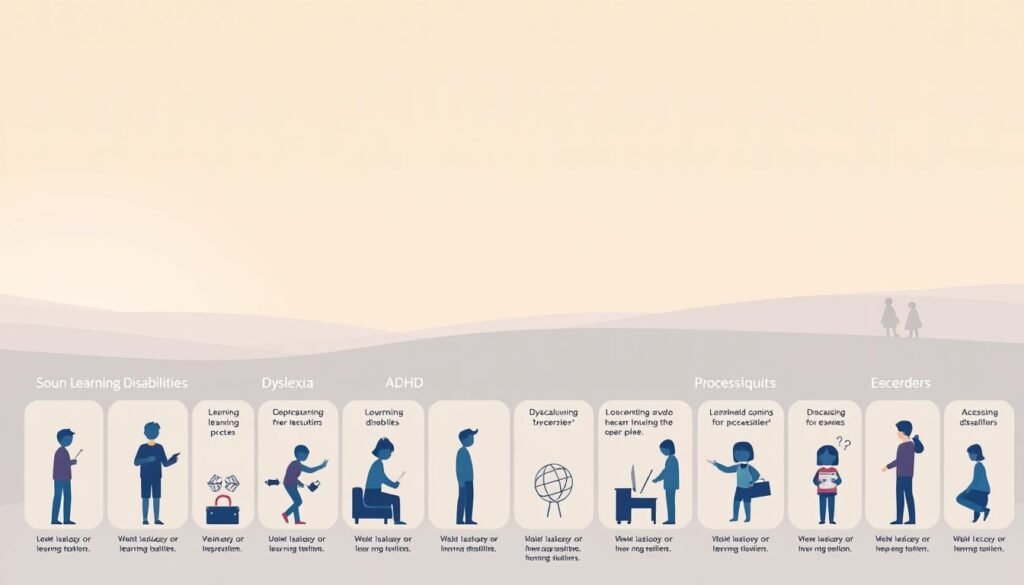
Other categories address challenges in listening and oral expression. They also cover reasoning abilities. These less-discussed learning disabilities can significantly impact school performance and daily life.
Yet they often get less attention than reading, writing, and math disorders.
The terms used to describe these conditions vary across different systems. Terms like specific learning disability, learning disorder, and learning difference may appear interchangeably. Understanding these variations helps families navigate diagnostic labels and educational classifications.
Prevalence in Children and Adults
Research shows that learning disabilities affect about 5-15% of school-age children in the United States. This represents a significant portion of students. Rates vary depending on the specific type and how it’s identified.
Language-based learning disabilities affect about 15-20% of the population. Among people with reading disabilities, 70-80% have dyslexia. This makes it the most common specific learning disorder.
This high percentage shows why early identification matters. Evidence-based reading help in schools is crucial.
Dyscalculia affects approximately 3-7% of the population. It affects boys and girls at similar rates. This math disorder often goes unrecognized longer than reading disabilities.
Math challenges may be blamed on poor teaching or lack of effort. They’re not always seen as a genuine learning disability.
Getting accurate data presents challenges for researchers. Varying definitions and inconsistent identification practices complicate studies. Many adults with undiagnosed learning disabilities exist in the population.
They’ve navigated school and work without formal identification or support.
Learning disabilities are lifelong conditions. Children identified with these conditions continue to face challenges into adolescence and adulthood. However, with proper accommodations and help, people develop compensatory strategies.
These strategies allow them to achieve success despite ongoing difficulties.
Understanding Overlapping Conditions
Learning disabilities often occur together with each other. They also appear with other neurodevelopmental conditions. Approximately 30-60% of people with dyscalculia also have dyslexia.
This highlights significant overlap between math and reading disorders. This connection suggests shared brain processes affecting both number and language symbol processing.
The relationship between learning disabilities and ADHD is important. Research shows that 10-20% of people with dyscalculia have ADHD. Similar patterns exist across other types of learning disabilities.
Attention difficulties can worsen learning challenges. This makes it harder to tell whether struggles come from the learning disability or attention issues.
Autism spectrum disorder and language disorders also frequently occur with learning disabilities. Executive function deficits do too. These overlapping conditions create unique patterns of strengths and challenges.
These patterns differ significantly from person to person, even with the same primary diagnosis.
Good assessment practices must identify all relevant conditions. They shouldn’t focus narrowly on a single diagnosis. A complete evaluation examines multiple areas of functioning.
It considers how different conditions interact and influence overall performance. This integrated approach ensures intervention plans address all of a person’s needs.
Multiple conditions typically require coordinated help. This addresses each area of difficulty. It also considers how conditions influence one another.
A student with both dyslexia and ADHD may need reading help with attention-supporting strategies. Frequent breaks help maintain engagement.
Understanding overlapping conditions prepares families and professionals. It helps them approach learning disabilities with appropriate comprehensiveness. Simple, single-diagnosis explanations rarely capture the full picture.
Effective support requires understanding how multiple factors interact. This shapes learning experiences.
Dyslexia: Reading and Language Processing Challenges
Dyslexia is a lifelong condition that affects how people process language. It impacts reading, speaking, writing, and spelling abilities. This learning disability affects about 15-20% of people worldwide.
Dyslexia is the most common language-based learning challenge. It shapes academic achievement and daily communication throughout life. Research shows 70-80% of all reading disabilities stem from dyslexia.
Some people manage early reading instruction fairly well. However, they face bigger obstacles with advanced language demands later. Grammar, textbook comprehension, and essay writing become particularly challenging as schoolwork gets harder.
Recognizing Core Characteristics
Dyslexia disrupts phonological processing in the brain. This means the brain struggles to connect letters with their sounds. This core problem creates many challenges with written language throughout life.
Orthographic processing is another difficult area for people with dyslexia. This process helps recognize whole words automatically without thinking. Poor orthographic processing makes reading slow and exhausting.
The observable behaviors associated with dyslexia symptoms manifest in several distinct patterns:
- Slow, effortful reading that requires intense concentration and frequent pauses
- Difficulty decoding unfamiliar words without context clues or visual support
- Poor spelling despite adequate instruction and repeated practice with common words
- Challenges with reading comprehension stemming from the mental effort required for decoding rather than true comprehension deficits
- Trouble expressing ideas clearly in spoken language, including word-finding difficulties
- Difficulty understanding complex spoken instructions or explanations presented verbally
Dyslexia exists on a range of severity. People show different symptom patterns based on which language processes are most affected. This explains why two people with dyslexia may have completely different strengths and challenges.
How Dyslexia Affects Learning
Dyslexia affects learning in all school subjects, not just reading. Students face growing challenges as schoolwork gets harder. Written language becomes the main way teachers teach and test students.
Reading Difficulties
Problems with sounds create most reading difficulties in dyslexia. The brain struggles to match sounds to letters efficiently. This makes reading require hard work instead of happening automatically.
Slow reading creates barriers to learning across all subjects. Students who read slowly see less text than their classmates. This reduces their exposure to vocabulary, concepts, and background knowledge over time.
Reading challenges affect motivation and self-confidence in deep ways. Students who struggle while classmates succeed often develop anxiety about reading. They may avoid reading whenever possible, which limits skill development even more.
Spelling and Writing Challenges
The same sound-processing problems that hurt reading also affect spelling. People with dyslexia often misspell common words despite lots of practice. The mental effort needed to spell correctly takes attention away from writing content.
Poor automatic word recognition reduces writing fluency significantly. Getting words onto paper requires conscious effort and attention. This interferes with organizing ideas and composing thoughtful written work.
The following table illustrates how dyslexia affects different academic skill areas:
| Skill Area | Primary Challenge | Impact on Learning | Compensatory Strategies |
|---|---|---|---|
| Reading Fluency | Slow, labored decoding | Reduced text exposure and comprehension | Audiobooks, extended time, pre-reading support |
| Spelling | Inconsistent phoneme-grapheme mapping | Writing avoidance, limited expression | Spell-checkers, dictation software, editing support |
| Written Expression | Transcription cognitive load | Content underrepresentation | Graphic organizers, speech-to-text, scribing |
| Reading Comprehension | Decoding effort reduces processing capacity | Difficulty with complex texts | Modified texts, discussion-based learning, visual aids |
Signs of Dyslexia in Different Age Groups
Dyslexia looks different at various ages. Parents, teachers, and doctors need age-appropriate awareness for timely identification. Early identification helps during critical periods of brain development and skill building.
Preschool warning signs often emerge before formal reading instruction begins:
- Late speech development compared to age-expected milestones
- Trouble pronouncing words correctly, including persistent articulation errors
- Difficulty naming known objects despite clear recognition and understanding
- Challenges with rhyming activities and phonological awareness games
- Limited interest in letters or letter sounds despite exposure
Primary school indicators become clearer as reading instruction intensifies. Children may struggle to read single words alone. They perform better only when context provides support.
Confusion between visually similar letters represents a classic sign. Children reverse or swap letters like q/p, b/d, or m/w. Writing backward or mirror writing sometimes occurs, though this alone doesn’t confirm dyslexia.
Avoidance of reading tasks becomes increasingly evident. Children recognize their struggles compared to peers. Trouble recalling alphabets in order or retrieving letter sounds quickly signals potential dyslexia.
High school and adult presentations reflect persistent challenges despite years of compensation and instruction:
- Difficulty expressing ideas logically in written form, with better verbal articulation
- Constantly misspelling the same words despite corrections and practice
- Reading inaccurately with substitutions, omissions, or additions to text
- Trouble writing summaries and essays that accurately reflect understanding
- Slow reading pace that limits academic and professional productivity
- Reliance on context and background knowledge rather than decoding skills
Later identification remains valuable for implementing effective accommodations and support strategies. Adults who finally receive diagnosis often experience relief in understanding lifelong struggles. They can access appropriate workplace accommodations and assistive technologies.
The developmental perspective reinforces an important truth. Dyslexia represents a difference in brain processing rather than a deficit in intelligence or effort.
ADHD: Attention and Focus Difficulties
Attention-Deficit/Hyperactivity Disorder (ADHD) is one of the most commonly diagnosed neurodevelopmental disorders. It affects children’s ability to succeed in school. Symptoms directly interfere with learning across all academic subjects.
ADHD is not classified as a specific learning disability. However, it profoundly impacts educational outcomes. It frequently co-occurs with other learning challenges.
Research shows that approximately 10-20% of individuals with dyscalculia also have ADHD. This demonstrates significant overlap between learning disabilities and attention disorders.
The relationship between ADHD and learning disabilities creates unique challenges. Students, parents, and educators all face these difficulties. Children with ADHD may fully understand academic content during direct instruction.
However, they struggle to complete assignments and organize materials. They also have difficulty demonstrating knowledge on assessments. These difficulties stem from impairments in regulatory systems necessary for engaging with learning tasks.
ADHD in Children: Key Characteristics
ADHD in children shows distinctive patterns of inattention, hyperactivity, and impulsivity. These patterns significantly interfere with academic performance and social functioning. The core characteristics affect multiple domains of executive function.
These executive function challenges create barriers to learning. They extend beyond any single academic subject. They impact how children approach, engage with, and complete educational tasks.
Children with ADHD typically demonstrate difficulties with sustained attention to tasks. This is particularly true for tasks requiring prolonged mental effort. They also struggle with tasks that lack immediate reinforcement.
They struggle to maintain focus during lectures and independent work periods. Homework sessions also pose challenges. This difficulty becomes particularly evident in subjects requiring sequential processing or multi-step problem solving.
Working memory capacity represents another critical area affected by ADHD. Students may have difficulty holding information in their minds. They also struggle to manipulate information while performing cognitive tasks.
This limitation impacts their ability to follow multi-step directions. It affects their capacity to solve complex problems. It also hinders their ability to organize information for written assignments.
Inhibitory control over impulsive responses creates additional challenges in educational settings. Children may blurt out answers before questions are completed. They might interrupt peers during group work or rush through assignments without checking their work.
These behaviors often result in careless errors. This happens despite adequate understanding of the material.
The impact of ADHD on selective attention poses particular challenges in typical classroom settings. Background noise, visual stimuli, and peer activity can overwhelm children with ADHD. Other students easily ignore these distractions.
This heightened distractibility makes it difficult to extract relevant information. Children struggle to maintain focus on instructional content.
ADHD Diagnosis Criteria
The adhd diagnosis process follows specific criteria. These are established in the Diagnostic and Statistical Manual of Mental Disorders, Fifth Edition (DSM-5). Proper evaluation requires comprehensive assessment by qualified professionals.
Professionals must differentiate ADHD from other conditions. These other conditions may present with similar symptoms. The diagnostic criteria ensure that identified symptoms represent a genuine neurodevelopmental disorder.
For an adhd diagnosis, children must display multiple symptoms. These include inattention and hyperactivity-impulsivity that appear before age 12. The DSM-5 requires at least six symptoms from either category for children under 17.
Adolescents and adults require five symptoms from either category.
Inattention symptoms include failing to give close attention to details. Children have difficulty sustaining attention in tasks. They seem not to listen when spoken to directly.
They struggle to organize tasks and activities. Children may also avoid tasks requiring sustained mental effort. They frequently lose necessary materials.
Children become easily distracted by extraneous stimuli. They demonstrate forgetfulness in daily activities.
Hyperactivity-impulsivity symptoms encompass fidgeting with hands or feet. Children leave their seat in situations requiring remaining seated. They run or climb excessively in inappropriate situations.
They show inability to play quietly. Additional symptoms include being constantly “on the go.” Children talk excessively and blurt out answers.
They have difficulty waiting turns. They interrupt or intrude on others.
The comprehensive evaluation process for adhd diagnosis extends beyond symptom checklists. Clinicians conduct clinical interviews with parents and teachers. They review developmental history and gather behavior rating scales from multiple sources.
Many evaluations include psychological or neuropsychological testing. This assesses executive functions. It also identifies potential co-occurring learning disabilities that may require additional intervention strategies.
Symptoms must persist across multiple settings. These include home, school, and social contexts. They must demonstrate clear evidence of interference with functioning.
Diagnosticians must also rule out other potential explanations for symptoms. These include anxiety disorders, mood disorders, or environmental factors. These might produce similar behavioral patterns.
Three Types of ADHD
The DSM-5 recognizes three distinct presentations of ADHD. Each is characterized by different symptom patterns and functional impairments. Understanding these presentations helps educators, parents, and clinicians develop targeted intervention strategies.
The presentation assigned reflects the predominant symptom pattern over the past six months. Individuals may shift between presentations over time. Symptoms evolve with development.
Predominantly Inattentive Type
The predominantly inattentive presentation affects children who primarily struggle with attention and concentration. They also face organizational challenges while displaying minimal hyperactivity or impulsivity. These students often appear as daydreamers who seem lost in thought during instruction.
They may stare out windows or doodle excessively. They simply appear disconnected from classroom activities without causing behavioral disruptions.
Academic challenges for these students center on completing work and organizing materials. They also struggle with remembering assignments. They frequently lose papers and forget to turn in homework they completed.
They struggle to keep track of multi-step projects. Teachers may describe them as capable students who consistently underperform. This is due to apparent lack of effort.
The underlying issue involves genuine neurological differences in attentional control.
This presentation often goes undiagnosed longer than other types. These children do not display disruptive behaviors that draw attention. Their quiet struggle may be misinterpreted as laziness or lack of motivation.
Predominantly Hyperactive-Impulsive Type
Children with the predominantly hyperactive-impulsive presentation display constant movement and excessive talking. They have difficulty controlling behavioral impulses while showing fewer attention problems. These students struggle to remain seated during lessons.
They fidget constantly with objects. They may inappropriately leave their seats to wander the classroom. Their physical restlessness creates challenges for both learning and classroom management.
Impulsivity manifests in blurting out comments during instruction. Children interrupt peers during group work. They have difficulty waiting for turns in games or activities.
These children may grab materials from others. They start assignments before hearing complete directions. They rush through work to move on to more stimulating activities.
Their behavioral patterns often result in social difficulties. Peers may find their interruptions and impulsive actions frustrating.
This presentation typically receives earlier identification. The behavioral symptoms create obvious classroom disruptions. However, the underlying impact on learning may be underestimated.
Observers focus primarily on behavior management. They may not recognize how hyperactivity and impulsivity interfere with information processing and academic skill development.
Combined Type
The combined presentation is the most common form of ADHD. It includes significant symptoms from both the inattention and hyperactivity-impulsivity categories. Children with this presentation face the full spectrum of ADHD challenges.
They struggle simultaneously with focus, organization, physical restlessness, and impulse control. This combination creates particularly complex educational challenges. It requires comprehensive intervention approaches.
Students with combined type ADHD experience difficulty across all aspects of school functioning. They may start assignments impulsively without reading directions carefully. They then struggle to maintain attention through completion.
Their disorganization affects both physical materials and cognitive planning. Motor restlessness makes sustained independent work periods particularly challenging.
The combined presentation often requires more intensive support strategies. It may benefit most from multimodal treatment approaches. These address both behavioral regulation and attentional control.
Intervention plans typically must incorporate accommodations for both components. They address inattention and hyperactive-impulsive symptoms. This supports comprehensive academic success.
| ADHD Presentation Type | Primary Symptoms | Academic Impact | Classroom Behaviors |
|---|---|---|---|
| Predominantly Inattentive | Distractibility, forgetfulness, difficulty sustaining attention, organizational challenges | Incomplete assignments, lost materials, missed deadlines, underperformance on tests | Daydreaming, appearing disconnected, minimal disruption, quiet inattention |
| Predominantly Hyperactive-Impulsive | Fidgeting, difficulty remaining seated, excessive talking, interrupting, poor impulse control | Careless errors, rushing through work, difficulty following directions, social conflicts | Constant movement, leaving seat, blurting out answers, disrupting others |
| Combined Type | Significant symptoms from both inattention and hyperactivity-impulsivity categories | Comprehensive challenges across organization, completion, accuracy, and engagement | Multiple behavioral and attentional difficulties requiring extensive support |
Understanding the distinctions between ADHD presentations enables more precise identification of student needs. It supports development of targeted support strategies. Comprehensive learning disability evaluations often include ADHD assessment.
This is because of the high co-occurrence rates. It is also important to address both specific learning disabilities and attentional challenges in educational planning. Intervention plans that account for ADHD symptoms alongside any specific learning disabilities provide the most effective support.
Dyscalculia and Dysgraphia: Math and Writing Disorders
Two frequently overlooked learning disabilities create substantial barriers for millions of individuals. Dyscalculia and dysgraphia affect mathematical processing and written expression. These distinct conditions impact fundamentally different cognitive domains.
Both disorders share common characteristics as lifelong challenges. They require specialized intervention and accommodation. Understanding these disorders enables earlier identification and more effective support strategies.
Dyscalculia, sometimes called “number blindness,” represents a persistent learning disability. It inhibits the ability to learn and apply basic mathematical concepts. Research shows dyscalculia affects at least 3-7% of the population.
The condition affects boys and girls equally. It frequently co-occurs with other learning disabilities. Approximately 30-60% of individuals with dyscalculia also have dyslexia.
Dyscalculia differs from general mathematical difficulty in fundamental ways. This condition impacts numerical cognition at its core. Mathematical reasoning remains challenging even for highly educated and motivated individuals.
Mathematics builds each concept upon previously learned information. Early struggles compound over time. This creates increasingly significant barriers to mathematical proficiency.
Signs of Dyscalculia: Math Learning Challenges
The signs of dyscalculia manifest differently across developmental stages. They reflect both curriculum evolution and increasing numerical demands. Recognizing these age-specific indicators enables timely intervention.
Early identification proves particularly crucial for long-term outcomes. Foundational number sense deficits create cascading difficulties. Mathematical concepts become more abstract and interconnected over time.
During the preschool years, several observable behaviors may indicate emerging challenges. Young children with dyscalculia often struggle counting in correct sequential order. They frequently skip numbers or repeat the same numbers.
They experience difficulty understanding basic number concepts like “more” or “less.” Recognizing number patterns in everyday contexts proves challenging. These struggles distinguish dyscalculia from typical developmental variation.
A particularly telling early sign involves difficulty connecting numbers to physical objects. A child might count items incorrectly. They may fail to understand that the numeral “3” represents three actual things.
The primary school years bring more academically focused dyscalculia signs. Students exhibit persistent trouble remembering basic math facts. They demonstrate difficulty recognizing mathematical symbols and their operational meanings.
Additional indicators during elementary years include:
- Difficulty understanding comparative words like “greater than,” “less than,” or “equal to”
- Continued reliance on finger counting well past the age when peers have developed mental calculation strategies
- Persistent struggles with telling time on analog clocks
- Confusion about place value concepts (hundreds, tens, ones)
- Inconsistent performance on mathematics assessments despite understanding conceptual explanations
By high school, the manifestations of dyscalculia become more complex. Adolescents experience significant difficulty applying mathematical concepts to everyday activities. They often develop pronounced negative attitudes toward mathematics.
Secondary-level signs of dyscalculia also include difficulty interpreting graphs and charts. Challenges with time management and estimation become apparent. Notable inaccuracies occur when navigating using maps or following directional instructions.
Dyscalculia Symptoms in Daily Life
The functional impact of dyscalculia symptoms extends far beyond classroom performance. It affects practical independence and quality of life. The condition creates tangible obstacles in routine activities.
Money management presents particularly significant challenges for individuals with dyscalculia. Calculating change during transactions proves difficult. Comparing prices and managing budgets all require challenging numerical processing.
Many adults with dyscalculia report anxiety about financial transactions. They develop compensatory strategies like always paying with cards. This avoids calculating cash payments.
Budgeting and long-term financial planning pose additional hurdles. Understanding percentages for interest rates requires numerical reasoning. Calculating tips at restaurants or determining recipe quantities proves difficult.
“Dyscalculia is not just about struggling with math homework. It affects everything from managing time to understanding finances, creating real barriers to independence and career opportunities.”
Time management represents another domain where dyscalculia symptoms create functional difficulties. Reading analog clocks remains challenging for many individuals. Estimating time intervals or durations proves unreliable.
This affects punctuality, scheduling, and task allocation abilities. These skills prove essential for academic success and employment. Social functioning also depends on effective time management.
Measurement tasks in cooking or construction require numerical understanding. Dyscalculia compromises these abilities. Following recipes with fractional measurements presents obstacles.
Spatial navigation difficulties often accompany dyscalculia. Map reading and distance estimation prove challenging. Following directional instructions affects travel independence.
Dysgraphia Diagnosis and Writing Difficulties
Dysgraphia represents a distinct language-based learning disability. It involves multifaceted handwriting problems. The dysgraphia diagnosis process evaluates several interconnected components of written communication.
These components include difficulties with grammar application and spelling accuracy. Letter formation consistency and appropriate spacing prove challenging. Fine motor coordination, writing speed, and sentence production quality require assessment.
Dysgraphia presents differently in different individuals. Some primarily struggle with the physical act of writing. Others find the cognitive-linguistic aspects most problematic.
Older children and adults often express complex ideas verbally. They experience significant frustration transferring thoughts onto paper. This disparity between oral and written abilities characterizes dysgraphia.
The dysgraphia diagnosis typically involves comprehensive assessment. Educational psychologists or learning specialists conduct evaluations. They examine handwriting samples, timed writing tasks, and copying exercises.
| Developmental Stage | Dysgraphia Indicators | Functional Impact |
|---|---|---|
| Preschool (Ages 3-5) | Awkward pencil grip, rapid fatigue during writing, uneven letter spacing, poorly formed letters, incorrect writing posture, difficulty writing within margins, consistent avoidance of writing activities | Reluctance to participate in pre-literacy activities, frustration during drawing tasks, delayed development of letter recognition |
| Primary School (Ages 6-11) | Persistently messy handwriting, frequent erasures and corrections, inconsistent mixing of upper and lower case letters, continued misspelling of words despite practice, switching between cursive and print styles, mirror writing of letters or numbers, notably slow writing speed | Incomplete classroom assignments, difficulty taking notes, reduced volume of written output, disparity between oral and written performance |
| Secondary School (Ages 12-18) | Poor planning and organizational skills in writing, significant disparities between written and verbal expression quality, persistent trouble taking lecture notes, difficulty generating and organizing essay ideas, grammatical errors despite knowledge of rules | Lower grades on written assessments, anxiety about writing assignments, avoidance of courses requiring extensive writing, limited career options |
Fine Motor Skill Challenges
The fine motor component of dysgraphia involves difficulties with the physical act of writing. These challenges stem from motor planning and coordination deficits. They manifest as awkward or inefficient pencil grip patterns.
Students demonstrate inconsistent pressure application. Sometimes they press too hard and tear paper. Other times they write so lightly that letters are barely visible.
Letter formation proves laborious and inconsistent. Letters vary in size within the same word or sentence. The physical effort required for writing causes rapid fatigue.
Hand cramping, pain, or discomfort during extended writing tasks commonly occurs. These motor difficulties distinguish dysgraphia from other writing challenges. Students may demonstrate strong verbal abilities but find writing physically exhausting.
Spatial Awareness Issues
Beyond motor execution, dysgraphia frequently involves visuospatial processing challenges. These affect how individuals organize written work on a page. Maintaining consistent letter size within words proves difficult.
Irregular spacing between letters and words occurs frequently. Aligning text along horizontal lines challenges students even with ruled paper. Organizing information spatially on the page affects margin usage and paragraph indentation.
Mathematical calculations prove particularly challenging with spatial organization issues. Column alignment in multi-digit arithmetic becomes difficult. Algebraic manipulations require spatial organization that dysgraphia affects.
The spatial component also impacts copying tasks. Students demonstrate significant difficulty copying from the board to their paper. They frequently lose their place or misalign copied information.
Understanding dyscalculia and dysgraphia as distinct neurologically-based learning disabilities proves essential. They are not motivational issues or general cognitive limitations. Recognition of their specific manifestations supports timely identification.
Implementation of evidence-based support strategies can substantially improve functional outcomes. Quality of life for affected individuals improves with appropriate intervention. Accommodation enables success across educational and functional contexts.
Recognizing Early Signs of Learning Disabilities
Early detection of learning challenges is one of the most powerful interventions available to families and educators. Identifying early signs of learning disabilities during critical developmental periods enables timely support. This can significantly improve academic outcomes and emotional well-being.
Research shows that children who receive appropriate interventions during preschool and early elementary years experience better long-term success. Those whose challenges go unrecognized until later grades often struggle more.
Understanding the developmental progression of warning signs requires knowledge of typical milestones. It also needs awareness of indicators that suggest potential difficulties. While every child develops at an individual pace, certain patterns of struggle warrant closer observation and professional evaluation.
Early Warning Signs in Preschoolers
Identifying signs of learning disorders in preschool-aged children presents unique challenges. Typical developmental variation can closely resemble genuine learning difficulties. However, several indicators across different domains may suggest emerging challenges that warrant monitoring.
Language and pre-literacy development often provides the earliest clues. Preschoolers who may later be diagnosed with dyslexia frequently exhibit delayed speech development. Their vocabulary growth lags behind peers.
Difficulty with rhyming activities and sound manipulation games represents additional warning signs. Trouble recognizing letter names also indicates potential challenges.
Pre-mathematics indicators include trouble with counting sequences and difficulty understanding one-to-one correspondence. Challenges comparing quantities or recognizing simple patterns may signal potential dyscalculia. These struggles become more apparent once formal mathematics instruction begins.
Fine motor and pre-writing skills also merit attention. Children who demonstrate awkward pencil grip or avoid drawing activities may show early signs of dysgraphia. Poorly formed shapes and letters are additional indicators.
General learning indicators include difficulty following multi-step directions and trouble with memory tasks. Challenges understanding sequences also warrant attention.
Individual warning signs should not cause immediate alarm. However, patterns of multiple indicators across related developmental areas suggest the value of screening evaluation. This helps determine whether early intervention services might prove beneficial.
Signs of Learning Disorders in School-Age Children
Academic demands during elementary and middle school years make learning disabilities more apparent. The signs of learning disorders become evident as children encounter formal instruction in reading, writing, and mathematics.
Reading challenges manifest through slow progress despite quality instruction. Children may demonstrate persistent decoding difficulties and struggle to recognize common sight words. Letter confusion that extends beyond beginning literacy stages is also common.
Many develop strategies to avoid reading activities altogether.
Writing difficulties become increasingly obvious as academic expectations grow. Students with dysgraphia produce illegible handwriting despite extensive practice. They experience extreme difficulty with spelling.
Significant discrepancies between verbal expression abilities and written work quality appear. Mirror writing and poor spatial planning on the page represent additional indicators.
Mathematics struggles extend beyond simple calculation errors. Children with dyscalculia have persistent difficulty mastering basic math facts. They cannot apply learned procedures to new problems.
Particular challenges with word problems appear even when reading comprehension is adequate. Difficulty telling time and understanding money concepts often appears alongside computational struggles.
Cross-domain warning signs include significant homework battles and a growing gap between demonstrated ability and actual achievement. Developing negative self-concept related to learning is also common. These emotional and behavioral changes often signal that academic struggles have begun affecting overall well-being.
Red Flags in Teenagers and Adults
Learning disabilities not identified during childhood may become apparent when academic or workplace demands increase in complexity. Compensation strategies that worked during elementary years may prove insufficient for high school, college, or professional requirements.
Adolescents and adults may demonstrate persistent academic struggles despite adequate effort and intelligence. Many develop significant reading or writing avoidance. They choose courses or career paths that minimize exposure to their areas of difficulty.
Time management and organizational challenges frequently intensify as independence increases.
Difficulties in specific content areas become more pronounced. This is particularly true in subjects requiring extensive reading, writing, or mathematical reasoning. Standardized testing situations often reveal struggles that classroom accommodations and personal strategies have previously masked.
Developing anxiety or depression related to academic or professional performance represents a serious concern warranting evaluation.
Recognizing that learning disabilities can persist into adulthood remains essential. Many successful professionals discover their learning disabilities only after their children receive diagnoses. They finally understand their own lifelong struggles.
When to Seek Professional Evaluation
Determining when to pursue comprehensive assessment involves considering several factors beyond individual warning signs. Professional evaluation becomes appropriate when struggles persist despite good instruction and appropriate support. It is also needed when achievement gaps continue widening.
Emotional or behavioral changes related to learning also warrant evaluation.
Family history of learning disabilities increases the likelihood that similar challenges may affect other family members. This genetic component makes early monitoring particularly important for children with affected relatives.
The evaluation referral process differs for children versus adolescents and adults. Parents of school-age children can request evaluations through their school district. Districts must respond to formal requests under the Individuals with Disabilities Education Act (IDEA).
Private practitioners including educational psychologists, neuropsychologists, and learning disability specialists offer comprehensive assessments for individuals of all ages.
Understanding the types of professionals qualified to conduct learning disability assessments helps families navigate the evaluation process effectively. School psychologists and clinical psychologists with educational specialization possess the necessary training. Licensed educational diagnosticians also have the credentials necessary for comprehensive learning disability evaluation.
| Age Group | Dyslexia Warning Signs | Dysgraphia Indicators | Dyscalculia Red Flags |
|---|---|---|---|
| Preschool (3-5 years) | Late speech development, difficulty rhyming, limited letter recognition | Awkward pencil grip, poorly formed letters, avoidance of drawing | Trouble counting, difficulty with number concepts, pattern recognition struggles |
| Elementary (6-11 years) | Difficulty reading single words, letter confusion, slow reading progress | Messy handwriting, mirror writing, significant spelling difficulties | Difficulty with math facts, trouble telling time, persistent calculation errors |
| Secondary & Adult (12+ years) | Difficulty expressing ideas in writing, persistent misspelling, reading avoidance | Poor spatial planning, extremely slow note-taking, written work below verbal ability | Difficulty applying math to daily life, increased math anxiety, trouble with multi-step problems |
The comprehensive nature of professional evaluation ensures accurate identification of learning disabilities. It also rules out other potential explanations for academic struggles. This thorough assessment process creates the foundation for developing effective intervention strategies and securing appropriate educational accommodations.
Learning Disability Assessment and Testing
A thorough learning disability assessment provides critical insights needed to unlock each student’s potential. The evaluation process identifies specific learning challenges and cognitive strengths. Understanding this comprehensive procedure empowers families to advocate effectively for appropriate educational interventions.
Accurate identification of learning disabilities creates the foundation for developing evidence-based instructional strategies. A correct learning disability diagnosis helps teachers and parents provide appropriate support. The assessment reveals the complete learning profile rather than simply labeling deficits.
Professional evaluators use multiple measures to understand how cognitive processes affect academic performance. The learning disability testing procedure examines reading, writing, mathematics, and information processing abilities. This multi-faceted approach ensures that recommendations address the individual’s unique educational needs.
The Learning Disability Diagnosis Process
The systematic evaluation of learning challenges unfolds through three distinct stages that build upon each other. Each phase serves a specific purpose in creating a comprehensive understanding of the individual’s learning profile. This structured approach ensures thorough examination while avoiding unnecessary testing.
The preliminary identification phase begins when persistent learning challenges prompt concern from parents, teachers, or the individuals themselves. This stage involves reviewing academic performance data and gathering developmental history. Brief screening instruments help determine whether comprehensive evaluation is warranted.
Screening distinguishes between students who may benefit from general educational interventions and those requiring formal learning disability assessment. Response to Intervention approaches provide targeted instruction before proceeding to diagnostic evaluation. Educational teams review classroom performance, standardized test scores, and teacher observations during this phase.
Key components of initial screening include:
- Academic performance review across multiple subjects and grade levels
- Developmental and educational history questionnaires completed by parents
- Teacher reports documenting specific learning challenges and patterns
- Brief standardized screening tools measuring basic academic skills
- Analysis of previous intervention attempts and their outcomes
Step 2: Comprehensive Evaluation
The thorough learning disability testing process involves multiple measures across cognitive, academic, language, and neuropsychological domains. Qualified professionals administer standardized achievement testing in reading, writing, and mathematics. Cognitive ability assessment establishes intellectual baseline and identifies processing strengths and weaknesses.
Evaluators gather information from multiple sources including parents, teachers, and the individual being assessed. Processing evaluations examine phonological awareness, working memory, and processing speed. This comprehensive approach examines both areas of difficulty and areas of strength.
The DSM-5 emphasizes that symptoms must have persisted for at least six months despite provision of appropriate interventions. This criterion ensures that identified challenges represent genuine learning disabilities rather than temporary difficulties. Documentation of persistent struggles despite quality instruction supports accurate learning disability diagnosis.
Assessment components during comprehensive evaluation:
- Standardized achievement tests measuring academic skills against age and grade norms
- Cognitive ability tests evaluating intellectual functioning and reasoning
- Processing assessments examining how the brain receives and uses information
- Language evaluations measuring receptive and expressive communication skills
- Behavioral observations during testing sessions documenting work approaches
Step 3: Diagnosis and Report
Qualified professionals integrate assessment data to determine whether diagnostic criteria are met for specific learning disabilities. The evaluation report identifies particular disabilities present and describes the individual’s complete learning profile. Clear recommendations for interventions and accommodations translate technical findings into practical classroom applications.
Comprehensive reports explain assessment results in jargon-free language that families and educators can understand. The learning disability diagnosis includes both quantitative scores and qualitative descriptions of learning patterns. This documentation becomes essential for developing Individualized Education Programs and securing appropriate support services.
Feedback sessions allow families to ask questions and discuss implications of evaluation findings. Professionals explain how identified challenges affect daily learning and recommend specific strategies. Parents receive guidance on advocating for their child’s educational needs based on assessment results.
Types of Learning Disability Testing
Three primary evaluation components work together to provide comprehensive understanding of learning challenges. Each assessment type examines different aspects of cognitive and academic functioning. The combination of these evaluations creates a complete picture of the individual’s learning needs.
Educational Testing
Academic achievement evaluation focuses on reading, written expression, and mathematics using standardized, norm-referenced instruments. Reading assessment measures decoding skills, fluency, and comprehension abilities. Written expression testing evaluates spelling, sentence construction, and essay writing capabilities.
Mathematics evaluation examines calculation accuracy, problem-solving strategies, and mathematical reasoning. Educational learning disability testing determines whether achievement is significantly below expectations based on age, grade, or cognitive ability. Evaluators analyze error patterns to identify specific skill deficits requiring intervention.
Common educational assessment instruments include:
- Woodcock-Johnson Tests of Achievement measuring academic skills across domains
- Wechsler Individual Achievement Test evaluating reading, writing, and math
- Test of Written Language assessing composition and writing mechanics
- KeyMath Diagnostic Assessment examining mathematical concepts and operations
Psychological Assessment
Cognitive ability evaluation establishes intellectual baseline and identifies processing strengths and weaknesses that may explain learning difficulties. Intelligence tests measure verbal reasoning, perceptual reasoning, working memory, and processing speed. These scores help determine whether academic achievement is commensurate with cognitive potential.
Psychological learning disability assessment may also address emotional and behavioral factors affecting learning. Evaluators examine anxiety, depression, attention, and motivation issues that impact academic performance. This holistic approach ensures that support plans address all factors influencing educational success.
Processing assessments reveal how efficiently the brain handles different types of information. Working memory evaluation shows capacity for holding and manipulating information. Processing speed testing measures how quickly individuals complete cognitive tasks under time pressure.
Medical Evaluation
Physician examination rules out or identifies sensory impairments and neurological conditions that may contribute to learning difficulties. Vision and hearing screenings ensure that academic struggles do not stem from undetected sensory problems. Medical history review identifies health factors potentially affecting cognitive functioning.
Neurological assessment may be recommended when symptoms suggest underlying brain-based conditions. Medical learning disability testing ensures that appropriate health interventions supplement educational supports. Collaboration between medical and educational professionals creates comprehensive support plans.
Pediatricians and specialists evaluate conditions including:
- Vision problems affecting reading and visual processing abilities
- Hearing impairments impacting language development and phonological awareness
- Neurological conditions influencing cognitive processing and learning
- Health issues such as sleep disorders or nutritional deficiencies affecting concentration
What to Expect During the Evaluation
Understanding the practical aspects of learning disability assessment reduces anxiety and helps families prepare appropriately. Evaluation timelines typically span four to eight weeks from initial referral to completion. Testing occurs across multiple sessions of one to three hours each to prevent fatigue.
The testing environment provides a quiet, distraction-free setting that allows optimal performance. Evaluators establish rapport with examinees before beginning formal assessment procedures. Clear instructions precede each test, and examiners observe work approaches throughout sessions.
Families can prepare by:
- Ensuring the individual gets adequate sleep before testing sessions
- Providing nutritious meals to support concentration and energy
- Bringing glasses, hearing aids, or other necessary accommodations
- Gathering previous report cards, testing results, and relevant medical records
- Preparing questions to ask during the feedback session
Post-testing feedback procedures include comprehensive review of results and discussion of recommendations. Professionals explain findings in accessible language and answer family questions. Planning next steps involves discussing appropriate interventions, accommodations, and educational placements.
The evaluation process identifies specific areas of difficulty to develop appropriate support plans. Results guide Individualized Education Program development and inform instructional strategies. This comprehensive learning disability diagnosis creates the roadmap for academic success through targeted interventions.
| Assessment Type | Primary Focus Areas | Common Instruments Used | Information Provided |
|---|---|---|---|
| Educational Testing | Reading, writing, mathematics achievement | Woodcock-Johnson, WIAT, KeyMath | Academic skill levels compared to peers, specific deficit areas |
| Psychological Assessment | Cognitive abilities, processing skills, emotional factors | WISC, WAIS, processing assessments | Intellectual functioning, cognitive strengths and weaknesses |
| Medical Evaluation | Sensory functioning, neurological health, physical conditions | Vision/hearing screenings, neurological exams | Medical factors affecting learning, need for health interventions |
| Behavioral Observation | Work habits, attention, motivation, task approach | Structured observation protocols | Learning behaviors, attention patterns, emotional responses |
Comprehensive learning disability testing empowers families with knowledge needed to advocate effectively for educational services. Understanding assessment procedures helps individuals participate actively in their evaluation. This collaborative approach ensures that diagnostic results translate into meaningful support that addresses unique learning needs.
Accommodations for Learning Disabilities and IEP Development
Students with learning disabilities thrive when provided with appropriate accommodations and systematic support structures. A correct diagnosis helps develop evidence-based instructional strategies, curriculum, and interventions. Parents and teachers can provide meaningful help through carefully selected modifications and supports.
These support mechanisms form the foundation of effective educational planning. They enable students to access the same curriculum as their peers. The implementation requires collaboration between educators, families, and specialists.
Understanding Learning Disability Accommodations
Learning disability accommodations represent modifications to educational environments, instruction, and assessment. These adjustments do not alter learning standards or lower expectations. They level the playing field by addressing specific processing challenges.
Accommodations for learning disabilities fall into three primary categories. Each category addresses different aspects of the educational experience. Understanding these categories helps families and educators select appropriate supports.
Classroom Modifications
Classroom modifications encompass environmental and instructional adjustments that support daily learning activities. Environmental modifications include preferential seating arrangements that minimize distractions. Flexible grouping strategies match learning styles, and organized classroom layouts reduce cognitive load.
Instructional modifications address how information is presented and processed. Multi-sensory teaching approaches engage multiple pathways for learning. Extended time for assignments allows students to work at their own pace.
Additional instructional supports include chunking complex tasks into manageable steps. Graphic organizers provide organizational frameworks for thinking. Advance organizers preview new content and help students prepare for learning.
Assessment accommodations ensure that tests measure knowledge rather than processing limitations. Timing adjustments provide extended time or frequent breaks. These modifications allow students to demonstrate what they truly know.
Presentation format modifications alter how test questions appear. Oral administration of written tests benefits students with reading disabilities. Large print materials assist those with visual processing challenges.
Response format modifications change how students provide answers. Allowing oral responses helps students with writing difficulties express their knowledge. Word processors support those with dysgraphia, while alternative methods accommodate different learning strengths.
Assistive Technology
Assistive technology ranges from simple tools to sophisticated software solutions. Low-tech options include highlighted text that emphasizes key information. Color-coded materials organize content visually, and specialized paper guides writing.
High-tech solutions offer powerful capabilities for bypassing areas of difficulty. Text-to-speech software reads written material aloud, supporting students with reading disabilities. Speech-to-text programs enable verbal composition for those with writing challenges.
Additional technology includes audiobooks that provide access to literature. Electronic math tools support calculation processes. Organizational apps manage time and tasks, making learning more accessible and efficient.
IEP for Learning Disabilities: The Complete Process
The Individualized Education Program serves as the cornerstone of special education services. This legally binding document outlines specific supports, services, and goals. The IEP represents a collaborative agreement between schools and families.
Developing an effective IEP requires systematic planning and ongoing collaboration. Understanding the key components helps families navigate this critical process. Confidence grows through knowledge of the development steps.
IEP for Students: Key Components
Every legally compliant IEP contains specific elements that guide educational planning. The Present Levels of Academic Achievement and Functional Performance (PLAAFP) describes current abilities. This baseline information drives all subsequent planning decisions.
Measurable annual goals target priority skill areas identified through assessment. These goals specify what the student will accomplish within one year. Goals must be specific, measurable, achievable, relevant, and time-bound.
The description of special education and related services details exactly what supports schools provide. This section specifies who delivers services, how often they occur, and where. Related services might include speech-language therapy, occupational therapy, or counseling services.
Additional components include explanations of participation with nondisabled peers. Individual accommodations and modifications are specified. Transition planning begins at age 16 to prepare students for post-secondary success.
IEP Development Steps
The IEP development process follows a structured sequence. Initial referral begins when parents, teachers, or professionals suspect a learning disability. This referral triggers a timeline for evaluation that schools must follow.
Eligibility determination involves reviewing comprehensive assessments. The IEP team forms once eligibility is established. The team includes parents, teachers, school administrators, and relevant specialists.
Assessment review and analysis examine all evaluation data to identify strengths and needs. Goal development translates this analysis into specific, measurable objectives. Service determination specifies what supports are necessary to achieve these goals.
Document finalization creates the written IEP that all team members review and sign. Implementation with progress monitoring ensures services are provided as specified. This ongoing monitoring allows for adjustments based on student response.
| IEP Component | Purpose | Key Elements | Review Frequency |
|---|---|---|---|
| Present Levels (PLAAFP) | Establish baseline performance | Academic skills, functional abilities, impact of disability | Annually, or when re-evaluation occurs |
| Annual Goals | Define expected progress | Measurable objectives, evaluation methods, progress criteria | Reviewed quarterly, revised annually |
| Services and Supports | Specify interventions | Type, frequency, duration, location of services | Monitored continuously, adjusted as needed |
| Accommodations | Ensure access to curriculum | Classroom modifications, testing adjustments, assistive technology | Evaluated during progress reports |
| Progress Monitoring | Track goal achievement | Data collection methods, reporting schedules, parent communication | Ongoing throughout the year |
Special Education Resources and Support Services
Comprehensive support for students extends beyond the classroom to include various services. School-based services form the primary support network. Specialized instruction comes from special education teachers who understand learning disabilities.
Related services address needs that affect educational performance. Speech-language therapy supports students with language-based learning disabilities. Occupational therapy assists those with fine motor or sensory processing challenges.
Community resources expand the support network beyond school settings. Learning disability associations provide information, advocacy support, and connections to services. Parent support groups offer emotional support and practical advice from families.
Professional supports include educational therapists who provide intensive, individualized intervention. Tutors specializing in learning disabilities reinforce classroom instruction. Organizations like Positive Action offer evidence-based special education curriculums.
Early Intervention Strategies for Learning Challenges
Support should begin as soon as learning challenges are identified. Early intervention prevents academic gaps from widening. These proactive approaches benefit students across settings and situations.
Both home and school environments play critical roles in providing early intervention strategies. Coordinated efforts between these settings maximize intervention effectiveness. Consistency ensures better outcomes for students.
Home-Based Strategies
Parents can implement numerous strategies that support learning at home. Creating structured homework routines establishes consistent times and organized spaces for academic work. These routines help students develop executive functioning skills.
Using multi-sensory learning approaches at home reinforces school instruction. Reading aloud together combines auditory and visual processing while building vocabulary. Hands-on activities that incorporate touch and movement support concept development.
Breaking tasks into manageable steps prevents overwhelming feelings and builds confidence. Parents can model this process for children. Providing explicit instruction in organizational skills develops independence over time.
Maintaining positive emotional support remains crucial throughout the learning process. Celebrating effort and progress builds resilience and motivation. Acknowledging challenges while emphasizing strengths helps children develop realistic self-awareness.
School-Based Interventions
Schools implement systematic interventions through frameworks like Response to Intervention (RTI). This approach provides increasingly intensive tiers of support based on student response. Tier 1 includes high-quality core instruction for all students.
Evidence-based instructional programs target specific skill deficits with proven effectiveness. Phonics programs address reading challenges through systematic sound-symbol instruction. Explicit strategy instruction helps students with writing difficulties learn planning and organizing processes.
Progress monitoring ensures intervention effectiveness through regular data collection and analysis. This systematic approach allows educators to identify when interventions work. Collaborative problem-solving between parents and educators creates consistent support across settings.
Conclusion
Learning disabilities become easier to handle with early identification and consistent support. Research shows that students who receive timely help can succeed just like their peers. The right interventions make a real difference in school and career outcomes.
Parents, teachers, and specialists must work together to create strong support systems. A thorough assessment helps identify the best strategies for each student. An IEP provides the structure needed to deliver accommodations in school.
Learning disabilities reflect how the brain works differently, not limits on intelligence or potential. Many successful scientists, business owners, artists, and teachers have these same challenges. Their achievements prove that these conditions affect only specific skills while other abilities remain strong.
Knowing your learning profile helps you plan strategically and speak up for yourself. Understanding both strengths and challenges allows you to develop strategies that work. Moving forward requires patience, the right resources, and steady support.
With proper diagnosis, proven interventions, and appropriate accommodations, students with learning disabilities can thrive. The challenges are genuine, but success is absolutely possible. These neurological differences don’t have to hold anyone back with informed, comprehensive support.